Attacks on Ebola treatment facilities are escalating in the eastern Democratic Republic of the Congo (Democratic Republic of the Congo), even as the World Health Organization warns that the outbreak could worsen in both the DRC and neighbouring Uganda.
On Thursday, the Rwampara health centre was stormed by a group of angry residents demanding the bodies of relatives who had died from Ebola, according to local sources and partners involved in the government’s response.
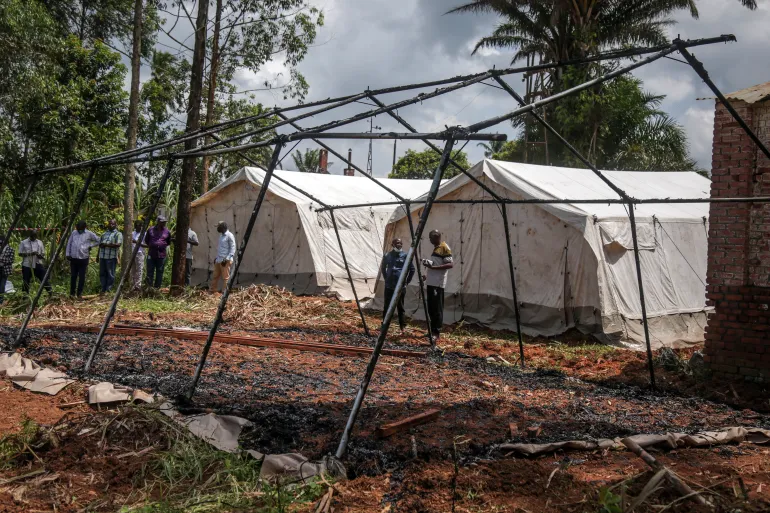
A day later, tensions flared again when a tent provided by Doctors Without Borders at a hospital in Mongbwalu, Ituri province, was set on fire.
ALIMA said in a statement that the incident occurred after the death of a patient showing Ebola symptoms in one of its treatment tents. Medical teams had isolated the body in line with strict infection-control protocols.
The organisation added that while staff were preparing the body for a safe and dignified burial, tensions escalated, leading to the destruction of two tents. Despite the disruption, teams were able to secure the body for burial in accordance with Ebola response procedures.
Health workers in Ebola-affected areas of eastern DRC have repeatedly faced resistance from communities over strict burial rules, which require specialised handling of bodies to prevent further transmission. Aid groups say fear, rumours and mistrust continue to fuel such tensions.
“Some people here believe that Ebola is a business,” said Gloire Idriss, a Rwampara resident who witnessed the unrest. “When healthcare workers refuse to hand over bodies, people think organs are being trafficked.”
Congolese Health Minister Roger Kamba has stressed that Ebola victims remain highly infectious after death and must only be handled by trained teams in protective equipment.
“Let us bury the deceased safely,” he told Radio France Internationale. “The dead must not take others with them into the grave.”
In many communities in eastern DRC, it is customary for relatives and neighbours to gather for traditional mourning rituals, including touching the body to say farewell — a practice that health officials say has contributed to past outbreaks.
“When my daughter died of Ebola last month, the medical team came to bury her. We didn’t get to say goodbye,” said Lokana Jean, a 40-year-old resident of Mongbwalu, whose name was changed for privacy. “It still hurts to have missed our cultural rites.”
As of Saturday, nearly 180 deaths and close to 800 confirmed cases had been recorded, according to the Congolese Ministry of Public Health.
Authorities in Ituri have introduced restrictions aimed at slowing transmission, including limits on public gatherings, suspension of wake services and a ban on transporting bodies between locations.
Public health expert Dr Rodriguez Kisando said misinformation is playing a major role in fuelling violence against Ebola response teams.
“When an epidemic breaks out, rumours spread quickly. If accurate information is not shared fast, people will believe anything, and that is when violence takes hold,” he said.
He warned that continued attacks on treatment centres and patients leaving care prematurely could accelerate the spread of the virus.
“As long as there are scenes of violence and patients escape treatment centres before recovery, the disease will continue spreading. This is extremely serious,” he added.
Meanwhile, officials say a decline in international funding has left the national treasury covering a significant share of the response, with shortages becoming increasingly evident on the ground.
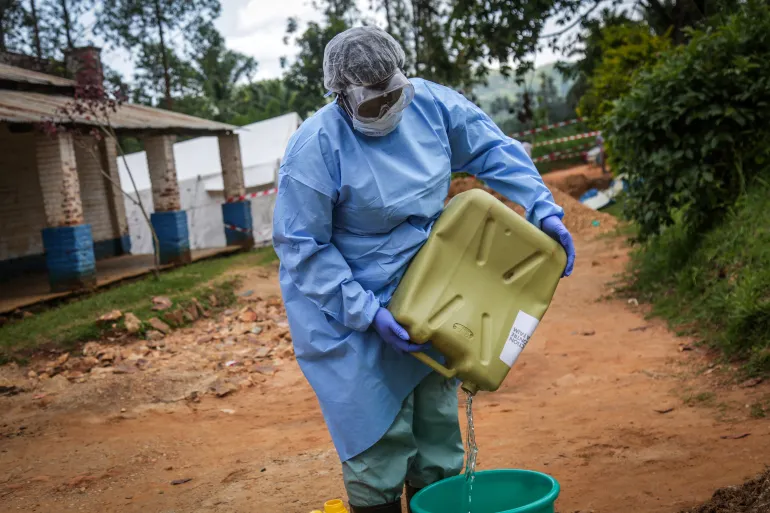
ALIMA has warned that resources needed to detect, treat and prevent Ebola remain critically insufficient, calling for stronger international support to contain the outbreak.
A senior Congolese official involved in the response in Rwampara, who spoke on condition of anonymity, said treatment centres are already under severe pressure.
“We are receiving new confirmed cases almost every day. The resources we have are not enough for the scale of the outbreak,” the official said.
Health authorities in Ituri and North Kivu are meanwhile urging residents to step up preventive measures. They are advising the public to wash hands regularly, avoid close contact with sick individuals, ensure food is properly cooked, refrain from self-medication, and cooperate with official response teams as efforts continue to control the spread.
The Africa Centres for Disease Control and Prevention has placed 10 African countries on high alert amid growing public health concerns. The countries flagged include South Sudan, Rwanda, Kenya, Tanzania, Ethiopia, the Republic of Congo, Burundi, Angola, the Central African Republic and Zambia.
In response to the alert, authorities in the Democratic Republic of Congo, Uganda and South Sudan have agreed to strengthen cross-border cooperation.
The coordinated measures will focus on improving disease surveillance, early warning systems, border monitoring, and boosting laboratory and emergency response capacity across the affected regions.