Not even heavy rain can deter shoppers from Gikomba, the bustling open-air market in Kenya widely regarded as the largest trading hub of its kind in East Africa.
On the day the BBC visited, parts of the market were waterlogged, yet shoppers — some wearing rubber boots — continued navigating the crowded pathways in search of its most popular goods: second-hand clothing.
The trade in garments imported from the United States, Europe and China remains a long-running challenge for the East African Community (EAC), of which Kenya is a member. The central question for policymakers and industry players is how the region can build a competitive fashion industry while competing with a steady influx of low-cost used clothing.
“We’re competing with second-hand clothing, but we can’t compete on price,” said Zia Bett, founder of the womenswear brand Zia Africa.
Elizabeth Paul, who runs Kuya Creations in Dar es Salaam, shares a similar concern. She says affordability continues to drive customer behaviour in her market.
“In my shop, the minimum price of a dress is 50,000 Tanzanian shillings (£14.50; $19.20). People tell me: ‘For 50,000 I can get 10 second-hand dresses, so let me buy those,’” she said.
A decade ago, the EAC strongly opposed the influx of second-hand clothing and explored plans for a regional ban. However, following diplomatic pressure from the United States, the proposal was dropped, though the debate has resurfaced in recent years.
In Uganda, where President Yoweri Museveni once criticised used clothing as coming from white “dead people”, authorities have introduced an additional 30% tax on imports in an effort to support local manufacturing and address environmental concerns.
In Kenya, a recent attempt to revise the taxation system for used clothing was abandoned after public backlash over fears it would drive up prices. The proposal had been included in the national Finance Bill but was later withdrawn.
Despite the policy debate, Kenya already imposes a 30% customs duty on imported second-hand clothing — a rate higher than that applied to new garments — as part of efforts to encourage domestic textile production.

According to trade data from the Observatory of Economic Complexity (OEC), Kenya remains Africa’s largest importer of second-hand clothing, commonly known as mitumba in Swahili.
Data shows that the country imported nearly 180,000 tonnes of used clothing in 2022 — a 76% increase compared to 2013, based on UN trade figures.
In neighbouring Uganda, a 2024 study by the government-funded Economic Policy Research Centre found that second-hand clothing remains the most popular choice among consumers, followed by imported new garments, with locally made clothing ranking last.
Uganda’s new policy introducing a 30% environmental levy on used clothing comes on top of existing charges, including a 35% import duty and 18% VAT.
“The levy of 30% on worn clothing is intended to mitigate environmental degradation while promoting domestic production,” the legislation states, according to the Kampala Report.
However, the move has sparked concern among traders in the sector, including Ugandan mitumba dealer Aaron Sekky, who says the policy could hurt livelihoods.
“I don’t agree with this, because this has to be a free economy,” he told the BBC.
He argues that the second-hand clothing trade supports a wide network of people, from importers and wholesalers to tailors who repair garments and vendors who sell food and drinks in local markets.
While there is no official figure on total employment in the sector, research commissioned by the Mitumba Consortium Association of Kenya (MCAK) estimates that up to 4.9 million people across East Africa depend on the used clothing trade for their livelihoods.
However, critics argue that the employment benefits are often overstated.
Dr Andrew Brooks, a researcher at King’s College London and author of Clothing Poverty: The Hidden World of Fast Fashion and Second-hand Clothes, says retail-based jobs alone do not significantly transform economies.
“Retail is the most limited form of job creation you can have in an economic sector, versus production, marketing and distribution,” he said.
“If you’re just importing things and selling things, you’re doing very, very little to contribute to your nation’s economy.”
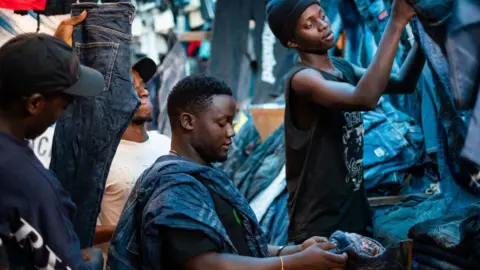
Similarly, Lisa Kibutu, a board member of the Kenya Fashion Council, says many jobs in the mitumba sector are “hand-to-mouth” roles that offer little room for growth or social mobility.
However, she also acknowledges that second-hand clothing continues to play an important role in Kenya’s economy and everyday life.
“When I left Kenya in the 80s, you would see poor people without clothing. Right now even the poorest person has decent clothing,” Kibutu said. She previously worked in the United States with designers including Giorgio Armani and Eileen Fisher.
Affordability remains a major factor driving demand, but second-hand clothing is no longer seen as something only for the poorest households.
In Dar es Salaam, shoppers at Ilala Market — a major hub for second-hand clothing — say quality and durability are key reasons for choosing mitumba.
“Most of the clothes have good quality… they last long,” said 40-year-old Najma Issa.
Twenty-two-year-old Juma Awadh echoed that view, telling the BBC: “I buy second-hand clothes because of quality and they look unique.”
Despite a 35% import tax on used clothing in Tanzania, Ilala Market remains busy, with customers continuing to flock there in search of affordable fashion — a reality that contrasts with earlier expectations within the East African Community.
In 2015, the then-six-member East African Community (EAC) — Burundi, Kenya, Rwanda, South Sudan, Tanzania and Uganda — announced plans to impose steep tariffs on mitumba, with an eventual aim of banning imports entirely.
However, the United States — a major exporter of second-hand clothing — argued that such measures would breach free trade rules and threatened to remove EAC countries from the African Growth and Opportunity Act (AGOA).
AGOA allows eligible sub-Saharan African countries to export thousands of products to the US duty-free, making it a key trade arrangement for the region.
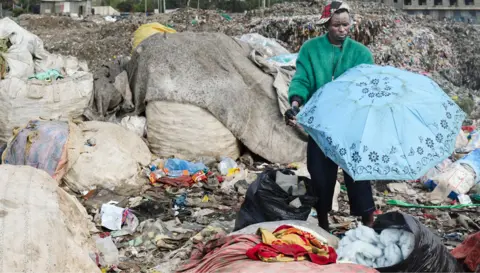
Following pressure from the United States, all East African Community (EAC) members except Rwanda eventually withdrew support for the proposed ban on second-hand clothing imports. Rwanda, however, maintained its position, prompting the US to impose a 30% tariff on Rwandan clothing exports, which had previously enjoyed duty-free access.
Rwanda maintains that its approach has delivered economic benefits, particularly after increasing taxes on imported second-hand clothing from $0.20 (£0.15) per kilogram to $2.50 (£1.90) in 2016.
According to the country’s trade ministry, used garments accounted for between 26% and 32% of textile and clothing imports in the two years before the tax hike. That share reportedly fell to between 2% and 7% in the following two years, while rising garment exports are being cited by authorities as evidence of growth in the local manufacturing sector.
Despite this, authorities say demand for mitumba — second-hand clothing — persists, including smuggled goods from neighbouring countries. Police regularly share images of seized bales on social media as part of ongoing enforcement efforts.
Environmental groups have raised concerns about the broader impact of the second-hand clothing trade, arguing that a significant proportion of exported garments are of such low quality that they end up in landfill. A 2023 estimate by the Changing Markets Foundation suggested that more than one in three used garments shipped to Kenya may fall into this category.
“There is no infrastructure to dispose of these massive amounts of textile waste, and official dump sites have been overflowing for years,” environmental organisation Greenpeace has warned.
However, Teresia Wairimu Njenga, chairperson of the Mitumba Consortium Association of Kenya (MCAK), argues that second-hand clothing traders play a key environmental role by extending the life cycle of garments.
“Can you imagine what would happen to Kenya if we are manufacturing 198,000 tonnes of new clothes per year?” she asked.
Meanwhile, the global debate over second-hand clothing is evolving, with countries that are signatories to the Basel Convention — an international waste treaty — currently considering whether used garments, particularly those made from synthetic fibres, should be reclassified as waste.

Critics such as Ugandan designer Joel Okalany, founder of the brand Ekikumba Fusion, which transforms used clothing into contemporary fashion pieces, argue that East Africa is not yet ready to fully phase out mitumba (second-hand clothing).
“The reality is, we are not yet ready for our own manufacturing to take off,” he told the BBC.
“In farming, someone using a tractor is more efficient than someone using a horse. In the tailoring industry, we are still at the level of using the horse.”
Authorities in Rwanda appear to share similar concerns. A 2022 report from the country’s trade ministry indicated that plans for a full ban on used clothing were being delayed due to “current domestic gaps in the production of textiles and apparel.”
Rwanda’s experience has also highlighted a broader challenge for the East African Community (EAC): restricting mitumba imports alone may not be enough to strengthen local industry if cheap new garments from countries such as China and Turkey continue to flood the market.
As supplies of second-hand clothing declined in Rwanda, many consumers reportedly turned to imported fast fashion instead.
Across the region, traders and local manufacturers say low-cost imports from China remain a major threat, as they compete directly with both second-hand sellers and emerging local brands.
“They’ll get something that is a copy from the runway or from a designer brand and sell it at a ridiculous price,” Kenyan designer Zia Bett said, though she remains hopeful about the future of local fashion.
She argues that African designers must focus more on storytelling, branding and quality in order to compete effectively. “The question now is: how do we build brands that people choose — not just afford?” she said.
For Njenga, both second-hand clothing and locally made garments have a role to play in the market.
“We should allow them to coexist,” the MCAK chairperson said. “Let’s not kill mitumba — give the consumer power of choice.”