Government Records GH₵24 Billion Underspend and Revenue Shortfall in First Quarter of 2026
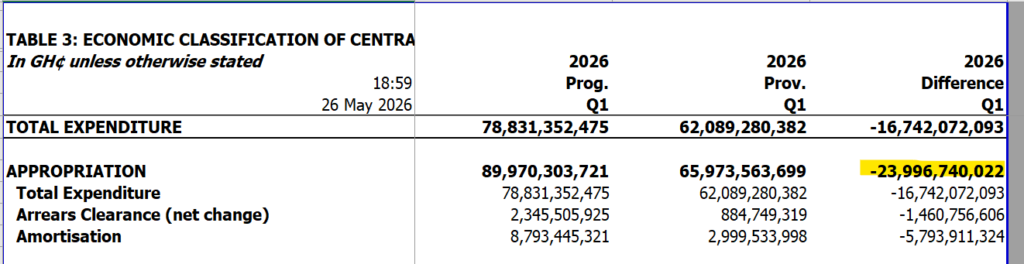
Government left about GH₵24 billion of its approved budget unspent in the first quarter of 2026, while also falling short of its revenue target by GH₵2.7 billion, according to fiscal data from the Ministry of Finance covering January to March.
An analysis by JoyNews Research indicates that out of an approved expenditure envelope of GH₵89.97 billion — which covers goods and services, debt servicing and arrears clearance — the government spent GH₵65.97 billion. This represents 73.3% of the total allocation, leaving roughly 27% unutilised within the period.
On the revenue side, total inflows including grants reached GH₵57.5 billion, below the programmed target of GH₵60.3 billion. This reflects a 4.5% shortfall for the quarter.
Capital Projects Bear the Heaviest Cuts
The figures come at a politically sensitive time, as the Ministry of Finance and the Ministry of Food and Agriculture continue to exchange public claims over how much funding has actually been released to government agencies this year.
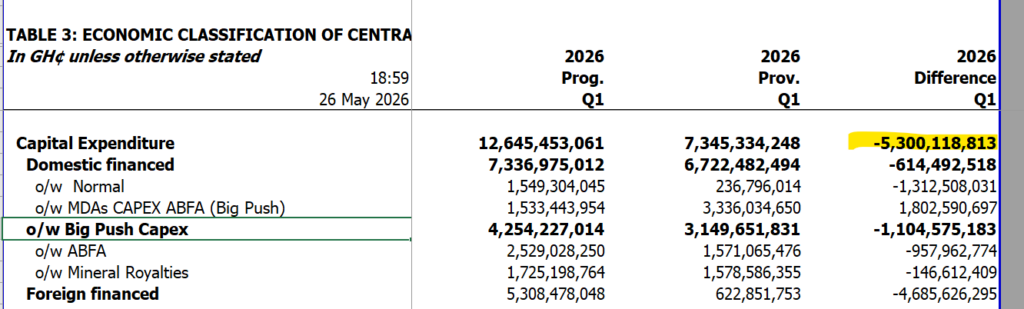
Capital expenditure recorded the steepest decline among all spending categories. Out of a programmed GH₵12.6 billion for the period, actual spending reached GH₵7.3 billion, representing a shortfall of 41.9%.
Within this category, the Big Push capital expenditure programme also fell significantly below target, missing its allocation by more than GH₵1 billion against a planned GH₵4.25 billion.
The largest gap was recorded in foreign-financed projects. Only GH₵0.6 billion was spent out of a programmed GH₵5.3 billion, a shortfall of 88.3%. This reflects a notable slowdown in project loans and donor-funded disbursements during the period.
By contrast, domestically financed capital projects performed relatively better, coming in just 8.4% below target at GH₵6.7 billion.
Statutory Funds Receive Below-Budget Transfers
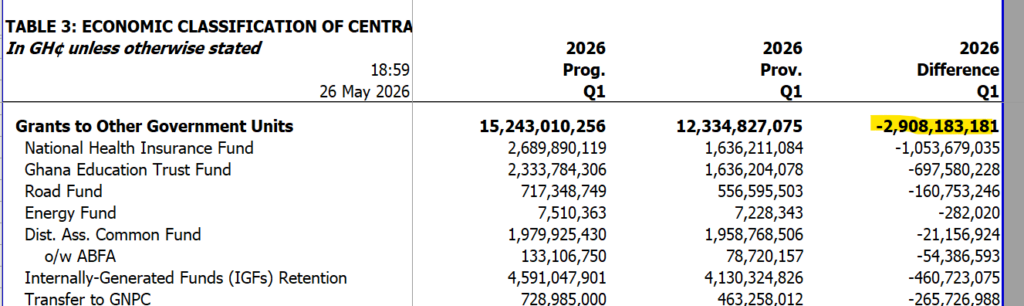
Transfers to statutory and earmarked government funds fell short of budget expectations during the period under review. Total disbursements stood at GH₵12.3 billion, compared with a programmed GH₵15.2 billion, representing a 19.1% shortfall.
The shortfall was reflected across the key national funds. The National Health Insurance Fund received GH₵1.6 billion out of a budgeted GH₵2.7 billion, a gap of 39.2%. The Ghana Education Trust Fund also fell below target, receiving GH₵1.6 billion instead of GH₵2.3 billion, representing a 29.9% shortfall.
The Road Fund likewise received less than planned, with a shortfall of GH₵160.75 million. The District Assemblies Common Fund also recorded a deficit of about GH₵21.16 million against its expected allocation.
Operations, Wages and Welfare Spending
Government spending on goods and services — the funds that support the day-to-day running of ministries and agencies — declined sharply during the period under review. It fell by 35.3% to GH₵1.3 billion, down from GH₵2.0 billion previously recorded.
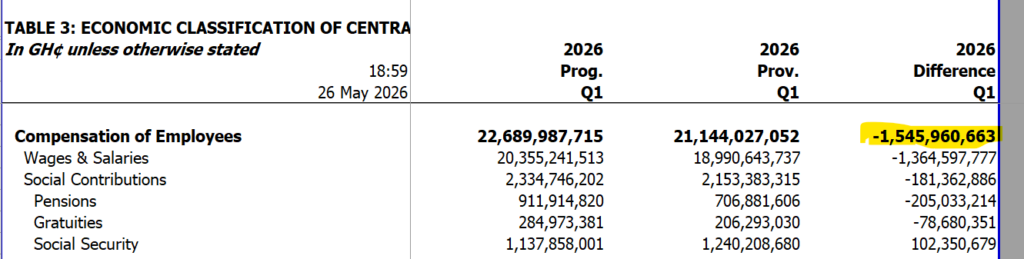
Compensation of employees, typically one of the most rigid components of the budget, also came in below target. Total spending stood at GH₵21.1 billion, compared with a programmed GH₵22.7 billion, representing a shortfall of 6.8%. Within that category, wages and salaries were also under budget by 6.7%.
Social benefits, which had been allocated GH₵0.5 billion for the period, recorded no expenditure at all.
Debt Repayments and Interest Payments Fall Short of Targets
Ghana’s debt servicing performance fell significantly below budget expectations in the period under review, with both principal repayments and interest payments recording notable shortfalls.
Amortisation — the repayment of loan principal — stood at GH₵3.0 billion, far below the GH₵8.8 billion that was scheduled for the period. This leaves about two-thirds of planned repayments outstanding.
Interest payments also came in under budget, reaching GH₵17.2 billion against a programmed GH₵21.7 billion, representing a shortfall of 20.4%.
The underperformance was largely driven by external debt servicing. Out of a GH₵3.0 billion external interest obligation, only GH₵0.3 billion was paid, leaving roughly 91.4% unpaid within the period.
Domestic interest payments, however, were much closer to projections, coming in at GH₵17.0 billion and broadly tracking the planned schedule.
It remains unclear what specifically accounted for the sharp divergence in external debt servicing. While exchange rate movements are often a key factor in such variations, available data from the Bank of Ghana indicates that the cedi remained relatively stable against major trading currencies, including the US dollar, between the fourth quarter of 2025 and the first quarter of 2026.
This suggests that the shortfall may be linked more to timing differences or broader repayment scheduling issues rather than significant currency pressures.


Revenue Shortfalls: Where the GH₵2.7bn Gap Emerged
Ghana’s revenue performance has fallen short of expectations, with an estimated gap of about GH₵2.7 billion driven largely by weaker-than-expected collections in key tax and non-tax categories.
Domestic taxes on goods and services recorded the biggest underperformance, falling GH₵2.6 billion below target — a 13.1% shortfall. Within that category, Value Added Tax (VAT) accounted for about GH₵0.8 billion of the missed revenue.
Taxes on international trade also underperformed, generating GH₵6.2 billion against a target of GH₵7.2 billion, reflecting a 14% decline largely attributed to softer import activity.
Non-tax revenue sources — including fees, dividends, and retained internally generated funds — totalled GH₵6.2 billion, below the programmed GH₵7.5 billion, representing a 17.7% shortfall.
Oil revenue was the weakest performer within the major categories, bringing in GH₵2.8 billion compared to a projected GH₵4.5 billion, a variance of 37.6%. Programmed grants of GH₵0.6 billion also failed to materialise within the period under review.
Not all revenue streams underperformed, however. Taxes on income and property exceeded expectations, recording GH₵24.9 billion against a target of GH₵24.4 billion. The performance was supported by stronger-than-expected company tax collections, which surpassed projections by 7%.
Dispute Over Budget Releases Sparks Public Row
Beyond the revenue figures, a growing disagreement has emerged between the Ministry of Finance and the Ministry of Food and Agriculture over the interpretation of budget releases and expenditure execution.
The disagreement centres on what each side considers as actual funds released versus approved allocations, with both institutions presenting sharply different interpretations of the same budget data.
The Ministry of Finance maintains that it has released more than GH₵1.67 billion to the Agriculture Ministry in 2026. According to the Finance Ministry, this represents about 85% of the total allocation for goods, services, and capital expenditure.
It further argues that budget execution has been strong, citing release rates of 94.73% for goods and services and 74.66% for capital expenditure, which it says reflects effective budget implementation.
On process compliance, the Finance Ministry insists that — except for transfers to the National Food Buffer Stock Company — all disbursements were triggered by requests from the Agriculture Ministry through the government’s GIFMIS financial management system and processed according to established procedures. It also points to transaction records, including requisition dates, journal entries, and warrant numbers, as supporting documentation.
The Ministry of Food and Agriculture, however, strongly disputes these claims. It has accused the Finance Ministry of misrepresenting financial data and using what it describes as “infantile propaganda” to mislead the public, arguing that critical food security programmes have been underfunded.
Rather than focusing on disbursement totals, the Agriculture Ministry says the official budget framework tells a different story.
It explained that it received a Commitment Authorisation on 15 February, followed by a First and Second Quarter Budget Allotment Letter four days later, which capped first-half spending at GH₵910 million.
According to the ministry, the allotment schedule further limited actual expenditure between January and June to approximately GH₵453 million, covering compensation, operational costs, and existing contractual obligations.
The ministry also provided a breakdown of allocations under the approved framework, including GH₵172.5 million for Farmer Service Centres, GH₵77.3 million for fertiliser and certified seeds, GH₵36.75 million for the Nkokonkitinkiti Programme, GH₵30 million for the National Food Buffer Stock Company, GH₵26.25 million for irrigation infrastructure, and GH₵4.5 million for the Feed Ghana Programme.
It insists that no revised allotment or additional authorisation has been issued to support the Finance Ministry’s claim of more than GH₵1.6 billion in releases.