Understanding Publican AI: How the A–B–C Valuation Model Works
Weeks after the April 2026 rollout of the Publican AI-assisted valuation and classification support system by the Customs Division of the Ghana Revenue Authority, uncertainty continues to ripple through Ghana’s trading community.
Freight forwarders, importers, customs house agents and other industry players suddenly found themselves operating in a new customs environment where declarations that once moved through familiar discretionary processes now appeared to face stricter algorithm-driven scrutiny.
While the use of artificial intelligence in customs administration is not new globally, the concern within Ghana’s trading sector has largely centred on uncertainty rather than technology itself.
Many traders and agents struggled to understand how the system works, what factors influence its decisions and why some declarations were suddenly being adjusted upward in what appeared to be dramatic valuation shifts.
That uncertainty deepened following the circulation of an internal communication within the GRA, which many industry players interpreted to mean that the outputs generated by Publican AI had effectively become binding on customs officers.
For many stakeholders, this created the impression that traditional customs judgement and documentary reconciliation had been replaced by machine-generated valuation outcomes.
However, subsequent engagements and clarifications from within the GRA sought to calm those fears by explaining that Publican AI was designed to support customs valuation and risk management — not eliminate officer discretion altogether.
Officials stressed that the system is intended to assist officers in identifying declarations that may require deeper scrutiny, rather than impose automatic or inflexible valuation decisions.
Understanding the A–B–C corridor
At the heart of the Publican AI framework is what industry stakeholders now describe as the “A–B–C corridor” model.
Rather than searching for a single fixed value for every imported product, the system appears to operate within a broader range of commercial plausibility based on historical trade patterns, documentary consistency, classification behaviour and observed market trends.
Under this approach, declarations that fall within the acceptable corridor are generally considered commercially believable within the system’s confidence environment.
In practical terms, the declaration is not viewed as fundamentally inconsistent or suspicious.
Within that corridor, customs officers are still expected to exercise professional judgement. Depending on the supporting evidence available, officers may accept the declared value, request clarification, make moderate adjustments or reconcile the declaration against other commercial documentation.
Industry experts say this is an important distinction because AI systems in customs administration are not intended to function as rigid pricing calculators.
Instead, the system behaves more like a confidence engine, examining factors such as trade history, supplier behaviour, payment structures, documentary harmony and broader commercial plausibility before assessing risk levels.
Why the rollout unsettled traders
The tension surrounding the deployment was largely driven by perception and communication gaps.
Many traders initially concluded that the AI system had effectively fixed customs values and removed room for negotiation or documentary explanation.
That perception intensified after some declarations were reportedly adjusted upward in ways traders considered abrupt and difficult to understand.
As a result, many operators began to fear that machine confidence scores were replacing internationally accepted customs valuation principles based on transaction value and documentary verification.
Subsequent clarifications from the GRA environment became important in restoring confidence, particularly after officials emphasized that Publican AI is intended to assist decision-making rather than replace customs judgement entirely.
The broader debate
The ongoing debate now centres less on artificial intelligence itself and more on how the system’s confidence logic is being applied operationally.
Stakeholders argue that customs valuation systems globally are designed to balance technology with human judgement because international trade is rarely uniform.
Commercial values can differ significantly depending on supplier relationships, distressed sales, seasonal clearances, bulk purchases, freight arrangements and other market conditions.
For that reason, many experts insist that AI-assisted customs systems should improve consistency and risk management without removing room for genuine commercial explanation.
As Ghana’s customs sector gradually transitions toward data-assisted governance, the Publican AI debate is increasingly being viewed as part of a wider adjustment to the growing role of technology in trade administration.
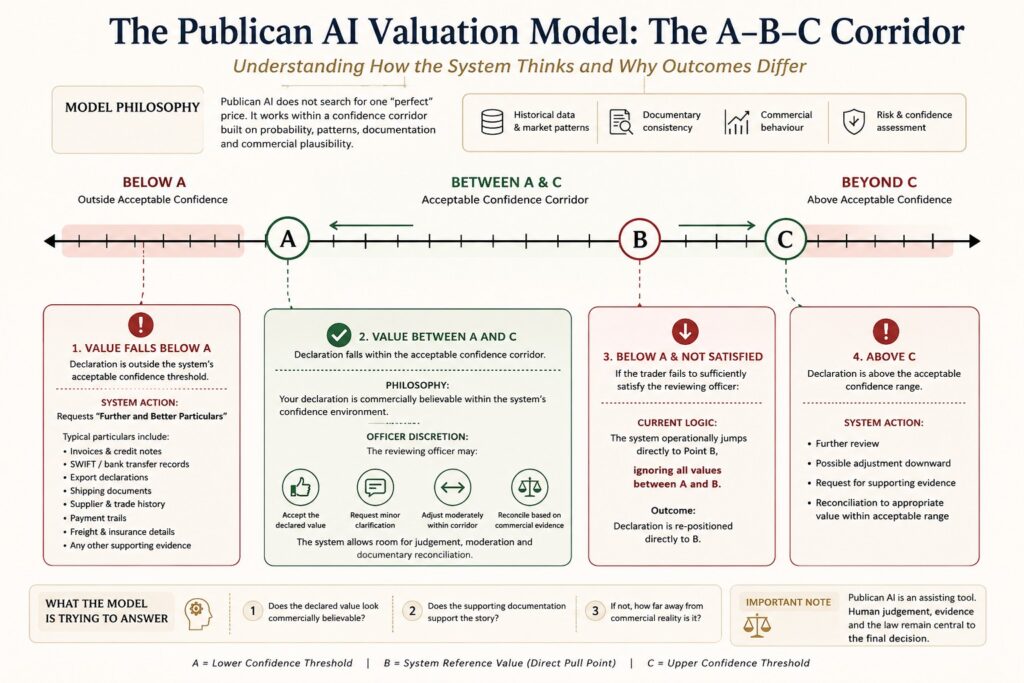
Concerns over the deployment of the Publican AI customs valuation system in Ghana continue to generate debate among traders, clearing agents and industry stakeholders, as officials seek to clarify how the technology is intended to operate within the customs environment.
At the centre of the discussion is a conceptual framework built around three reference points — A, B and C — which customs officials say are designed to measure the commercial plausibility of declared import values rather than impose fixed prices.
Under the model, a trader’s self-assessed customs value is considered commercially acceptable if it falls within the corridor between Points A and C. Within that range, customs officers are still expected to exercise professional judgement.
Depending on the supporting documentation and commercial evidence presented, officers may accept a declared value, request clarification, make moderate adjustments within the acceptable range or reconcile the declaration against available records.
The system’s philosophy is based on confidence assessment rather than rigid pricing. Instead of operating like a simple calculator, Publican AI functions as what many experts describe as a “confidence engine.”
It evaluates factors such as historical transaction patterns, trade history, supplier behaviour, classification consistency, payment structures, documentary harmony and broader commercial plausibility before determining whether a declaration falls within acceptable risk thresholds.
Industry experts say this approach reflects the realities of international trade, where identical products can legitimately carry different prices depending on commercial circumstances.
Why traders became concerned
Much of the anxiety surrounding the rollout stemmed from how the system was initially perceived by traders and freight forwarders.
Many interpreted the AI deployment to mean that customs values had effectively become machine-determined, leaving little room for self-assessment or officer discretion.
That perception deepened after some import declarations were reportedly adjusted upward in ways many traders considered abrupt and difficult to explain.
For several stakeholders, the concern was not the use of artificial intelligence itself, but the fear that machine-generated confidence scores were beginning to override traditional customs valuation principles based on transaction value and documentary examination.
Subsequent clarifications from within the Ghana Revenue Authority environment sought to address those fears by stressing that Publican AI is intended to assist customs officers, not replace human judgement entirely.
Officials have maintained that documentary reconciliation and officer discretion remain central to the valuation process.
How the system responds below Point A
The most sensitive part of the framework begins when a trader’s declared value falls significantly below Point A, which the model treats as the lower confidence threshold.
At that stage, the system reportedly shifts from standard assessment into verification mode, triggering requests for additional documentation to justify the declared value.
Those requests may include bank transfer confirmations, invoices, export declarations, shipping documents, supplier verification records, freight details and broader commercial evidence.
From a customs risk-management perspective, stakeholders acknowledge that additional scrutiny of unusually low declarations is understandable.
However, concerns arise when traders believe the system moves too aggressively toward Point B — viewed by many as a higher valuation benchmark — if officers remain unsatisfied after reviewing submitted documents.
According to industry players, this creates the impression that the system leaves insufficient room for gradual reconciliation between a trader’s explanation and the machine’s confidence thresholds.
The debate over AI-assisted customs administration
The controversy has also sparked wider discussions about the difference between AI-assisted customs administration and AI-driven customs decision-making.
Experts argue that an assisting system should help customs officers identify inconsistencies, anomalies and risk patterns while still allowing trained officials to interpret commercial realities.
A fully dictating system, however, risks turning machine-generated confidence estimates into binding valuation outcomes.
Observers say recent clarifications from GRA officials appear aimed at reinforcing the idea that Publican AI is designed to support — not eliminate — customs judgement.
Why commercial prices differ
Stakeholders have also cautioned against assuming that similar products must always attract identical prices in international trade.
Commercial values often vary due to factors such as distressed inventory sales, supplier relationships, seasonal clearance deals, damaged packaging discounts, bulk purchasing arrangements, credit terms and fluctuating market conditions.
Because of these realities, experts insist that customs valuation systems globally still rely heavily on human judgement alongside technology.
Officials have further clarified that used vehicles are currently not part of the operational deployment scope of the Publican AI model, contrary to assumptions circulating in sections of the public.
Balancing technology and human judgement
Analysts say the long-term success of the Publican AI system will depend on how effectively it balances data-driven risk analysis with practical commercial understanding.
They argue that the most effective customs systems are not those that eliminate human discretion, but those that improve the quality and consistency of decision-making through better data and technology.
Supporters of the system believe AI can help identify anomalies, strengthen documentary verification, reduce arbitrary treatment and improve efficiency within customs administration.
Critics, however, maintain that sufficient room must remain for genuine commercial explanations in a trading environment that is rarely uniform.
As Ghana’s customs sector transitions from largely manual assessment processes to more data-assisted systems, many observers see the ongoing debate as part of a broader adjustment to the growing role of artificial intelligence in public administration and trade governance.