Hondurans have cast their ballots in a general election dominated by threats from US President Donald Trump.
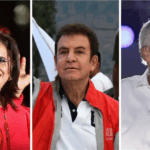
There are five presidential candidates, but the poll is essentially being seen as a three-way race between former defence minister Rixi Moncada of the leftist Libre party, TV host Salvador Nasralla from the centrist Liberals, and businessman Nasry “Tito” Asfura, of the right-wing National Party.
Trump has thrown his support behind Asfura and threatened to cut financial aid to the Central American nation if he does not win.
But the most recent opinion poll put Nasralla in the lead. Voting passed off peacefully, with only occasional reports of minor irregularities.
Voting was extended for an hour in some places where there were long queues, but most Hondurans it seems were able to cast their votes without issue.
The main parties and their candidates have all said they will respect the outcome of the election – although the ruling Libre party has said it will not accept a decision based on preliminary results, only on the final count of the paper ballots.
Presidents in Honduras can only serve a single four-year term, so the incumbent, Xiomara Castro, who was the country’s first female president when she took office in 2021 for the Libre party, was not on the ballot.
She has backed Moncada to take her place. The 60-year-old lawyer has pledged to protect “natural wealth” from “21st-century filibusters who want to privatise everything” if she wins. Moncada has also expressed her commitment to combating corruption “in all its forms”.
On Saturday, Moncada accused Trump of meddling in the election, calling his endorsement of her right-wing opponent “totally interventionist”.
Trump had said that the US would be “very supportive” if Tito Asfura won the presidential election, in which voters were also choosing all 128 members of Congress and almost 300 local representatives.
“If he doesn’t win, the United States will not be throwing good money after bad, because a wrong Leader can only bring catastrophic results to a country, no matter which country it is,” Trump wrote on his social media platform, Truth Social.
The US sent more than $193m (£146m) to Honduras last fiscal year, according to the State Department website, and despite aid cuts, has sent more than $102m this year. The Trump Administration has already reportedly cut $167m in economic and governance aid that had been earmarked for 2024 and 2025, the Congress website says.
In another post, Trump wrote that he and Asfura, who is the former mayor of the capital, Tegucigalpa, could “work together to fight the Narcocommunists” and counter drug trafficking.
Nasry Asfura has pledged in a series of social media posts to bring “development and opportunities for everyone”, to “facilitate foreign and domestic investment into the country” and “generate employment for all.”
However, his party has been plagued by scandals and corruption accusations in recent years – including the sentencing of former party leader and ex-president Juan Orlando Hernández last year.
Hernández was jailed for 45 years in the US on drug-smuggling and weapons charges – a decision Trump now intends to overturn.
Asfura has carefully tried to distance himself from Hernández. On Friday he told news agency AFP that he has “no ties” with the ex-president, and that “the party is not responsible for his personal actions.”
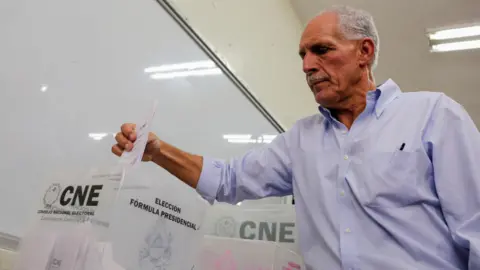
The current frontrunner, though, is 72-year-old Salvador Nasralla, who is running for president for the fourth time.
He claims that his win in 2017 was stolen due to “electoral fraud perpetrated by Hernández”. This was never proven and a partial recount found no irregularities, though the decision did spark mass protests across the country.
According to his campaign website, Nasralla says his government’s main focus would be “an open economy”, and that he is committed to generating employment. He also says that if he wins, he will sever ties with China and Venezuela.
Tensions between Venezuela and the US have escalated recently – the US has built up its military presence in the area and carried out at least 21 deadly strikes on boats it says were carrying drugs. Venezuela’s President Nicolás Maduro has said the US actions are an attempt to oust him.
On Saturday, Trump declared that Venezuela’s airspace should be considered closed, even though he does not have the power to do that.
Beyond Honduras’ relationship with the US, many voters were asking more fundamental questions about this race as they cast their ballots.
Will the vote pass off smoothly, and will the results be delivered on time?
Will the ruling Libre party accept defeat and give up power if they lose?
Crucially, will the armed forces, who have been accused of creeping politicisation, remain independent and not aligned with any individual party or politician?
Pre-emptive accusations of election fraud, made both by the ruling party and opposition, have sown mistrust in the vote and sparked fears of post-election unrest.
It prompted the president of the National Electoral Council, Ana Paola Hall, to warn all parties “not to fan the flames of confrontation or violence”.