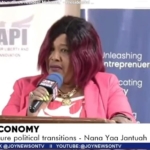
Presidential Staffer Nana Yaa Jantua says government is committed to developing a resilient 24-hour economy designed to outlive the administration of President John Dramani Mahama.
According to her, the objective is to institutionalize the 24-hour economy as a national economic framework that promotes industrialization, increases productivity, and expands employment opportunities long after President Mahama leaves office.
“We want the 24-hour economy to outlive His Excellency John Dramani Mahama. It is being developed in a structured and well-formulated manner so Ghanaians can fully benefit. It will be beautiful to see a Ghana running three full shifts around the clock”, she said.
Speaking at the Institute of Liberty and Policy Innovation’s High-Level Business Regulatory Dialogue, she stressed that the policy is not a political slogan but a national productivity strategy aimed at transforming how businesses operate across all sectors.
She also noted that President Mahama is particularly encouraged by the growing leadership of young Ghanaian entrepreneurs and is determined to support interventions that strengthen enterprise growth and spur job creation.
“It is the hope of His Excellency John Dramani Mahama that institutions, especially those run by young Ghanaians, thrive. He is ready to support the interventions they put in place to make the economy work”, she added.
Nana Yaa Jantua also furthered that despite public debate about the feasibility of a 24-hour economy, several institutions have already begun operating around the clock. She cited the Assembly Press as an example, emphasizing that off-peak hours allows them to take advantage of a more stable electricity.
She also revealed that the Ministry of Energy and Green Transition, and the Ministry of Local Government have initiated plans to install streetlights nationwide, particularly in markets, to support nighttime economic activity.
“The 24-hour economy will thrive if the whole country is well lit. The law to guide the policy is currently in Parliament, and the implementation document is ready”.
Government believes the policy will significantly enhance business competitiveness, reduce operational bottlenecks, and position Ghana as a productivity-driven economy within the sub region.