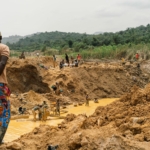
Ghana’s fight against illegal mining, popularly known as galamsey, has long been undermined by fragmented, duplicated and often uncoordinated interventions, fueling environmental destruction and escalating public health risks.
Speaking at the University of Ghana School of Public Health during the maiden Preparatory Working Session and Planning of Resource Mobilisation for a Scoping Workshop on the Restoration of Artisanal Small-Scale Mining Sites, Director of the West Africa Centre for Global Environmental and Occupational Health (WAC-GEOHealth), Professor Julius N. Fobih, stressed the urgency for a holistic rethink.
“I stand before you today with a sense of urgency and responsibility to add my voice to the already many voices calling for a careful assessment of the impact of irresponsible mining on the environment in our country,” Prof. Fobih said.
He outlined the severe consequences of galamsey, noting that more than 60 per cent of Ghana’s water sources have been devastated, farmlands destroyed, and millions exposed to serious health threats.
“The environmental impact of mining in Ghana is severe, marked by significant deforestation, large-scale water and land pollution from chemicals like mercury, and extensive land degradation,” he said.
“These issues are particularly driven by a high rate of illegal small-scale mining, which contaminates rivers and soil, destroying agricultural land and impacting public health through toxic substances entering the food chain and water sources.”
Prof. Fobih traced mining’s historical evolution, from indigenous gold extraction in the 10th century to commercial mining in the late 1800s, and stressed that pollution escalated sharply from the early 2000s due to both large-scale operations and illegal small-scale mining.
“While mining has been part of Ghana’s history for centuries, the use of chemicals like mercury in artisanal mining became a major source of widespread pollution of water bodies and land,” he said.
Despite various government interventions, Prof. Fobih said regulatory and enforcement gaps persist.
“The government struggles with enforcing existing laws, particularly regarding illegal small-scale mining,” he noted. “Corruption, lack of political will, and insufficient logistical capacity for monitoring have all contributed to this failure. The result is widespread illicit activity that harms the environment and deprives the state of revenue.”
He also cited weak land reclamation policies, poor mineral transport infrastructure, and the lack of incentives for small and local miners as major shortcomings.
“Legitimate small-scale miners often face difficulties accessing financial support and training on modern, sustainable mining techniques. This vulnerability can push them towards informal or illegal operations, making the sector harder to formalise and regulate,” he added.
Prof. Fobih called for stronger legal frameworks and equitable revenue distribution to ensure host communities benefit from mining activities.
“Transparent, consistent, and well-defined laws, especially for emerging minerals like lithium, are necessary for long-term sector stability,” he said.
He urged stakeholders to work together to craft a unified national framework.
“Today’s event seeks to engage stakeholders to define the scope of environmental degradation in Ghana and to identify resources both in-country and externally for the restoration and remediation of the degraded mine sites. Let us seize this opportunity to deepen our understanding, foster collaboration, and chart a course towards safeguarding our environment, protecting public health, and securing the future for generations to come.”
The session brought together representatives from government, mining companies, development partners, civil society, the media, and academia. Participants refined objectives, prioritised resource needs, and discussed strategies for funding mobilisation and partner engagement ahead of a national forum.
JoyNews environmental journalist and galamsey advocate Erastus Asare Donkor stressed the urgency of enforcement, a review of licensing regimes, political will, and a shift in public attitude. He described Ghana’s water bodies, forests, and farmlands as “dead.”
“All the efforts appear not to be working because there appears to be a lack of commitment on the part of duty bearers,” he said, calling for decisive action rather than endless dialogue.
He described the Preparatory Working Session as “a step in the right direction” but emphasised that commitment from duty bearers will determine its success.
Ing. Kenneth Ashigbey, convener of the Media Coalition Against Galamsey, underscored the need to clearly distinguish illegal mining from legitimate small-scale mining to avoid misguided interventions.
Other speakers joining virtually from Scotland reinforced the importance of engaging illegal miners directly as part of the solution. Representatives from Goldbod echoed the call for a single national framework to support sustainable gold-buying initiatives.
Benjamin Dwira, Managing Director of Logiest Group Limited, shared experiences from land reclamation efforts in the Amansie Central District of the Ashanti Region.
“Our reclamation effort is not just about covering pits; we are bringing in the right technology from our partners to ensure that residents in affected communities can use these reclaimed lands for economic activities such as farming,” he said.
The Preparatory Working Session, hosted by the University of Ghana’s School of Public Health, aims to set the agenda for a national forum that will adopt a unified, nationwide framework to combat galamsey.
Prof. Fobih said the date for the national forum will be announced in due course.