December is usually defined by loud music, crowded stages and hopeful anticipation. For Ghanaian music creators in 2025, however, the season arrives with something more concrete than applause. It comes with figures, systems and a renewed attempt to fix a long-troubled royalty conversation.
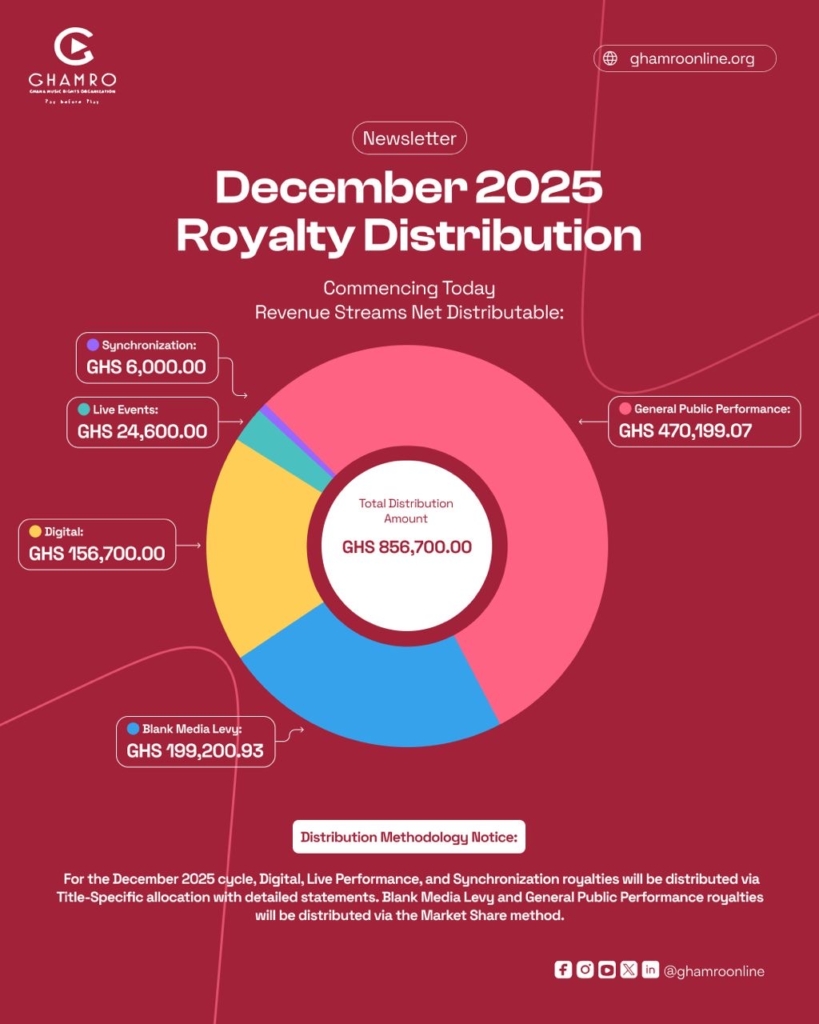
The Ghana Music Rights Organisation (GHAMRO) has officially commenced its December 2025 royalty distribution, releasing a total of GH₵856,700.00 to rightsholders across multiple revenue streams. This distribution covers Digital, Live Events, Synchronisation, Blank Media Levy and General Public Performance. Beyond the headline figure, the breakdown of the funds reveals an important story about where music money is truly coming from and how it is being shared.
This cycle is not merely a routine payout. It represents a deliberate effort by GHAMRO to bring clarity, structure and credibility to a system that has often been questioned, misunderstood or mistrusted by creators.
Breaking Down the GH₵856,700.00 Distribution
At the core of the December 2025 distribution is transparency, beginning with a clear breakdown of how the total amount has been allocated across revenue streams.
Out of the GH₵856,700.00 distributed:
• Synchronisation royalties accounted for GH₵6,000.00, reflecting licensed use of music in films, advertisements and audiovisual content.
• Live events royalties totalled GH₵24,600.00, generated from properly licensed concerts and performances.
• Digital royalties amounted to GH₵156,700.00, representing publishing income from digital platforms.
• Blank Media Levy contributed GH₵199,200.93, drawn from levies on recordable media.
• General Public Performance royalties formed the largest share at GH₵470,199.07, arising from licensed public use of music across various spaces.
Together, Digital revenue and Blank Media Levy total GH₵355,900.93, representing 41.5 per cent of the overall distribution. The remaining 58.5 per cent, amounting to GH₵500,799.07, represents actual collections from live performances, synchronisation and general public performance distributed to rightsholders.
This breakdown matters because it highlights a critical truth: royalties are driven by use, payment and compliance, not popularity alone.
Technology at the Centre of a New Direction
What makes this distribution cycle particularly significant is the system behind it. GHAMRO’s partnership with the World Intellectual Property Organization (WIPO) and the adoption of the WIPO-Connect platform marks a major step in modernising Ghana’s royalty ecosystem.
In an industry where music travels instantly but accounting has traditionally moved slowly, WIPO-Connect introduces order. The platform enables seamless tracking and allocation of royalties across all revenue streams while aligning GHAMRO’s operations with global best practices.
For rightsholders, this shift promises clearer insights into how royalties are calculated and distributed. For the organisation, it reduces guesswork and manual inefficiencies that have historically undermined trust.
How the Money Is Shared: The Method Behind the Numbers
GHAMRO states that the December 2025 distribution follows CISAC professional rules for Collective Management Organizations, combined with a hybrid methodology designed to suit Ghana’s evolving music landscape.
Under this system, Title-Specific Allocation has been applied to Digital, Live Events and Synchronisation royalties. This means individual musical works are rewarded based on actual usage and licensing, rather than broad estimates.
On the other hand, Blank Media Levy and General Public Performance royalties are distributed using the market share method, which reflects overall usage patterns within the licensed environment.
The aim, GHAMRO says, is balance: rewarding specific use where data is available, while fairly distributing pooled revenues where detailed usage information may be limited.
Registration, Identification and Payment: The Unavoidable Basics
Despite the advances in systems and partnerships, GHAMRO is clear that technology alone cannot fix everything. Royalties only reach the right creators when musical works are properly registered, correctly identified and fully paid for by music users.
If a song is not registered, it cannot be matched.
If usage is not reported, it cannot be calculated.
If users do not pay, there is nothing to distribute.
It is a simple equation that continues to shape the size and accuracy of royalty payouts, regardless of how often a song is heard.
The Compliance Gap Holding the Industry Back
One of the most persistent challenges remains broadcaster compliance. GHAMRO reports that more than 90 per cent of broadcast networks in Ghana are non-compliant when it comes to royalty payments and accurate usage reporting.
This gap significantly limits the potential of the distribution system. Even with advanced platforms and improved methodologies, unpaid usage results in unpaid royalties. Until broadcast networks commit to fulfilling their obligations, the full value of Ghana’s music economy will remain unrealised.
Compliance, GHAMRO stresses, is the bridge between good systems and meaningful earnings for creators.
A Future of Individual Statements and Fewer Grievances
Perhaps the most important promise emerging from this distribution cycle lies in what is coming next. Based on the systems already deployed and others currently underway, GHAMRO says future royalty distributions will come with individual statements for rightsholders.
These statements are designed to show clearly how each payment was calculated, which revenue streams contributed and which works earned what. The goal is to dispel long-standing feelings of unfairness, confusion and the belief among artistes that they did not receive their due.
By replacing mystery with information, GHAMRO hopes to shift conversations from emotion to evidence.
Beyond December: Building Trust One Cycle at a Time
GHAMRO describes its current efforts as part of a broader vision to build a royalty system that creators can trust. That vision is powered by technology, partnerships and adherence to international standards, but it ultimately depends on cooperation across the entire music value chain.
As December 2025 royalties reach rightsholders, the message from GHAMRO is deliberate and measured. The money is moving. The systems are improving. The numbers are clearer. But the success of the system will always depend on registration, compliance and engagement.
In an industry long driven by passion and performance, this distribution cycle suggests that precision, data and accountability are finally beginning to find their rhythm.