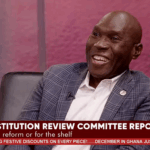
Former Member of Parliament for Tamale Central, Inusah Fuseini, has raised questions about proposals to extend Ghana’s presidential term from four to five years, arguing that recent experience shows effective governance is achievable within the current constitutional framework.
Speaking on Newsfile on JoyNews on Saturday, 27 December, Mr Fuseini said he was not persuaded that a longer presidential term was necessary, citing the performance of President John Dramani Mahama as evidence that meaningful progress can be made within a four-year mandate.
His comments come days after the Constitution Review Committee (CRC) submitted its report to President Mahama, marking a significant step in Ghana’s ongoing review of the 1992 Constitution. The report, presented on Monday, 22 December, contains several key recommendations, including proposals to separate the executive from the legislature, reaffirm the constitutional limit of two presidential terms, and extend the duration of a presidential term.
While commending the CRC for its work, Mr Fuseini said he had reservations about the suggestion to lengthen the term of office for the presidency, noting that the debate is not new and has resurfaced periodically over the years.
“I have reservations. My first reservation is that I am not entirely convinced that we need to extend the term of the presidency,” he told the programme.
He traced the origins of the proposal to January 2009, when former President John Agyekum Kufuor, in his final State of the Nation Address to Parliament, argued that longer periods of governance in countries such as Singapore and Malaysia may have contributed to their development.
“This suggestion is not new,” Mr Fuseini said. “The first time it entered our national discourse was on 5 January 2009, when His Excellency John Agyekum Kufuor delivered his final State of the Nation Address. He cited Singapore and Malaysia and the duration of governance that probably aided the growth and development of their countries.”
However, Mr Fuseini argued that Ghana’s political and constitutional context is different, and that a four-year term already strikes a balance between giving a government time to implement its agenda and ensuring regular accountability to voters.
According to him, the current administration has demonstrated that a president can form a government quickly and deliver tangible results within the existing timeframe.
“And John Dramani Mahama has demonstrated that, clearly in this term of his presidency,” he said.
He added that the President’s early progress challenges the notion that a four-year term is too short for effective leadership.
“He has shown that you can set up your government in less than three months and get it running,” Mr Fuseini said. “In fact, he has also shown that you can achieve significant success in the first year of government. That goes to dispel what President Kufuor said in 2009.”
In his view, these developments weaken the argument that Ghana needs a longer presidential term to accelerate development or improve policy continuity. Instead, he suggested that decisive leadership, clear priorities and efficient governance structures are more important than extending the length of time a president spends in office.
The CRC’s report is expected to fuel further national debate in the coming weeks, as stakeholders examine its recommendations and their implications for Ghana’s democratic system. The committee has presented a summary of its findings to the President, with the full and final report due to be made public in January.
Once released, the proposals are likely to be subjected to public consultations and parliamentary scrutiny before any constitutional amendments are considered. For now, voices such as Mr Fuseini’s highlight the divisions within the political landscape over whether extending the presidential term would strengthen governance or undermine the principles of accountability embedded in Ghana’s constitution.