An Empirical Look at Fiscal Discipline, Debt Sustainability, and Ghana’s Case for a Borrowing Law
ACCRA — Finance Minister Dr. Cassiel Ato Forson has announced plans to introduce a new Loans Act aimed at tightening controls on public borrowing and ensuring that every loan delivers measurable value to the economy. The proposed legislation will clearly define permissible uses of borrowed funds, requiring that all borrowing be tied to high-impact, value-for-money investments.
The timing of the initiative is deliberate. Ghana is emerging from its worst economic crisis in a generation — including a sovereign default in 2022, a painful debt restructuring, and a US$3 billion IMF Extended Credit Facility (ECF) programme that has, by most accounts, stabilized the country’s macroeconomic path. Public debt, which peaked at 79.1% of GDP in 2023, is projected to fall below 50% by 2030 under the IMF programme.
The key question is simple: does the evidence support the need for a legal borrowing framework? Using data from the World Bank for ten African countries, IMF programme documents, and a suite of econometric tests, the answer is a qualified yes — but with important caveats regarding design and enforcement.
The debt trajectory that made the Loans Act necessary
To understand why Ghana needs a Loans Act, we must first look at how the crisis unfolded. After HIPC debt relief, Ghana’s debt-to-GDP ratio fell from 113% in 2000 to a low of 26% in 2006. What followed, however, was a dramatic reversal — debt began climbing rapidly, driven by chronic fiscal deficits, energy sector bailouts, an expanding wage bill, and the absence of legally binding rules on borrowing purpose or limits.
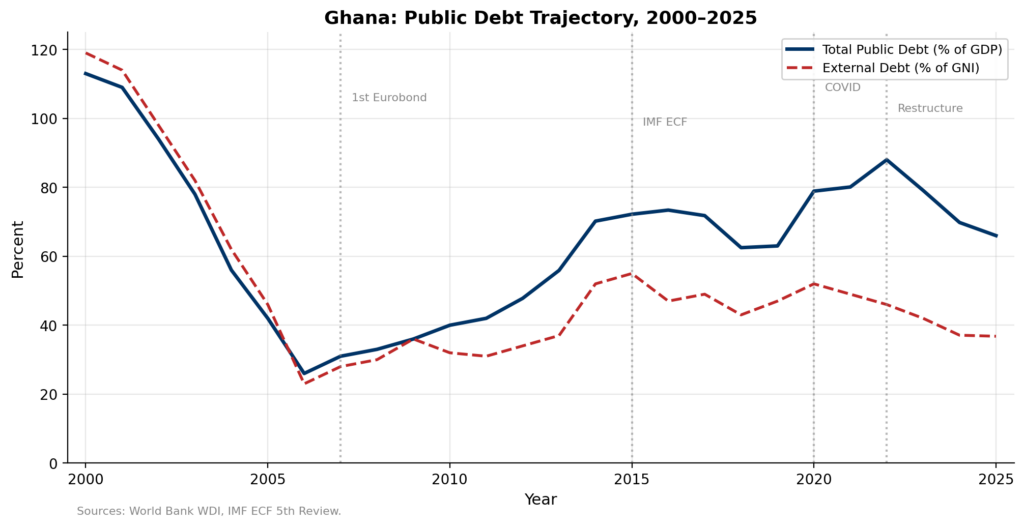
Figure 1: Ghana’s public debt trajectory, 2000–2025. Vertical lines mark key policy events. Sources: World Bank WDI, IMF
Ghana’s 2007 Eurobond issuance marked the country’s entry into international capital markets. Between 2006 and 2023, public debt tripled from 26% to 79% of GDP, driven by persistent fiscal deficits, energy sector bailouts, a rising wage bill, and critically, no legal limits on borrowing purpose or volume.
While the Public Financial Management Act (2016) introduced sanctions for fiscal mismanagement, it fell short of establishing binding debt ceilings or requiring that loans be linked to productive investments.
Ghana’s debt buildup is not unique in Africa, but its pace is striking. Compared to peers like Kenya, Senegal, Côte d’Ivoire, Zambia, and Nigeria, Ghana’s debt rose faster and more steeply than all but Zambia, which ultimately faced default.
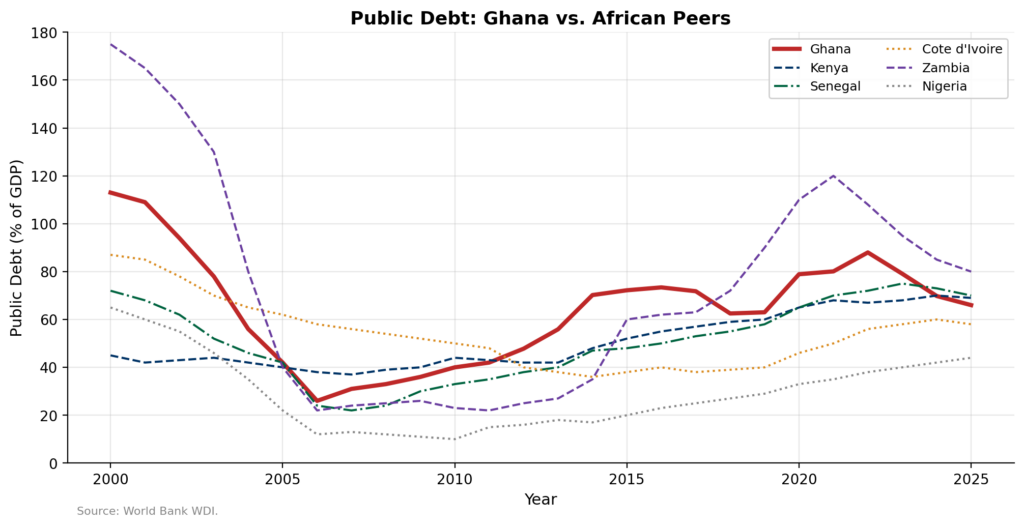
Figure 2: Public debt trajectories — Ghana vs African peers, 2000–2025. Source: World Bank WDI
IMF Programme Delivers Early Wins
The IMF’s 5th ECF Review, concluded in December 2025, highlights encouraging progress for Ghana’s economy. Growth exceeded expectations, reaching 5.7% in 2024, while inflation has returned to the Bank of Ghana’s target range.
International reserves, which had fallen to a precarious 1.6 months of import cover in 2023, have climbed to 3.3 months and are projected to reach 4.1 months by 2030, providing a vital buffer against external shocks.
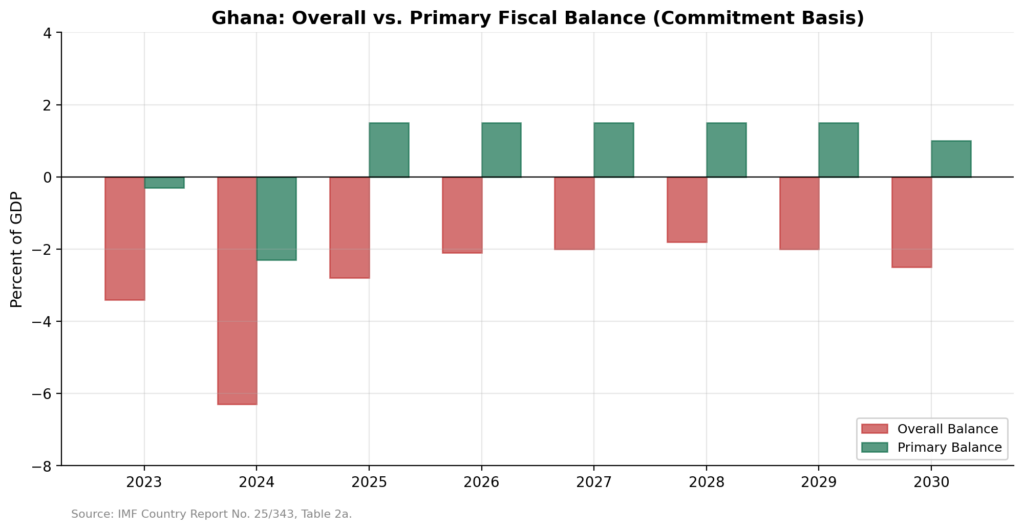
Most notably, Ghana recorded a primary fiscal surplus of 1.5% of GDP in 2025, marking the first surplus in several years and signaling a return to fiscal discipline under the programme.
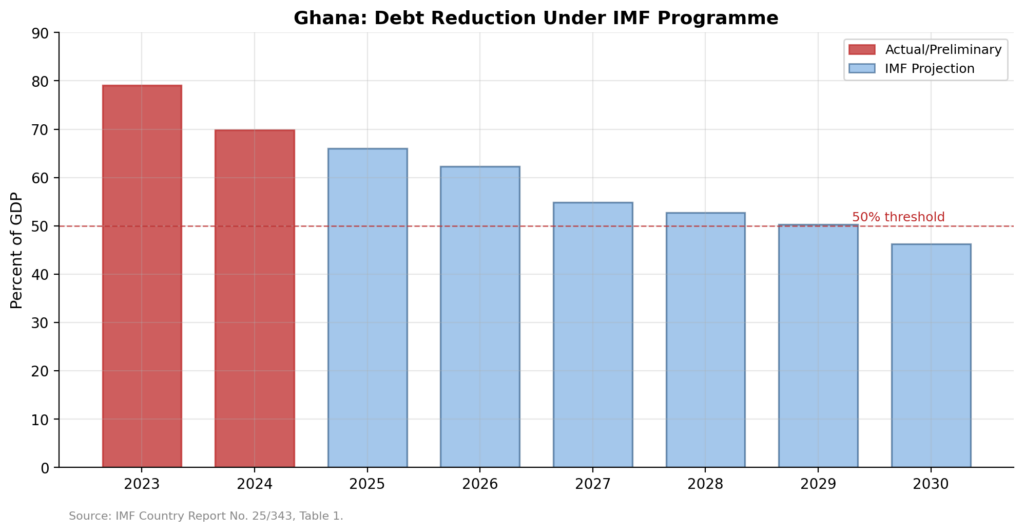
Figure 3 illustrates Ghana’s debt trajectory under the IMF programme, with actuals in red and projections in blue (IMF Country Report No. 25/343). The programme aims to reduce public debt to 46.3% of GDP by 2030, supported by rising revenues, higher capital spending, and gradually lower interest payments.
Revenue is projected to climb from 15.2% to 17.0% of GDP, driven by tax administration reforms and VAT restructuring. Capital expenditure is set to rise from 2.3% to 3.4% of GDP, while interest payments are expected to fall from 4.3% to 3.5%, easing pressure on the budget.
Key economic indicators at a glance
| Indicator | 2023 | 2024 | 2025 | 2027 | 2030 | Target |
|---|---|---|---|---|---|---|
| Real GDP growth (%) | 3.1 | 5.7 | 4.0 | 4.8 | 5.0 | ≥5.0 |
| Inflation, avg (%) | 39.2 | 22.9 | 17.3 | 7.9 | 8.0 | 8±2 |
| Revenue (% GDP) | 15.2 | 15.9 | 15.9 | 16.8 | 17.0 | ≥17 |
| Primary balance (% GDP) | −0.3 | −2.3 | 1.5 | 1.5 | 1.0 | ≥1.0 |
| Public debt (% GDP) | 79.1 | 69.8 | 66.0 | 54.9 | 46.3 | <50 |
| Reserves (months) | 1.6 | 2.6 | 3.3 | 3.4 | 4.1 | ≥3.0 |
Source: IMF ECF 5th Review, Country Report No. 25/343
While these projections are encouraging, one figure stands out: the primary balance fell sharply to −2.3% of GDP in 2024, from −0.3% in 2023. The likely cause? Ghana’s December 2024 general election. Election-year fiscal slippage is a familiar pattern, driven by spending surges and revenue shortfalls in the months leading up to polling.
The rebound to a 1.5% surplus in 2025 is reassuring, showing that fiscal discipline can be restored. But it also underscores the challenge: fiscal restraint can quickly erode when political incentives shift. This pattern strengthens the argument for a Loans Act. A legally binding framework would help ensure discipline precisely when electoral pressures make it politically costly to maintain. IMF conditionality is temporary; the question remains—what happens after the ECF programme ends?
Evidence on Fiscal Discipline
To explore this, we compared Ghana’s fiscal performance in IMF programme years versus non-programme years from 2000 to 2025. The results are telling: the average fiscal balance during programme years was −2.9% of GDP, compared with −4.4% in non-programme years, an improvement of 1.5 percentage points. While the difference is marginally significant (p = 0.107), it reinforces a clear pattern: IMF programmes improve discipline, but the effect is temporary.
This further highlights the need for a domestic legal anchor to lock in fiscal responsibility and ensure that Ghana’s borrowing and spending remain sustainable over the long term.
Data from the IMF shows that under the ECF programme (2023–2030), external discipline—including strict performance targets, regular reviews, and the threat of programme suspension—does improve Ghana’s fiscal outcomes. However, the effect is modest and temporary. Historically, once conditionality ends, the country tends to revert to deficit spending. The 2020–2022 period is a cautionary tale: within four years of the previous ECF programme ending, Ghana faced a sovereign default.
This underscores the central economic argument for the Loans Act. A domestic legal framework that replicates even part of the disciplining effect of IMF conditionality—and does so permanently—could significantly strengthen Ghana’s fiscal architecture.
Where Does the Money Go?
Beyond the amount borrowed, a key concern is how the funds are spent. IMF data on expenditure composition highlights a troubling trend, raising important questions about the productivity of Ghana’s borrowing.
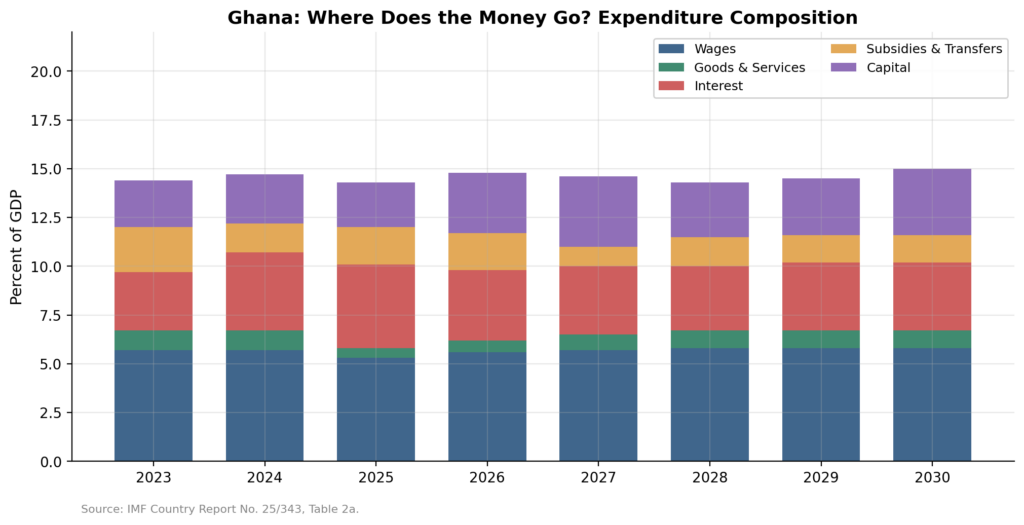
In 2025, interest payments consumed 4.3% of Ghana’s GDP—nearly double the 2.3% allocated to capital expenditure. The wage bill, at 5.3–5.7% of GDP, remains the single largest spending category. Put another way, for every cedi the government invests in infrastructure, schools, or hospitals, about GH¢1.87 goes toward debt service.
Econometric analysis tested whether the composition of government spending drives growth. Using a time-series regression for Ghana (2000–2024), neither capital expenditure nor recurrent expenditure showed a statistically significant positive effect on GDP growth. A Vector Autoregression (VAR) model further confirmed that debt does not Granger-cause growth (p = 0.39). In simple terms, borrowing over the past two decades has not been productively channelled.
These findings reinforce the core principle of the proposed Loans Act: every loan should be tied to high-impact, value-for-money investments. Without this requirement, borrowing tends to flow toward recurrent spending and debt service, creating a self-reinforcing cycle of fiscal pressure.
Rebuilding Reserves: Strengthening the Buffer
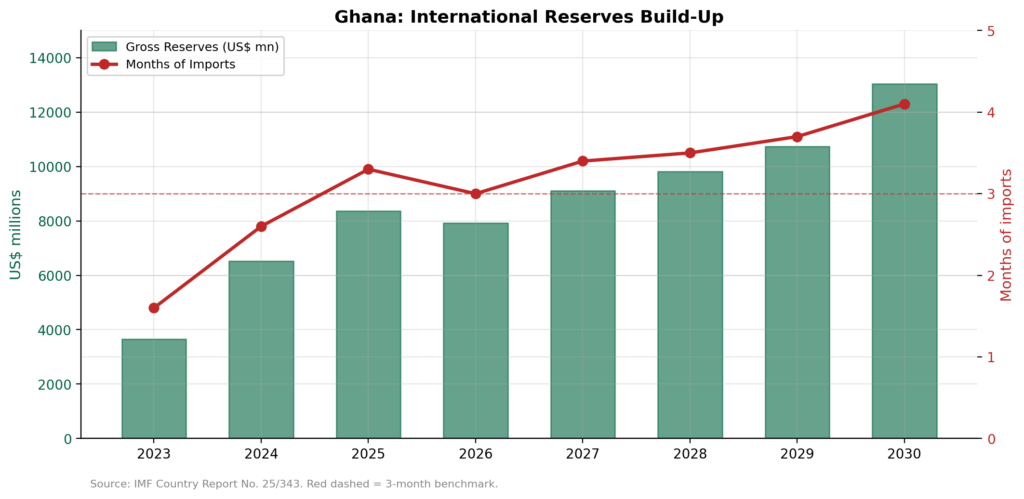
One of the standout achievements of Ghana’s recent IMF-supported programme has been the rebuilding of international reserves. From a dangerously low 1.6 months of import cover in 2023, reserves are projected to exceed four months by 2030, providing a crucial buffer against external shocks. Experts stress that the proposed Loans Act should include provisions preventing reserves from being tapped to finance fiscal deficits—a practice that contributed to the 2022 crisis.
Do Fiscal Rules Work? Lessons from Africa
A panel study of 10 African countries (2000–2025) examined whether fiscal rules—like Kenya’s Public Finance Management Act, Nigeria’s Fiscal Responsibility Act, or the WAEMU convergence criteria affecting Senegal and Côte d’Ivoire—help lower debt levels. Results were mixed. In some cases, the presence of fiscal rules was absorbed by country fixed effects, reflecting long-standing legislation such as Senegal’s.
However, the fiscal balance emerged as the most consistent predictor of debt dynamics. Across all models, each one-percentage-point improvement in the fiscal balance correlated with a 2.4–3.0 percentage point reduction in the debt-to-GDP ratio. In other words, the effectiveness of fiscal rules comes not from the law itself, but from the fiscal discipline they generate.
Tests on Ghana’s debt show it follows a non-stationary process—drifting without converging to a sustainable level. An Engle–Granger cointegration test found only borderline evidence of a long-term equilibrium between debt and growth (p = 0.058). Without a structural anchor such as the Loans Act, Ghana’s debt could continue on a “random walk” rather than stabilising.
Designing Fiscal Rules That Work
International experience shows fiscal rules succeed or fail based on enforcement, not elegance. Brazil’s 2000 Fiscal Responsibility Law reduced subnational debt but was bypassed at the federal level. Kenya’s PFM Act set generous debt ceilings that were weakly enforced, and the EU’s Stability and Growth Pact was routinely violated by major members.
By contrast, Chile’s structural balance rule—backed by an independent fiscal council, transparent methodology, and political consensus—has been highly effective. Ghana can draw from this model.
Based on empirical findings, the Loans Act should include:
- Legislated debt ceiling: A ceiling of 55–60% of GDP, with an amber warning at 50%, would constrain borrowing while allowing room for development projects.
- Primary balance floor: Embedding a minimum primary surplus of 1% of GDP ensures fiscal space for debt reduction even post-programme.
- Borrowing purpose test: Every loan—domestic or external—should be tied to a capital project with a published cost–benefit analysis.
- Escape clause with automatic sunset: Severe shocks (e.g., GDP contraction >3%) allow temporary suspension of the debt ceiling, automatically reinstated after two years.
- Independent oversight: Establish or empower a fiscal council with statutory authority to monitor compliance, publish assessments, and flag deviations.
Why Now Matters
Ghana is at a crossroads. The IMF programme is delivering results, macroeconomic fundamentals are improving, and the post-restructuring recovery is underway. But this window of opportunity is limited. The Loans Act addresses a critical gap in Ghana’s fiscal framework: the absence of a binding legal structure to constrain borrowing.
Empirical analysis highlights three key points:
- IMF conditionality improves fiscal discipline temporarily, but effects fade post-programme.
- Ghana’s borrowing has not been productively channelled; neither capital nor recurrent spending significantly boosts growth.
- Fiscal balance is the most important determinant of debt sustainability; without a structural anchor, debt will drift rather than converge.
The Loans Act can provide that anchor—but legislation alone is not enough. Enforcement, transparency, and credible sanctions are essential to make the law effective.
The Time to Act Is Now
The credibility window is open. Before the next commodity boom, election-year spending spree, or global shock tests Ghana’s fiscal discipline, the Loans Act must be well-designed and faithfully enforced. Done right, it could mark a new chapter in Ghana’s fiscal history. Otherwise, the country risks repeating familiar mistakes.
About the Author
Dr Stephen Lartey is a development economist with a PhD in Economics, specialising in institutions, fiscal and monetary policy, macroeconomics, and causal inference. The author can be reached at [contact details].larteystephen@gmail.com

Data Sources & Methodology
This analysis draws on World Bank WDI data for 10 African countries (2000–2025) accessed via the wbopendata API, IMF ECF 5th Review data (Country Report No. 25/343, December 2025), and the Worldwide Governance Indicators.
The study employs a range of econometric methods, including panel fixed- and random-effects regressions, Vector Autoregression (VAR) with impulse response functions, Granger causality tests, Fisher panel unit root tests, and Engle–Granger cointegration tests.
For researchers and practitioners, the full replication code (Stata .do file) is available directly from the author.