Developing trusted professionals
The Chartered Institute of Bankers (CIB), Ghana has crowned the University of Ghana, Legon as winners of the second edition of the National Banking and Ethics Challenge (NBEC 2.0), held at the CIB Ghana Auditorium in Accra.
The University of Ghana Business School topped the competition with 35 points, followed by the University of Professional Studies, Accra (UPSA) with 29.5 points, while the University for Development Studies (UDS) placed third with 26.5 points. The closely fought grand finale attracted faculty members, students, and senior players from the banking industry across the country.
Competition grows in scale and ambition
NBEC 2.0 recorded a major expansion in participation, with 12 universities taking part — more than double the five institutions that featured in the inaugural edition held in May 2025.
The competing schools included Kwame Nkrumah University of Science and Technology, University of Ghana, University of Cape Coast, University of Education Winneba, University for Development Studies, Central University, Academic City University College, Wisconsin International University College, All Nations University, Pentecost University, UPSA, and others.
The institutions represented a mix of public research universities, private universities, and professionally focused colleges, underscoring the growing national reach of the initiative. The competition progressed through three stages — preliminaries, semifinals, and a final showdown that determined the overall winner.
In his remarks, CIB Ghana President Benjamin Amenumey described the initiative as both a training platform and a strategic intervention aimed at shaping the future of the banking sector.

“The National Banking and Ethics Challenge was born out of a simple belief,” he said. “The future of banking will be shaped by professionals who are ethically grounded, intellectually strong, and ready for a global industry that is constantly evolving.”
He added that as innovation continues to reshape the financial sector, qualities such as sound judgment, accountability, and integrity are becoming even more important as the true foundation of banking practice.
This vision, he noted, has helped drive growing interest in the competition.
“The interest is so high — we have twelve universities participating, and I am confident it will only get better. Every contestant in the CIB Ghana 2026 National Banking and Ethics Challenge is a winner in their own right, whether in the knowledge gained, the experience, or the networks built,” Mr. Amenumey said.
Tangible benefits for participants
The Chartered Institute of Bankers Ghana also announced a range of practical benefits for participants at this year’s event, underscoring its focus on developing the next generation of banking professionals.
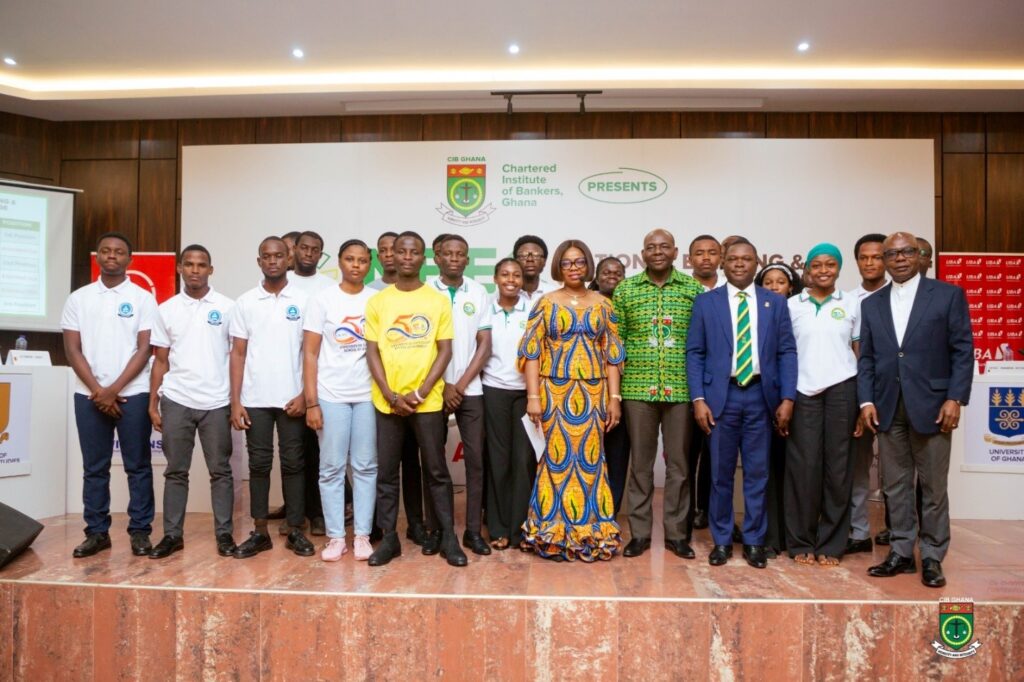
GCB Bank has announced internship opportunities for all participants in the second edition of the National Banking Ethics Challenge, giving students a direct pathway into the industry and valuable hands-on experience.
As part of the incentives, contestants who go on to enrol as Chartered Bankers with the Chartered Institute of Bankers Ghana will receive a full waiver on their registration fees. Students who attended the event but did not compete are also eligible for a 50 percent discount on student registration.
Beyond the competition itself, organisers set up a dedicated mentorship hub, where students received career guidance and professional development support throughout the day — ensuring that participants walked away with practical insights, not just certificates.
Banking professionalism as the rationale
Providing context for the initiative, Mr. Robert Dzato, CEO of the Chartered Institute of Bankers Ghana, said the challenge is rooted in the institute’s legal mandate under the Chartered Bankers Act 2019 Act 911 — to promote the study of banking and regulate professional standards within the sector.
He outlined four key objectives behind the competition, beginning with what he described as the most critical: building a pipeline of trustworthy professionals.
To illustrate the responsibility that comes with the profession, Mr. Dzato compared banking to aviation — noting that just as mistakes in aviation can lead to loss of life, poor decisions in banking can have far-reaching consequences for individuals and the broader economy.
Behind every failed financial decision, he said, are real human stories — businesses that collapse, education plans that are disrupted, and healthcare needs that go unmet — underscoring the need for competence, integrity, and sound judgment in the industry.

“Trust is the real currency in banking,” he said. “Cash may be the raw material, but trust is what sustains the system. And that trust is built on ethics, character, and doing the right thing — even when no one is watching.”
This principle underpins one of the core goals of the National Banking Ethics Challenge, which is aligned with the United Nations Sustainable Development Goals — particularly SDG 4 Quality Education. The goal calls for stronger financial literacy at all levels of society, and the Chartered Institute of Bankers Ghana believes universities are a critical starting point.
By taking the competition to tertiary institutions, the Institute is pushing the idea that financial education should not begin only when professionals enter the industry, but should be embedded throughout their training.
Another key objective is to expand public understanding of banking. Organisers say many of the questions are intentionally practical — covering everyday issues such as how banking products work, what happens to dormant accounts, how estates are managed after a customer’s death, and how to guard against cyber fraud and digital financial crime.
The idea, Mr. Dzato explained, is that learning should not be limited to contestants alone. Even audience members, he said, should leave the auditorium with a better grasp of how the financial system works.
The competition also aims to contribute to the re-professionalisation of Ghana’s banking sector. Mr. Dzato acknowledged that public trust has taken a hit in recent years, pointing to high-profile cases of misconduct, the Ghana banking sector clean-up 2017 2018, and a rise in staff-related fraud — all of which have raised concerns about integrity within the industry.
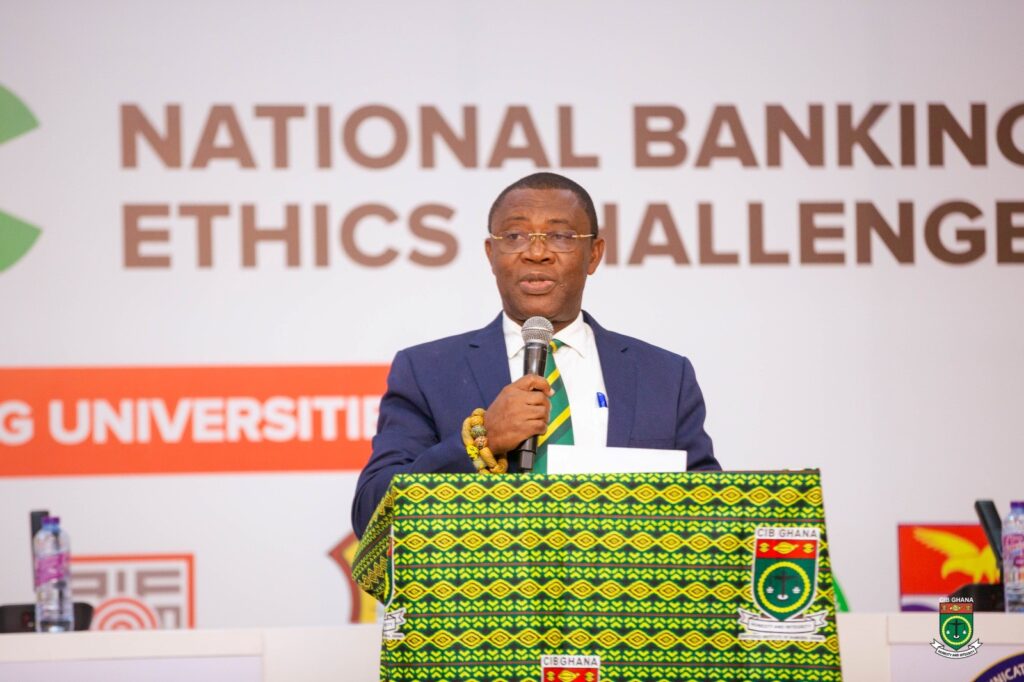
The National Banking and Ethics Challenge (NBEC), organisers say, is more than a competition — it is a deliberate effort to build a new generation of bankers whose skills and ethical standards are not only certified, but also visible and accountable to the public.
Adding his voice, Clifford Duke Mettle, a former President of the Chartered Institute of Bankers Ghana and an alumnus of the University of Ghana, encouraged students and contestants to see the challenge as a defining step in their professional journey rather than a one-off event.
Reflecting on his own path into banking, he urged participants to take the lessons learned beyond the competition stage and apply them in everyday life — particularly in educating others. He challenged them to become ambassadors of financial literacy and professionalism within their communities, influencing conversations among family, friends, and peers.
“Banking is a wonderful profession. It gives you status, but more than that, it gives you responsibility. The essence of what we are doing here is to show that once you work in a bank, people can trust you, people can believe in you,” he said.
NBEC 2.0 scope
The second edition of the National Banking Ethics Challenge tested participants across a wide range of real-world banking and finance topics, reflecting the demands placed on today’s chartered bankers.
Contestants were assessed on everyday banking operations, including financial products and services, dormant accounts, and estate processes following the death of an account holder. Environmental, Social and Governance (ESG) principles also formed a key part of the assessment.
The competition further explored fraud prevention and detection, with questions covering cyber fraud, SIM swap fraud, and internal (staff-related) fraud. Participants were also tested on digital banking trends, including the rise of digital currencies and cryptocurrency.
Other areas included cybersecurity, consumer protection in digital finance, and core financial literacy — such as understanding the differences between savings, current, and investment accounts — rounding out a curriculum designed to reflect the realities of modern banking.

The design of the question bank reflects NBEC’s dual mandate to develop technically capable professionals and to serve as a vehicle for public financial education. Questions were constructed so that even audience members with no prior banking training could benefit from the knowledge being exchanged on stage.
The Chartered Banker pathway
Mr. Dzato also outlined CIB Ghana’s four-level qualification structure for those seeking to become chartered bankers. The framework progresses from Fundamentals in Financial Services at Level 1, through Financial Services Practitioner at Level 2 and Expert Practitioner in Financial Services at Level 3, to Strategic Leader in Financial Services at Level 4.
The structure is designed around practitioner-responsive, modular learning, what Mr Dzato described as a shift from “just-in-case” to “just-in-time” education, allowing bankers to pursue depth in specific subject areas such as treasury management without completing the full qualification pathway.
The Institute also offers a suite of complementary programmes, including a digital learning academy, an ESG curriculum developed in partnership with the International Finance Corporation (IFC) and the Environmental Protection Agency (EPA Ghana), and an ethics certification e-learning programme. The ethics programme, which is free to all member institutions including the Bank of Ghana, recorded approximately 10,000 completions under its first iteration; Ethics 2.0 was launched in early 2026. CIB Ghana also conducts biannual post-monetary policy seminars, bringing together the Ministry of Finance, the Bank of Ghana, the Association of Industries, and the banking community to discuss policy implications ahead of Monetary Policy Committee decisions.
NBEC 3.0 and beyond
Mr. Dzato confirmed that CIB Ghana intends to make the National Banking and Ethics Challenge an annual event, with plans for significant structural and thematic evolution in the next edition. On the institutional front, the Institute plans to introduce a regional zone format comprising a southern zone and a northern zone, broadening access for universities outside the Greater Accra catchment area and reducing logistical barriers for institutions in the north. This structural change, if implemented, would meaningfully increase the competition’s reach while maintaining the quality of the grand finale.
On content, NBEC 3.0 is expected to incorporate emerging regulatory areas, including developments around non-performing loans and digital assets and cryptocurrency, reflecting the rapidly evolving landscape that chartered bankers must navigate. Deeper institutional partnership with university banking and finance faculties is also a stated priority, including the sharing of CIB Ghana resources and the development of pathways for academic staff to themselves become chartered bankers.
“We are not limiting ourselves to Ghana. Our vision is to be the most relevant institute for professional banking education in Africa. We are developing trusted human capital for the continent,” Mr. Dzato said.
About CIB, Ghana The Chartered Institute of Bankers (CIB) Ghana is the statutory professional body for banking and financial services professionals in Ghana, established under the Chartered Bankers Act 2019 (Act 911). The Institute’s mandate is to promote the study of banking and regulate the practice of the banking profession. CIB Ghana sits at the intersection of academia and industry, developing trusted, ethical, and competent professionals for the Ghanaian and African banking sectors. The Institute offers the Chartered Banker qualification across four levels, a digital learning academy, ethics certification, and ESG training programmes, and conducts regular policy dialogue with regulators and industry stakeholders.
The structure of the question bank reflects the dual mandate of the National Banking Ethics Challenge — to train technically skilled professionals while also promoting public understanding of finance. Questions were deliberately designed to be accessible, ensuring that even audience members without a background in banking could learn from the discussions on stage.
The Chartered Banker pathway
Speaking on the institute’s professional framework, Mr. Dzato outlined the four-tier qualification system offered by the Chartered Institute of Bankers Ghana for those pursuing chartered banker status.
The pathway begins with Fundamentals in Financial Services at Level 1, followed by Financial Services Practitioner at Level 2, Expert Practitioner in Financial Services at Level 3, and culminates in Strategic Leader in Financial Services at Level 4.
He explained that the programme is built around flexible, modular learning tailored to the needs of working professionals. Describing it as a shift from “just-in-case” to “just-in-time” education, Mr. Dzato said the approach allows bankers to specialise in key areas — such as treasury management — without necessarily completing the entire qualification track.
Beyond the core programme, the institute has rolled out several complementary initiatives. These include a digital learning academy, an ESG-focused curriculum developed in collaboration with the International Finance Corporation and Environmental Protection Agency Ghana, as well as an ethics certification e-learning course.
The ethics programme, which is available free to all member institutions — including the Bank of Ghana — recorded around 10,000 completions in its first phase. An upgraded version, Ethics 2.0, was introduced in early 2026.
CIB Ghana also hosts biannual post-monetary policy seminars, bringing together stakeholders such as the Ministry of Finance Ghana, the Bank of Ghana, the Association of Ghana Industries, and players in the banking sector to discuss policy directions ahead of Monetary Policy Committee decisions.
NBEC 3.0 and beyond
Looking ahead, Mr. Dzato revealed plans to make the National Banking and Ethics Challenge an annual event, with significant changes expected in future editions.
One major proposal is the introduction of a regional competition format, split into northern and southern zones. The move is aimed at expanding participation beyond the Greater Accra area and easing travel and logistical challenges for institutions in other parts of the country.
On the content side, the next edition — NBEC 3.0 — is expected to reflect emerging trends in the financial sector. Topics such as non-performing loans, digital assets, and cryptocurrency are likely to feature prominently, in line with the evolving demands of the banking industry.
The institute is also seeking deeper collaboration with university departments, particularly in banking and finance. This includes sharing learning resources and creating pathways for academic staff to earn chartered banker qualifications.
“We are not limiting ourselves to Ghana. Our vision is to be the most relevant institute for professional banking education in Africa. We are developing trusted human capital for the continent,” Mr. Dzato said.
About CIB Ghana
The Chartered Institute of Bankers Ghana is the statutory body responsible for regulating banking and financial services professionals in Ghana. Established under the Chartered Bankers Act 2019 Act 911, the institute promotes professional standards and the study of banking.
Positioned at the intersection of academia and industry, CIB Ghana focuses on developing ethical, competent, and industry-ready professionals. Its offerings include the four-level Chartered Banker qualification, digital learning programmes, ethics certification, ESG training, and ongoing policy engagement with regulators and industry stakeholders.