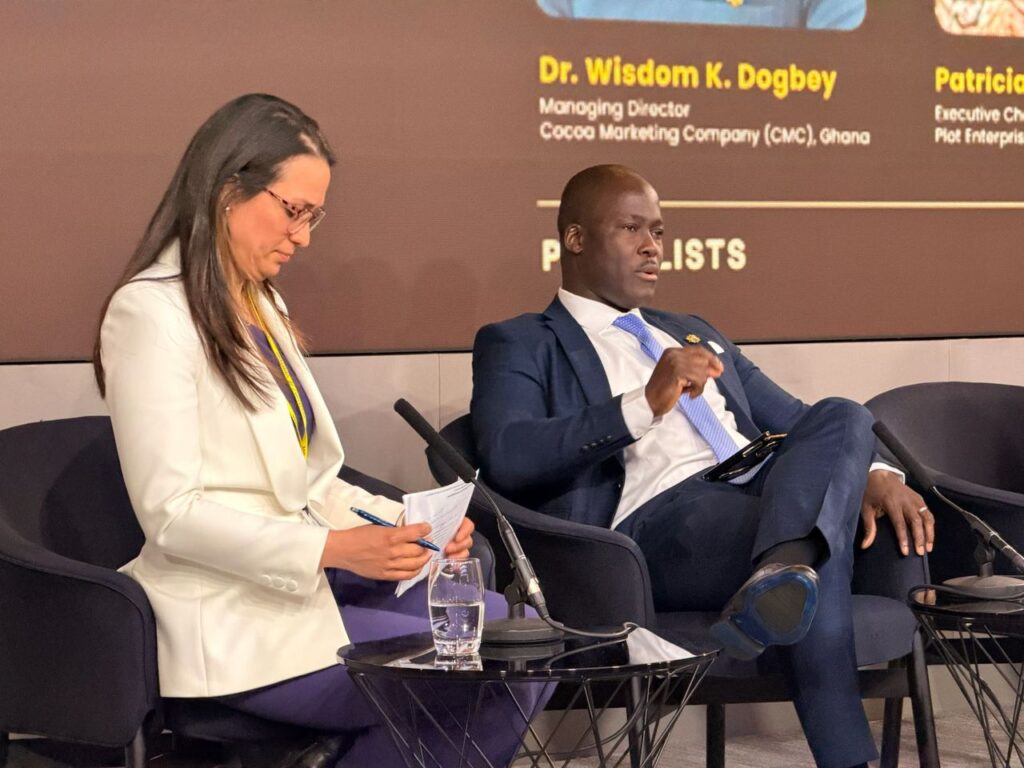
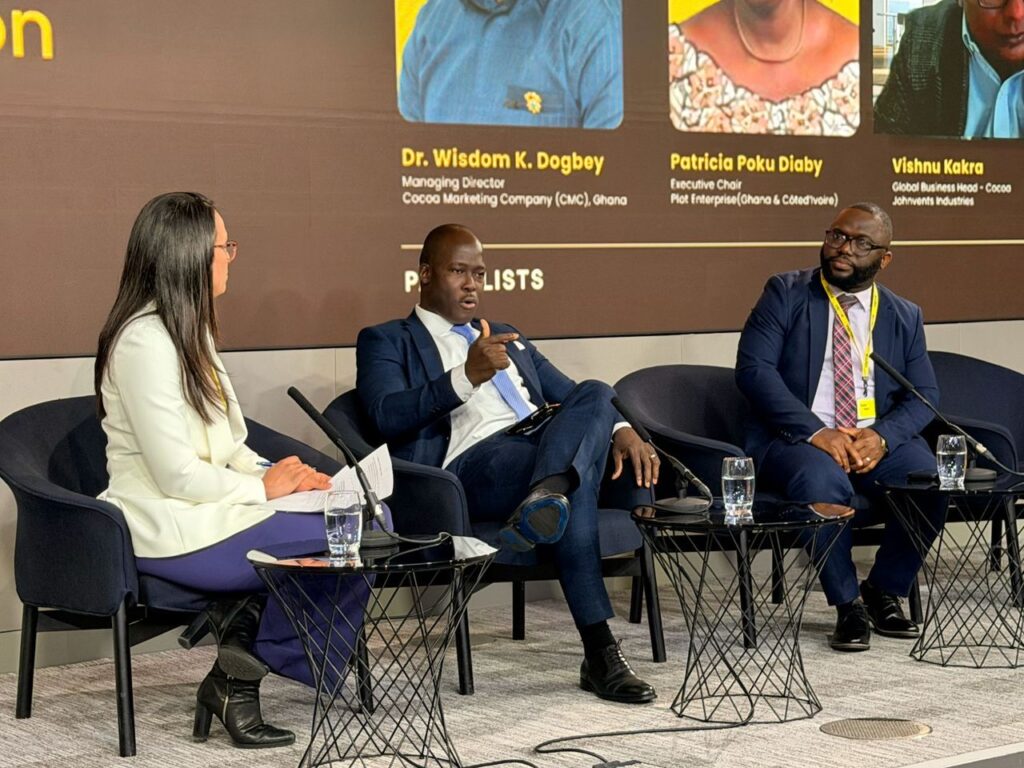
At the London Stock Exchange on Wednesday, the Managing Director of the Cocoa Marketing Company (CMC), Dr Wisdom Kofi Dogbey, delivered a strong, data-driven pitch to global cocoa traders, commodity financiers, and industry executives in support of Ghana’s ambitious 50% domestic cocoa processing policy.
Speaking at the Africa Cocoa Finance and Investment Forum (ACFIF) 2026, Dr Dogbey presented what many attendees described as one of the most detailed and commercially focused arguments for cocoa sector transformation to come out of West Africa in recent years.
A shift Ghana says is long overdue
Ghana produces between 650,000 and 800,000 tonnes of cocoa in a good harvest season, but for decades about 70% of that output has been exported in raw form. That, the CMC boss argued, has meant the country misses out on the higher earnings from grinding and refining.
He said the government is now determined to change that under President John Dramani Mahama’s 50% processing policy, which is expected to take effect from the 2026/27 crop season.
“Ghana has thirteen processing companies with 500,000 tonnes of combined installed capacity, and they are running well below potential—not from technical deficiency, but from lack of reliable, commercially priced bean supply,” he told investors. “The 50% domestic processing policy… is the government of Ghana’s decision to correct that.”
Building the case for profitability at origin
Responding to concerns about whether cocoa processing in Ghana can truly be profitable, Dr Dogbey outlined what he described as a clear commercial advantage under the new framework.
He explained that Ghana’s policy structure deliberately blends different grades of cocoa beans, including main crop beans sold without ICE discount and light crop and remnant beans that carry international discounts of 20% or more. This mix, he said, helps create a more competitive processing margin.
He also noted that Ghana’s cocoa quality has improved significantly in recent years, particularly in bean size and fat content, making it more attractive for industrial use.
In addition, processors benefit from pricing advantages on light crop beans, which are offered at discounted international rates even though they often meet main crop standards in other markets—giving local factories a cost edge over some overseas competitors.
He further pointed out that companies operating under Ghana’s Free Zones framework enjoy a 10-year corporate tax holiday, followed by a reduced 15% rate, compared to the standard 25% corporate tax.
The capacity challenge
Dr Dogbey also addressed a key structural issue affecting the sector: underutilisation of processing plants. He noted that many factories currently operate at just 30% to 40% of capacity, meaning fixed costs are spread over too little output, making operations financially unsustainable even when margins are technically sound.
He argued that under the new policy, a guaranteed supply of cocoa beans would increase utilisation rates to between 75% and 80%, a level at which most plants could operate profitably.
The presentation reinforced Ghana’s broader message to investors at the forum: that with stable supply, improved incentives, and policy backing, cocoa processing at origin can move from potential to profitability.
The untapped value in cocoa
One of the most compelling parts of the Managing Director’s remarks at the Africa Cocoa Finance and Investment Forum focused on Africa’s position in the global cocoa value chain—and the scale of opportunity the continent continues to miss.
He pointed out the imbalance in global earnings, noting that while Africa dominates raw cocoa production, its share of the final market value remains disproportionately low.
“The global chocolate market is worth approximately $130 billion a year. Africa produces 70 to 75% of the raw cocoa that feeds it. Africa earns less than 10% of that $130 billion. That gap is the untapped value,” he told the forum.
Beyond chocolate, he urged stakeholders to look at cocoa as a broader industrial input rather than a single commodity. He highlighted cocoa butter’s growing demand in the global cosmetics and personal care industry, where it is used in products such as moisturisers, lip balms, and body lotions. He also pointed to its use in pharmaceuticals and the expanding market for cocoa-based health and wellness products, driven by its naturally occurring compounds linked to cardiovascular and anti-inflammatory benefits.
“We are not talking about a better price for cocoa. We are talking about Ghana supplying the global beauty, healthcare, and food manufacturing industries, not just the confectionery trade,” he said.
CMC’s plan to hit the 50% processing target
The Managing Director of the Cocoa Marketing Company (CMC) also outlined how the organisation intends to deliver on Ghana’s 50% cocoa processing target ahead of the 2026/27 crop season.
He explained that CMC is rolling out a three-pronged strategy aimed at strengthening supply reliability, financing access, and export linkages for local processors.
First, from the 2026/27 season, CMC will allocate defined volumes of cocoa directly to selected domestic processors, including Cocoa Processing Company (CPC), WAMCO, Niche Cocoa, Plot Enterprise, and TF Commodities. This arrangement, he said, will give processors a guaranteed supply of raw beans under structured commercial terms, improving planning and production stability.
At the same time, a domestic bond programme currently being finalised is expected to provide liquidity support to Licensed Buying Companies (LBCs), enabling them to purchase cocoa directly from farmers more efficiently. This mechanism will allow Ghana Cocoa Board (COCOBOD) to settle payments through its contractors upon delivery, helping to speed up the supply chain and improve reliability for processors.
According to the CMC chief, the result will be a more consistent flow of beans to factories, improved plant utilisation, and lower production costs per unit.
The third pillar, and one he described as particularly attractive to investors, involves securing long-term offtake agreements between Ghanaian processors and international buyers, including participants at the forum. He explained that firm purchase agreements with creditworthy partners significantly reduce risk for processors and can unlock access to commercial financing that has traditionally been difficult to secure in Ghana’s processing sector.
Confronting financing and operational constraints
The Managing Director of the Cocoa Marketing Company (CMC) was frank about the challenges facing Ghana’s cocoa processors, especially when compared with their European counterparts. When asked about the biggest barriers, he pointed first to financing—both access to credit and its high cost.
He explained that European processors are often able to borrow at close to base rates to purchase cocoa beans, while Ghanaian processors face significantly higher interest rates. This, he said, is not due to inefficiency at plant level, but rather the pricing of sovereign and currency risk into local lending.
“A European processor borrows to buy beans at close to base rate. A Ghanaian processor pays rates several multiples higher, not because the plant is poorly run, but because Ghana’s sovereign and currency risk is priced into every loan regardless of the factory’s own creditworthiness,” he said. “That premium erodes the processing margin and makes origin processing appear uneconomic, when the real problem is the financing cost, not the processing.”
He also pointed to additional constraints, including higher energy costs in Ghana, port-related logistics delays and expenses, and compliance requirements linked to the European Union Deforestation Regulation (EUDR). However, he noted that Ghana’s existing traceability systems under Ghana Cocoa Board are helping to manage some of these compliance pressures.
Despite these challenges, he was clear in his conclusion: none of the constraints, either individually or collectively, should be seen as a reason to halt progress.
“None of these constraints, individually or together, is a reason not to proceed. They are reasons to proceed with adequate support, which is exactly why we are at the London Stock Exchange today,” he said.
A deliberate global platform
The choice of the London Stock Exchange as the venue for the Africa Cocoa Finance and Investment Forum was described as intentional. As a global centre for commodity finance, the location underscored the significance of the discussions taking place.
For the Mahama administration, which has pledged a new approach to economic management, hosting the forum in London was seen as both symbolic and strategic—signalling Ghana’s intention to position itself more firmly within global investment and commodity markets.
Observers at the event noted that the CMC Managing Director’s presentation stood out for its mix of policy direction and detailed commercial analysis. His focus on profitability, bean quality, tax incentives, and financing structures resonated with an audience more interested in investment viability than political messaging.
With the 2026/27 cocoa season approaching and implementation of the 50% processing policy underway, the message from Accra—delivered in the heart of global finance—was clear: Ghana is actively opening up to cocoa investment, and the supporting economic framework is being built in real time.