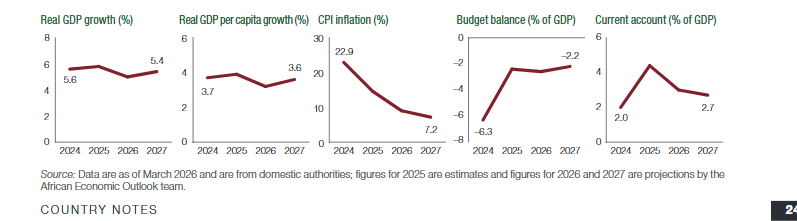
The African Development Bank (AfDB) is projecting Ghana’s economy to grow by 5.0% in 2026 and 5.4% in 2027.
This compares with an estimated GDP growth of 5.8% in 2025.
In its African Economic Outlook 2026 report, the Bank said Ghana’s medium-term economic outlook remains positive, although it is still exposed to certain risks.
It attributed the projected growth to improved investor confidence, prudent macroeconomic management, and continued strength in the services sector and household consumption.
“Growth is projected at 5.0% in 2026 and 5.4% in 2027, supported by improved confidence, prudent macroeconomic management, and continued strength in services and consumption,” the report stated.
However, the AfDB noted that Ghana continues to face an estimated investment financing gap of about 9% of GDP.
It explained that high public debt levels, low domestic revenue mobilisation, and tighter global financial conditions have limited access to long-term, affordable financing.
According to the report, addressing these challenges will require diversifying the economy, strengthening policy and institutional reforms, and improving the integration of domestic and international financial systems to mobilise resources at scale.
Stable macroeconomic outlook key to attracting investment
The report notes that maintaining a stable macroeconomic environment—supported by sustainable debt levels, strong institutions, and efficient financial systems—is essential for attracting both domestic and foreign capital into priority development areas.
It highlights key enablers such as better alignment between fiscal and monetary policies, stronger regulatory and supervisory frameworks, reliable financial infrastructure, accurate data systems, and transparent public financial management anchored in accountability.
According to the report, consistent policy coordination is crucial to encourage private sector investment and make effective use of concessional financing.
To boost development financing at scale, it calls on Ghana to strengthen domestic resource mobilisation by widening the tax base, improving revenue collection, and deepening local currency capital markets in order to reduce dependence on external borrowing.
It further recommends the strategic use of concessional and catalytic funding through public–private partnerships and blended finance arrangements to reduce risk in critical sectors such as infrastructure, health, education, and the energy transition.
These measures, the report suggests, would help attract private capital, improve economic resilience, and support sustained and inclusive growth.
Growth outlook in Africa
Meanwhile, the African Development Bank (AfDB) projects that growth in West Africa will stabilise at 4.7% in 2026 and ease slightly to 4.5% in 2027, compared with an estimated 4.8% in 2025.
The bank says the outlook remains broadly positive, with growth expected to be widespread across the region. Ten out of 15 West African countries are projected to record growth of 5% or higher in 2026, placing them among the fastest-growing economies on the continent.