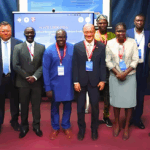
The 7th International Symposium on West African Studies (ISWAS) was recently held at the Ghana Institute of Management and Public Administration (GIMPA) with a bold charge: move Artificial Intelligence (AI) from theory to a tool for equity, empowerment, and resilience across West Africa.
The symposium, themed Sustainable Economic and Social Development in West Africa: AI Empowerment and Innovation, is a collaboration between the University of Electronic Science and Technology of China (UESTC), GIMPA, and the University of Cape Coast (UCC).
In a keynote that blended diplomacy with economic urgency, Chinese Ambassador to Ghana Tong Defa said AI’s value lies in real applications.
He urged delegates to imagine a near future where digital infrastructure transforms Ghana’s output.
“Let’s imagine: what if AI technology is widely applied in Tema Port, in the cultivation of cassava and cocoa, and in the construction of the Volta Economic Corridor?” he asked.
He said such integration would greatly boost national productivity.
He further linked the discussion to outcomes from the recent FOCAC Summit and reaffirmed China’s commitment to helping developing nations bridge the intelligence divide so West Africa gains a stronger voice in global AI governance.
GIMPA Rector, Prof. Samuel Kwaku Bonsu, welcomed participants with a reflection on the symposium’s journey since 2017.
He said the GIMPA–UESTC partnership has grown beyond academic exchange into cultural integration.
He expressed hope that AI will become a key driver of sustainable development across West Africa and that the symposium will spur deeper cooperation and capacity building.
Representing the Acting Vice-Chancellor of UCC, Professor Rosemond Boohene, warned that technology must not be adopted solely for speed.
She stressed the need for high-level digital skills to unlock the region’s demographic advantage and to respond to vulnerabilities such as climate shocks and educational gaps.
She said West Africa must position itself not just as a participant but as a leader in AI-driven transformation.
Prof. Shurong Zhao, Director of the Centre for West African Studies at UESTC, outlined the conference’s research agenda, including studies on risks in China–West Africa e-business collaboration and how they can be addressed.
In another keynote, Prof. Nora Ann Colton of the University College London’s Global Business School for Health spoke on how AI is addressing healthcare challenges in the United Kingdom and how similar solutions could be adapted for West Africa.
Touching on the public sector, the Head of the Local Government Service, Dr Nana Ato Arthur, urged stronger AI policy governance and ethical regulation across public institutions.
Professor Rosemond Boohene, in a technical presentation, lamented the absence of a strong West African context in global AI development. She called for greater support to build an AI ecosystem owned and shaped by West Africans.
After the main presentations, the symposium broke into six parallel seminars, with over 65 scholars discussing big data analytics in public administration, national security, social governance, and methods for preserving West African cultural heritage through digital technology.
The symposium was held with strategic support from the Ghana Chinese Chamber of Commerce and the Centre for West Africa Studies (CEWAS).
The Centre for West African Studies of UESTC was jointly established by UESTC, the University of Ghana, UCC, GIMPA, AAMUSTED, and the University for Development Studies in 2017.
The event was also co-hosted by Global Afrisino, highlighting the private sector’s growing role in digital capacity building.
Organisers say the 8th ISWAS will be even bigger as it forms part of the 2026 China–Africa Year of People-to-People Exchange.