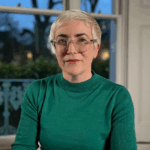
A leading academic, who led a recent government review into sex and gender data collection, has threatened legal action against the University of Bristol, claiming it failed to protect her freedom of speech.
Prof Alice Sullivan has also written to the university regulator, the Office for Students, after a trans rights protest disrupted a talk she gave at the university.
Universities have a legal duty to uphold the right to free speech, while balancing that with the right to protest by those who object.
The University of Bristol rejected her claims and said the talk went ahead safely – despite “unacceptable disruption” – in line with its “strong commitment to upholding free speech”.
Universities have a longstanding legal duty to protect the rights of staff, students and visiting speakers to express views which others might find offensive.
That has come into sharper focus with a new freedom of speech law in higher education, which came into force in August in England.
The University of Bristol said every action it had taken was in support of free speech.
Prof Sullivan’s review for the government, published in March, recommended that data on biological sex and gender identity should be recorded as distinct categories.
She said she was first invited to speak about her work by an academic at the University of Bristol in July 2024, and agreed to an event that autumn.
In a new letter to the university, which warns she is willing to bring a legal challenge, Prof Sullivan said the university had first suggested the event was held online rather than in person.
When asked by the BBC why she had rejected that offer, Prof Sullivan said she did not realise what the scale of potential protests would be, but accepted that some people might have strongly opposing views on gender identity and had the right to express them.
“Everyone has a right to peaceful protest, but that must never amount to a heckler’s veto, which means shutting down other people’s right to speak,” she said.
“This isn’t just about my rights as a visiting speaker, this is about the rights of the university community to hold discussions and to have people come and listen.”
After further delay, the event was scheduled for 22 October 2025.
As Prof Sullivan arrived, some attendees filmed the protest on their phones at the front of the building.
Videos – seen and verified by the BBC – show some of the protesters making rude gestures as others held signs.
Prof Sullivan told the BBC it was like a “zombie apocalypse” as some protesters pressed up against the window with placards and loudhailers.
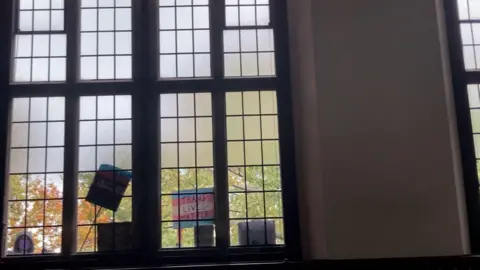
The fire alarm was set off more than once, disrupting the talk, until security staff advised them to move to a higher floor.
As she left after the event, Prof Sullivan said she heard “howls of ‘shame on you, shame on you’”.
The police told the BBC they had attended the event and said no arrests had been made.
The letter now sent by Prof Sullivan’s lawyers says the University of Bristol had 15 months to find a secure location on campus for the talk.
It adds that documents disclosed by the university reveal that there had been complaints by its LGBTQ+ staff network about her speaking.
Prof Sullivan says she has raised many of her concerns with the Office for Students, which, as the regulator of universities in England, has the power to fine institutions if they fail to uphold freedom of speech.
Earlier this year, the OfS handed out a record fine of £585,000 to the University of Sussex, warning that its transgender and non-binary inclusion policy had a “chilling effect” on freedom of speech.
Kathleen Stock had previously left her job as professor of philosophy at Sussex following protests against her gender-critical views, which generally say that a person’s sex cannot be changed and takes precedence over their gender identity.
Following the Sussex fine, the University of Bristol withdrew a similar policy, which said all staff were responsible for removing “transphobic and anti-trans material” from campus.
In August, a new freedom of speech law came into force, strengthening universities’ legal obligations to uphold freedom of speech.
The government has not yet brought in the complaints process promised as part of the stronger powers.
Prof Sullivan has told Arif Ahmed, the OfS’s director of free speech, she is concerned that “gender ideology” led to Bristol’s “actions to obstruct and frustrate my talk”.
She told the BBC that senior managers at the university “could have apologised, and they could have said we intend to do better in future”.
“That is what I want from them,” she said.
A University of Bristol spokesperson said the talk went ahead safely and in line with its “strong commitment to upholding free speech”.
“Although protesters caused unacceptable disruption, appropriate measures were in place to enable the event to continue and to protect the speaker and attendees,” they said.
The university added that the vice-chancellor had subsequently met with Prof Sullivan.
“We refute claims that we failed to protect her freedom of speech; every action we took was in support of this, and the restrictions she outlines were all necessary for public safety,” the spokesperson said.
“Our stance is clear – free speech must be lawful. There is no protection within the law for abusive speech that incites violence, harassment or discrimination.
“Clearly, the intimidating behaviour of protesters was not peaceful, and we have condemned their unacceptable behaviour.
“We will take disciplinary action if anyone from the university community is identified as being involved.”