A quiet shift appears to be unfolding within Ghana’s insurance market—one that has largely escaped public debate, parliamentary scrutiny, or formal policy announcement. Yet, as with many structural changes, its impact is becoming visible through official correspondence rather than public pronouncements.
On December 11, 2025, the State Interests and Governance Authority (SIGA) issued a directive to state insurers, followed by a series of engagement expectations directed at state-owned enterprises and other specified entities. While the language of the communication was measured, its intent was clear.
State institutions were being encouraged to prioritise their insurance placements with state-linked firms, notably SIC Insurance PLC and SIC Life Insurance Ltd—signalling a potential shift in how public sector risk is being allocated.
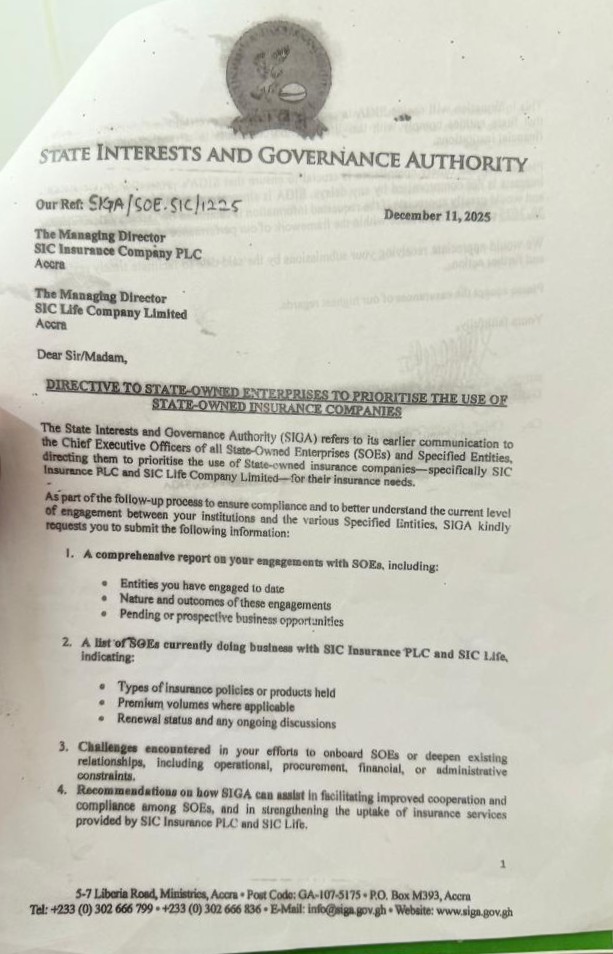
Within weeks, the signal began to ripple through the system. Correspondence followed, engagements intensified, and, more notably, behaviour started to shift.
One such example is a letter from SIC Life Insurance Ltd, dated December 23, 2025, and addressed to GIHOC Distilleries. The communication does not stand alone. It makes direct reference to guidance from the Ministry of Finance and the State Interests and Governance Authority (SIGA), while urging that the company be “favourably considered” during the institution’s policy renewal process.
Although presented as a routine commercial request, the appeal is clearly framed within the context of policy direction, underscoring how administrative signals can influence market decisions.
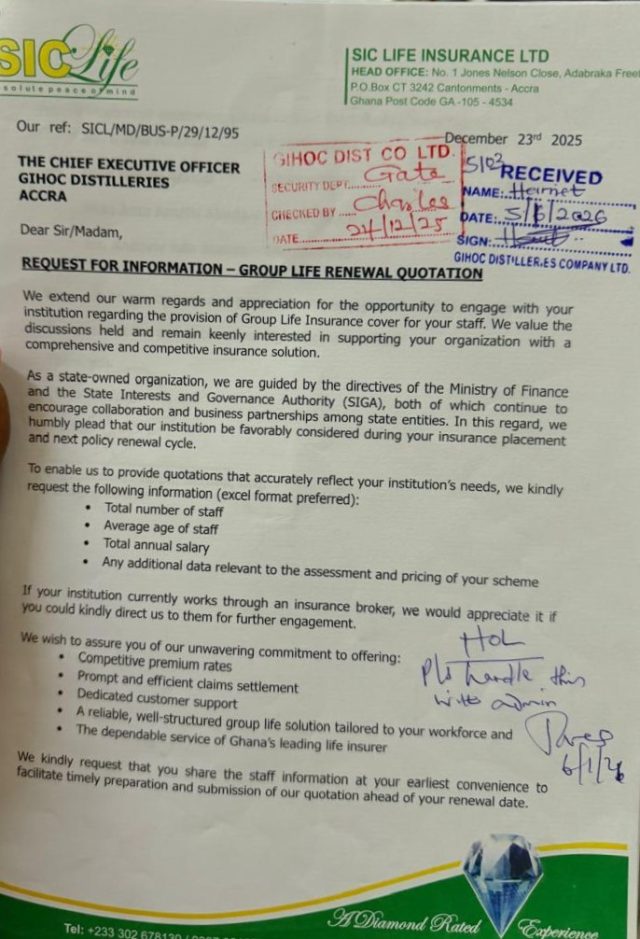
That distinction matters. Because in a purely competitive market, no insurer needs policy backing to
In a competitive insurance market, companies typically differentiate themselves through pricing, underwriting strength, claims performance, and reinsurance capacity. But when policy direction begins to influence how contracts are awarded, the dynamics can shift significantly.
The scale of what is at stake is substantial. The State Interests and Governance Authority (SIGA) oversees a portfolio of more than 140 active entities, including 53 state-owned enterprises and 31 joint venture companies, spanning key sectors such as energy, finance, transport, and infrastructure. Major institutions like the Ghana National Gas Company, Volta River Authority, Ghana Revenue Authority, and Cocoa Marketing Company all manage complex, high-value risk portfolios—often running into hundreds of millions, if not billions, of cedis.
At this level, insurance goes far beyond retail transactions. It becomes a form of structured finance, determining which insurers take the lead, how local firms participate, which international reinsurers provide backing, and ultimately how risk is priced. Any shift in how these contracts are allocated can therefore have system-wide implications.
Ghana’s non-life insurance market itself remains competitive, though clearly stratified. Enterprise Insurance leads with about 30 per cent market share, while Star Assurance, SIC Insurance PLC, Hollard, and GLICO General operate within a narrower band of roughly 4 to 6 per cent each. The rest of the market is fragmented among smaller players, making it a competitive but concentrated landscape.
Within this structure, SIC Insurance PLC occupies a unique position. It is not the dominant private player, nor is it a typical state agency. As a publicly listed company, government holds a minority stake—around one-third—while the majority is owned by private and institutional investors. This creates a more complex dynamic when state-linked institutions are steered in its direction, as public business is effectively being channelled toward a commercially structured entity with mixed ownership.
This raises a broader governance question. The same state that oversees public enterprises through SIGA, shapes procurement direction through policy, and regulates the insurance sector via the National Insurance Commission, also holds an ownership interest in one of the market participants. While this arrangement is not inherently unlawful, it blurs the line between policy guidance and market interference.
The effects are already being felt across the industry. Some insurers report non-renewal of existing policies, reduced access to state-linked risk placements, and abrupt changes in engagement patterns. Concerns are also beginning to surface more formally.
GLICO General Insurance Ltd, led by A. Achampong-Kyei, has submitted a petition to the President, citing disruptions in established insurance placements, the reassignment of portfolios without competitive evaluation, and concerns over the role of third parties in international reinsurance arrangements. The petition also raises questions about market distortion and the neutrality of regulation.
Given GLICO’s longstanding presence and experience in complex underwriting—particularly in high-risk sectors like energy—its concerns carry weight. This is not simply about lost business; it points to a broader shift in how the market may be evolving.
Ghana has encountered similar patterns before. There was a time when state-linked insurers dominated public sector placements. Over the years, reforms were introduced to open up the market, improve pricing, and strengthen competition. That transition allowed firms such as Enterprise, GLICO, Hollard, and Star Assurance to grow their capacity and compete effectively, both locally and internationally.
Now, however, there are indications that the system could be tilting back—not through explicit legal changes, but through administrative influence. And when such influence is applied consistently across a system of this scale, its impact can mirror that of formal directives.
The issue, then, is no longer whether change is occurring—it is how and why. Is Ghana intentionally reshaping its insurance market to favour greater state-linked participation, or is the system gradually drifting in that direction without a clear policy decision?
If it is a deliberate shift, it must be justified transparently and grounded in law. If it is unintended, then it requires urgent scrutiny before it becomes entrenched.
For now, the evidence lies in emerging patterns, industry feedback, and growing concern. The next step is to move beyond observation to deeper examination—looking closely at how decisions are made, what legal frameworks apply, and where practice may be diverging from principle.
Because ultimately, this is not just about who wins contracts. It is about how those contracts are awarded—and what that says about the integrity of the system.