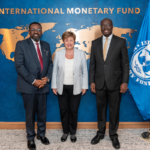
The Executive Board of the International Monetary Fund (IMF) has approved Ghana’s fifth programme review under the IMF supported programme.
This followed a meeting held on December 17, 2025, in Washington, DC, to assess key benchmarks and targets under the programme.
Joy Business understands that the board took this decision based on the significant progress Ghana has made under the programme in relation to the fifth review.
The staff report is expected to be released in the coming hours, providing further details on Ghana’s performance under the programme so far, as well as any concerns the Fund may have about the economy.
Passing the fifth programme review
The development could lead to the IMF Board authorising the disbursement of about $380 million to the Bank of Ghana.
Joy Business understands that the funds could hit the Bank of Ghana’s account before the end of 2025.
This expectation is based on Ghana’s current performance under the IMF programme and progress in meeting agreed reforms.
Impact and benefits
Market analysts say securing board approval would significantly boost donor and investor confidence, especially as the cedi continues to stabilise.
The decision is expected to send a strong signal to both local and international investors about Ghana’s commitment to fiscal discipline and adherence to IMF programme conditions.
Government officials have also assured the markets that fiscal discipline will be maintained even after Ghana exits the IMF programme in May 2026.
While concerns persist about the risk of unsustainable spending after the programme, sources insist that Ghana’s current performance demonstrates a strong commitment to prudent economic management.
To further strengthen investor confidence, the government is reportedly considering subscribing to one of the IMF’s policy instruments, though not a full programme.
Officials believe this would provide an additional signal of stability and reassure markets that fiscal discipline will be sustained.
The IMF has acknowledged Ghana’s progress in laying the foundation for post programme fiscal discipline.
Speaking at a press conference in Washington, DC, IMF Director of Communications Julie Kozack highlighted key reforms, including a revamped fiscal responsibility framework, the establishment of an independent fiscal council, and improvements in public financial management to enhance spending efficiency.
Staff level agreement and fifth programme review
On October 10, 2025, the IMF announced that it had reached a staff level agreement with Ghana after a two week mission to assess economic developments.
The agreement was subject to IMF management approval and executive board consideration.
Once the board review is completed, Ghana will gain access to SDR 267.5 million, approximately $385 million, bringing total IMF financial support since May 2023 to SDR 1,975.5 million, about $2.83 billion.
The IMF staff report also commended Ghana’s progress in key reform areas, including debt restructuring, fiscal consolidation, energy sector reforms, foreign exchange operations, and financial sector resilience.
“The authorities are making progress on debt restructuring, fiscal consolidation, energy sector reforms, foreign exchange operations, and financial sector resilience,” the report noted.