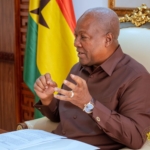
When President John Dramani Mahama ascended the dais on the seventh of January, 2025, to reclaim the mandate of the Republic, he did so not merely as a victor of the polls but as a signatory to a sacred social contract with a people weary of economic turbulence.
This was to be no ordinary term of office: it was the commencement of the Accra Reset, a sophisticated reengineering of the Ghanaian state designed to move beyond the survivalist paradigms of the past toward a future of resource sovereignty and institutional rectitude.
The Architecture of a Leaner State
In a masterstroke of administrative perspicacity, the President moved with characteristic dispatch to sign the Civil Service Executive Instrument 2025 just forty-eight hours after his inauguration.
By surgical reduction, the executive branch was streamlined from thirty ministries to a more potent twenty-three, a move projected to save approximately eighty-five million dollars for the national treasury over the quadrennium.
This was the first chord in a wider symphony of fiscal discipline, further underscored by a stringent Code of Conduct for public officials and a moratorium on the purchase of state assets by political appointees: actions that signalled the end of the era of impunity.
Macroeconomic Equilibrium and Global Validation
Under the steady hand of the administration, Ghana’s economic narrative has transitioned from one of distress to one of remarkable recovery.
The Fifth Review of the International Monetary Fund’s Extended Credit Facility concluded in December 2025 with a verdict of broadly satisfactory, unlocking a vital three hundred and eighty-five million dollar disbursement.
The metrics of this recovery are nothing short of extraordinary: headline inflation, which stood at a staggering twenty-three point eight percent at the end of 2024, plummeted to a single-digit six point three percent by November 2025, the lowest level witnessed since 2021.
The Ghana cedi, once a symbol of volatility, emerged in 2025 as one of the world’s most resilient currencies, anchored by a robust accumulation of gross international reserves, which swelled to over eleven billion dollars, providing nearly five months of import cover.
This domestic renaissance has been echoed in the hallowed halls of global finance, with S&P Global, Moody’s, and Fitch all bestowing sovereign credit rating upgrades upon the Republic, citing improved liquidity and reduced fiscal risks.
The 24-Hour Economy: A National Reawakening
Central to the President’s transformative vision is the 24-Hour Economy, officially inaugurated on the second of July, 2025.
Far more than a mere shift system, the 24 H Plus Agenda is a comprehensive eight-pillar strategy aimed at unlocking the nation’s latent productive capacity.
From the Make 24 initiative, which has seen the resurgence of the Akosombo and Juapong textile plants, to the Connect 24 transport corridors, the policy is meticulously designed to generate 1.7 million jobs and reduce transportation costs by nearly eighteen percent. It is a policy that seeks to decolonise time itself, ensuring that Ghana’s markets and industries remain alive and bustling at all hours.
Asserting Resource Sovereignty
A hallmark of this first year has been the uncompromising pursuit of resource sovereignty. The establishment of the Ghana Gold Board in March 2025 has already yielded a significant surge in foreign exchange inflows by formalising and regulating the precious minerals trade.
Furthermore, the administration displayed a rare and commendable commitment to transparency by withdrawing the Lithium Mining Agreement from Parliament following rigorous policy engagement with civil society.
This move ensured that the governance of Ghana’s critical minerals is grounded in feasibility studies rather than mere scoping, securing the maximum long-term value for the Ghanaian people.
The Social Compact and the Conscientious Citizen
The administration’s human-centred approach has found expression in a suite of social interventions that provide immediate relief to the vulnerable.
From the No Academic Fee policy for first-year tertiary students to the distribution of over six million sanitary pads to schoolgirls to combat period poverty, the dividends of democracy are being felt in every household.
Yet, as the president himself acknowledged, the path is not without its challenges. The decline in the 2025 WASSCE results and the eight-point-four-billion-dollar energy sector debt remain formidable obstacles that the administration is meeting with forensic audits and structural reforms.
The illegal mining crisis, described by the clergy as an ecocidal tragedy, continues to demand the collective resolve of the nation.
The Dawn of the New Ghanaian
In his first twelve months, President Mahama has proven that delivery is not just about action but about systems.
Through the Accra Reset, he is not merely fixing an economy: he is forging a New Ghanaian, the Conscientious Citizen who demands integrity, accountability, and excellence.
This is a performance that transcends the ephemeral whims of politics: it is the deliberate construction of a resilient, self-reliant Republic that will endure for generations to come.
Raymond Ablorh is a distinguished policy, research, strategy, and communication consultant with a career spanning over two decades of profound contribution to the national discourse. EMAIL: raymondablorh25@gmail.com