South Africa has deployed troops to several provinces to support overstretched police in tackling violent crimes, including illicit mining and gang activity.
Earlier this year, President Cyril Ramaphosa announced that 2,200 soldiers would be sent to the five provinces hardest hit by crime. Authorities say the deployment, planned to run for a year, aims to restore order in high-crime areas. However, critics caution that military involvement in civilian policing rarely produces lasting results.
Illicit mining and gang violence remain persistent problems in South Africa, which continues to rank among the countries with the highest murder rates globally. Official crime statistics from October to December 2025 indicate that roughly 71 people were killed each day.
The first group of soldiers was deployed to several parts of Gauteng Province, including Johannesburg, in March. A second, larger cohort began operations in the Eastern Cape, Free State, North West, and Western Cape provinces from 1 April.
In Eldorado Park, a Johannesburg suburb targeted in the initial deployment for its high levels of gang violence, residents expressed mixed feelings about the army’s presence.
Leola Davies, a 74-year-old pensioner, described the area as a “hell-hole to live in.”
“Sodom and Gomorra have nothing on this place. I stay indoors all day because I just don’t want to be the next victim. Things are getting worse,” she said.
Elviena le Roux, a mother of three, voiced skepticism, saying the military presence might worsen the violence.
“I don’t believe having the military here will help,” she told the BBC.
Ronald Rabie, 56, acknowledged that the soldiers make a temporary difference by creating a safer environment for families.
“Once they leave, things return to chaos – they need to be here permanently,” the father of three said.
While authorities remain hopeful that the deployment will curb crime, experts and residents alike are questioning whether a temporary military presence can address the deeper causes of violence in the country.
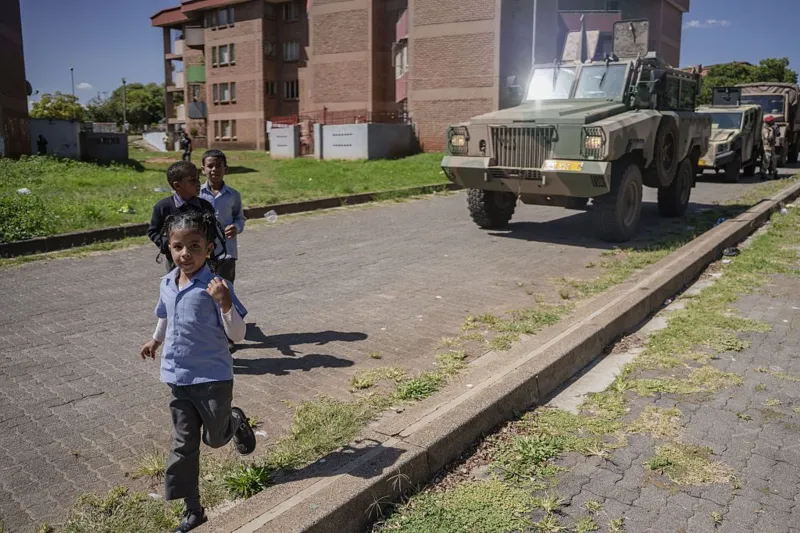
South African President Cyril Ramaphosa has once again deployed troops to tackle the country’s rising crime rates, a move that comes amid growing public debate over the military’s role in civilian policing.
This is not the first time the army has been called in. In 2023, over 3,000 soldiers were mobilised for six months to address illegal mining activities nationwide. In July 2021, troops were deployed to help contain deadly riots that erupted after the arrest of former President Jacob Zuma.
South African law allows soldiers to arrest civilians only in exceptional circumstances, and they must hand suspects over to the police immediately.
Experts, however, caution that the military is trained for combat, not for the community-focused policing needed to build public trust. The country’s history also adds layers of complexity: during apartheid, the army was used to enforce racial rule, a legacy that continues to shape how some South Africans view soldiers on their streets today.
Criminologist Guy Lamb told the BBC he doubts the current deployment will deliver lasting results. “Soldiers are not designed for policing; they are trained for combat and maximum force,” he said. “There’s a real risk they could escalate tense situations or act too aggressively.”
Lamb pointed to the army’s role during the Covid-19 pandemic as an example. At that time, soldiers enforcing curfews faced criticism for using excessive force, detaining civilians unlawfully, and engaging in harassment.
Authorities remain optimistic that the military presence will help reduce crime, but Lamb warns that without a clear strategy addressing the root causes of violence, crime is likely to spike again once the soldiers withdraw.
“So we’re likely to see this pattern continue,” he said, “because there is currently no plan to address why crime in these areas is so violent.”