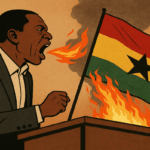
Ghana is not collapsing because we disagree. We are bleeding because we have forgotten how to disagree with dignity.
A nation can survive hard elections. A nation can survive fierce competition. But when our public conversation turns into a marketplace of humiliation—when “insult” becomes “strategy,” and “shame” becomes “content”—we begin to set fire to the very fabric that holds us together: family respect, community trust, and the moral authority of leadership.
That is why I call political insults a national security issue—not in the sense of silencing people, but in the sense of protecting Ghana’s social peace. A country is not only defended by the police, the military, and the courts. It is defended by norms: what we refuse to say, what we refuse to applaud, and what we refuse to forward.
When insults enter politics, they don’t stay in politics
Words do not die on the radio. They migrate.
They travel from the studio to the trotro. From Facebook Live into the market. From party meetings to school compounds. From WhatsApp groups to family dining tables. Then, quietly, they become culture.
Today, a young person can quote a politician’s insult more easily than a politician’s policy. That is not a sign of “vibrant democracy.” It is a sign of moral confusion—when our national debate trains the youth in aggression more than in ideas.
And the evidence that our airwaves are being polluted is not speculation.
The Media Foundation for West Africa (MFWA), in a consolidated monitoring report covering June 1, 2024, to February 28, 2025, recorded 814 cases of indecent expressions across 30 radio stations, with election-related issues accounting for 50% (408 cases).
In just July 2024, MFWA recorded 62 incidents on selected stations; Accra FM alone recorded 34 (about 55%), and the most common category was insulting and offensive comments.
If we can measure it, then we must stop pretending it is normal.
The lie we tell ourselves: “It’s just talk”
Ghanaians are wise people, and our traditions understand the power of speech. In the old days, the okyeame (linguist) was not only a speaker; he was a gatekeeper of peace. He knew that one careless sentence could break a stool, split a clan, and spark a feud that lasts generations.
So when we excuse political insults as “just talk,” we are rejecting our own ancestry. We are mocking the very wisdom that kept communities stable long before modern political parties existed.
The National Peace Council has warned about hate speech and indecent expressions and has even produced guidelines to help “sanitise the airwaves” from needless verbal attacks and discriminatory speech.
This is not about being “soft.” This is about being safe.
The pipeline: insult → polarization → intimidation → violence
Not every insult becomes violence. But every violence begins with a mindset—one that dehumanises the opponent and trains supporters to see fellow citizens as enemies.
That is why peacebuilding institutions treat toxic political language as an early warning sign. In October 2024, Ghana’s National Peace Council identified 36 critical hotspots where electoral violence could erupt and intensified engagement in selected areas.
And it is also why Ghana’s political parties, under the Peace Council’s aegis, signed a code of conduct on vigilantism and election violence in July 2024 and inaugurated a monitoring commission to oversee compliance.
You do not wait for fire before you respect water.
The hidden victims: families and the youth
Political insults don’t only attack opponents. They poison families.
When public figures model disrespect, it permits disrespect at home. A father who insults his political opponent easily insults his spouse. A youth who learns “winning” through ridicule struggles to build healthy friendships, marriages, and workplaces.
And when insults become entertainment, empathy becomes weakness.
We must ask ourselves: What kind of Ghana are we training—one that can debate, or one that can only disgrace?
Our children are watching. The most dangerous lesson they can learn is this: “If you can insult well, you can lead well.” That is how nations replace competence with noise.
Free speech is not free violence.
Yes, Ghana’s Constitution protects freedom of speech. But our democracy was never designed to be a free market of degradation.
Even regulators are warning that the media space is drifting into dangerous territory. For example, the National Media Commission (NMC) has publicly cautioned media outlets about offensive content and indicated readiness to impose penalties for violations.
And the concern is broader than politics alone: in October 2024, the NMC cited 44 TV stations for broadcasting unethical, indecent, and offensive content, and warned that sanctions could be on the table if decency is not upheld.
A free press is a democratic asset. But when platforms become megaphones for humiliation, they stop serving democracy and start sabotaging it.
So what must Ghana do—practically, not poetically?
We need a national reset—simple, enforceable, and culturally rooted.
1) Political parties must treat insults as misconduct, not “communication.”
Every party should publicly adopt a Decency Code for spokespersons, serial callers, and social media activists: clear sanctions, suspension from media rounds, and public apology protocols. If we can discipline people for financial misconduct, we can discipline people for verbal recklessness.
2) Media houses must stop outsourcing moderation to “vibes.”
A strong host does not laugh when guests cross the line. A strong producer does not keep “ratings” as a god. Adopt and enforce zero-tolerance rules on hate speech, tribal slurs, and dehumanising language—especially during peak political programming. MFWA’s monitoring repeatedly points to moments where indecent expressions go unchecked, which escalates tension.
3) Citizens must stop funding disrespect with attention.
If we stop sharing insults, insults will lose market value. If we stop cheering humiliation, humiliation will lose political usefulness. The simplest civic action today is this: refuse to forward what you would not want said about your mother, your tribe, your faith, or your child.
4) Traditional and religious leadership must “reclaim the microphone.”
Chiefs, queen mothers, pastors, imams, and family heads should make public decency part of community discipline again—especially in hotspots and politically tense constituencies. Peace is not only negotiated in Accra; it is enforced in towns, clans, and households.
5) Teach civic debating again—especially in schools.
The NCCE has consistently cautioned against insults and hate speech and continues sensitisation efforts, including with students, because the next generation must inherit skill—not rage.
The patriotic test: can we oppose without poisoning?
You can criticise a government without cursing its supporters. You can expose wrongdoing without insulting someone’s family. You can campaign hard without stripping opponents of dignity.
That is not a weakness. That is Ghana.
If the tongue burns the flag, the country does not need louder tongues—it needs wiser ones. Our politics must return to persuasion, evidence, and vision. Ghana is too precious to be reduced to insults.
Let us not become a nation where the loudest mouth wins, and the wisest voice hides.
Because when political insults become normal, the future becomes unsafe—not only for politicians, but for families, for classrooms, for markets, and for the fragile trust that makes Ghana.
–
The writer, James Faraday Odoom Ocran, is an educator and public-sector professional with a deep interest in civic values, social cohesion, and ethical leadership in Ghana, an HR management and development practitioner, writer, and AI and intelligent orchestrator trainer & education consultant. Can be reached via ocranodoomfaraday@gmail.com