The Design and Technology Institute (DTI) has officially broken ground on a $28 million Multi-Skills Campus at Berekuso in Ghana’s Eastern Region, a landmark initiative set to transform technical and vocational education across the country and the continent.
Hailed as a future Centre of Excellence, the campus aims to address Ghana’s widening skills gap while positioning the country as a hub for workforce development. Spread over 11.29 acres in the scenic Akuapem Hills, opposite Ashesi University, the campus is designed to accommodate 1,500 residential students annually and train up to 3,500 learners each year when fully operational. It will serve as a Pan-African centre, bridging the divide between classroom theory and industry practice.
The groundbreaking drew senior government officials, traditional leaders, industry stakeholders, diplomats, and development partners, highlighting the national significance of the project. Speaking at the ceremony, Minister for Youth Development and Empowerment, George Opare Addo, emphasized the persistent disconnect between education and industry in Ghana.
“Every year, 300,000 young people enter the labour force, yet employers continue to struggle to find skilled talent,” he said. “The challenge is not a lack of ambition among our youth, but the absence of practical, industry-relevant training that meets the needs of employers.”
DTI Founder and President, Constance Elizabeth Swaniker, described the project as a defining milestone in the institute’s decade-long journey to revolutionize skills training in Ghana. She explained that DTI was established in response to a growing skills gap observed in the manufacturing sector and has since focused on delivering hands-on, industry-driven education.
Starting with just 32 students in 2019, DTI has expanded to six campuses nationwide, training more than 48,900 young people and supporting over 81,000 into employment or meaningful work, with pass rates exceeding 90 per cent. Female participation has risen dramatically, from 21 per cent to over 50 per cent, while partnerships with more than 160 industry players have strengthened pathways into the workforce.
Despite these achievements, demand continues to outstrip capacity, with over 4,000 applications received in 2025 alone. The Berekuso Multi-Skills Campus is therefore a crucial expansion to meet growing interest in technical and vocational education and to equip Ghana’s youth with the practical skills needed for the future.
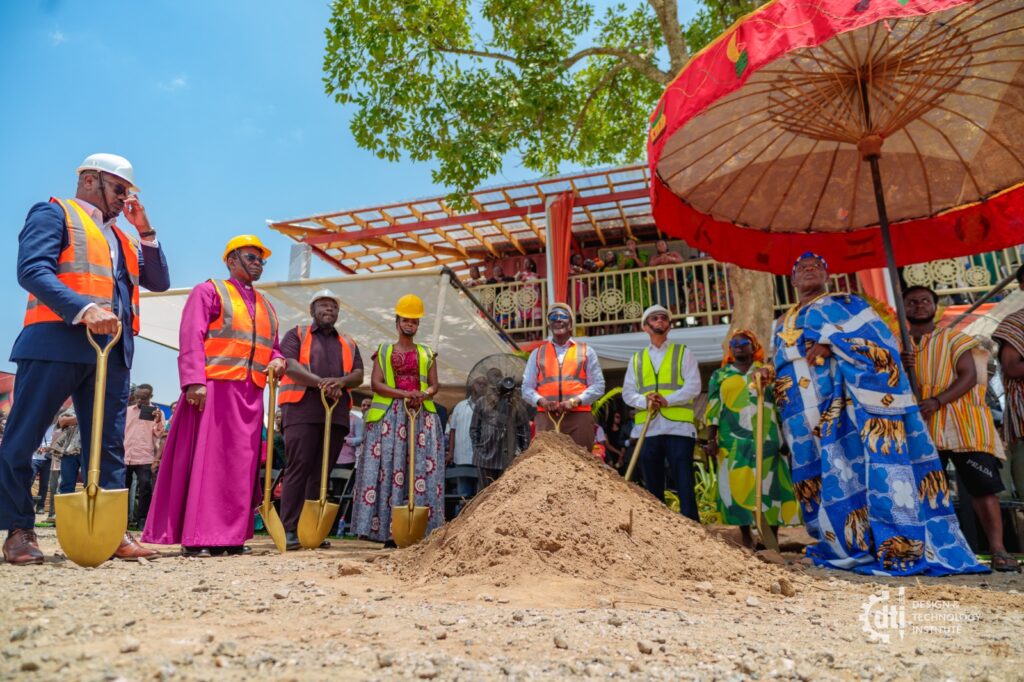
The first phase of the Berekuso Multi-Skills Campus is underway, supported by a €3 million grant from the African Union’s Skills Initiative for Africa, with additional financing from KfW. The project is expected to be completed within 24 months.
The new campus will feature two three-storey academic blocks, a two-storey administrative block, a 160-booth welding and fabrication workshop—touted as the largest in Ghana—advanced non-destructive testing laboratories, industrial training spaces, a student centre, an amphitheatre, and facilities open to the community. New programmes will include industrial plumbing, industrial electrical systems, cleaning science, and agricultural mechanisation.
Corporate Ghana has also stepped in to support the initiative. Fidelity Bank Ghana contributed $100,000 toward the student centre and pledged ongoing support through financial literacy programmes, entrepreneurship training, and access to financial services to help students transition into sustainable careers. The Ghana Ports and Harbours Authority and Modec Production Services Ghana Ltd. provided materials to assist construction.
Local traditional leaders, including Odeɛfoɔ Oteng Korankye II and Osabarima Nana Ansah Sasraku III, endorsed the project, describing it as a significant investment in both the youth and the broader development of the Berekuso community.
Ms. Abiola Swaniker, speaking at the launch, called for stronger partnerships between government, the private sector, and development organisations. She urged stakeholders to contribute through scholarships, equipment donations, and employment pathways for graduates.
“This project is bold and ambitious. Let us move from support to partnership,” she said, adding that Africa’s future will be shaped not by potential alone, but by deliberate investments in skills and human capital.
Fidelity Bank Ghana Managing Director Julian Opuni highlighted the global skills mismatch, noting that while around one billion young people are expected to enter the workforce over the next decade, only about 460 million jobs will be available. He stressed that DTI’s approach focuses on building real capability, equipping young people with the skills to secure or create meaningful employment.
The Berekuso Multi-Skills Campus is expected to play a pivotal role in preparing Ghana’s workforce for the future, addressing youth unemployment, and bridging the skills gap in critical sectors of the economy.