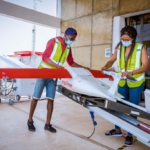
The United States Government has announced a significant financial commitment of up to $150 million to support the expansion of Zipline International Inc.’s drone delivery network, which provides life-saving medical supplies across Africa.
The funding aims to dramatically increase access to essential items—including blood products, vaccines, and critical medicines—to as many as 15,000 health facilities across five partner countries: Ghana, Côte d’Ivoire, Kenya, Nigeria, and Rwanda.
The commitment, announced during a U.S. Embassy digital press briefing on Tuesday, December 2, 2025, is central to Washington’s updated global health strategy.
America First Global Health Strategy
The support is a key component of the new U.S. Department of State’s America First Global Health Strategy, designed to maximise value for American taxpayers.
The strategy prioritises reducing waste, eliminating dependency on foreign aid, and ensuring development assistance aligns with U.S. foreign policy goals.
Jeff Graham of the U.S. Department of State emphasised that partnering with Zipline, an American robotics and drone-technology company, is critical to modernising the U.S. approach to global health.
“He said partnering with Zipline, an American robotics and drone-technology company, is central to modernising the U.S. approach to global health.”
Under the agreement, the U.S. will help scale Zipline’s advanced robotics to overcome slow and unreliable logistics challenges that have historically prevented timely access to essential health supplies in remote and underserved rural communities.
Graham highlighted the dual benefit of the initiative:
“Graham described the initiative as a major step toward strengthening health systems’ ability to respond to disease outbreaks and emergencies while also supporting U.S. manufacturing and creating jobs across partner countries.”
Projected Impact: 130 Million People Reached
The investment is expected to spur massive growth in Zipline’s operational footprint across the continent. Zipline is slated to open new distribution centres across the five participating nations. Rwanda, for example, is projected to double its daily delivery capacity.
Ultimately, the expanded network is projected to reach up to 130 million people in Africa.
This national-scale rollout is expected to generate significant economic returns, with projections indicating the creation of an estimated 1,000 jobs and the generation of more than $1 billion in annual economic gains across partner nations. The expansion is also supported by organisations such as the Elton John AIDS Foundation.
Caitlin Burton, CEO of Zipline Africa, detailed the company’s technology and overarching mission:
“Chief Executive Officer (CEO) of Zipline Africa, Caitlin Burton, explained that Zipline operates autonomous, all-weather drones day and night, providing a centralised, on-demand medical supply chain far more efficient than traditional logistics systems.”
The Sustainability Model: From Aid to Ownership
While the U.S. is providing the initial capital injection, Mr. Graham stressed that the long-term sustainability model requires beneficiary governments to eventually assume full operational responsibility for their national health-delivery networks.
Ms. Burton explained that the model allows countries to replace multiple expensive, disease-specific programmes with one unified delivery infrastructure that tackles various health challenges simultaneously.
“She stressed that while the U.S. provides initial capital support, governments eventually cover the fixed and predictable long-term operating costs.”
She asserted that the network’s comprehensive design is aimed at achieving national health goals:
“This system is meant to operate nationwide and at the scale required to deliver volumes of medical products that can actually change health outcomes. We now know how to solve challenges like maternal mortality and malnutrition, and the network is built to meet those goals.”
By unifying the logistics chain, the system ensures that medical products reach all patients, even in remote areas where “distance or stigma might prevent people from seeking care,” Ms. Burton noted.
The government investment level, she added, “will reflect national priorities and their commitment to building responsive, agile, and resilient health systems.”