When a central bank cuts interest rates while simultaneously withdrawing billions of cedis from the financial system, it’s natural to wonder: are these policies working against each other?
This question has arisen in the context of recent actions by the Bank of Ghana. Over the past several months, the central bank has gradually reduced the policy rate while intensifying efforts to absorb excess liquidity from the system. The latest rate cut—from 15.5 percent to 14 percent—highlights a consistent strategy: easing borrowing costs while continuing large-scale liquidity management.
The scale of this effort is significant. The Governor recently revealed that in 2025 alone, the Bank absorbed roughly GH₵17 billion in excess liquidity.
At first glance, this combination may seem counterintuitive. Lower interest rates typically signal liquidity injection, while sterilization removes cash—and often at a cost. So why pursue both simultaneously? The answer lies in the way monetary policy works: through multiple channels, each targeting a distinct objective.
Easing Rates: Supporting Credit and Growth
The data is clear. Interest rates across the economy have fallen sharply. The interbank rate dropped from over 27 percent in early 2025 to about 12.6 percent by February 2026, closely following the downward trajectory of the policy rate. Treasury bill yields and lending rates have mirrored this trend, while the Ghana Reference Rate fell from 32.17 percent in January 2024 to roughly 11.7 percent, confirming that monetary easing is effectively lowering borrowing costs across the economy.
Tightening Liquidity: Preserving Stability
At the same time, liquidity indicators tell a different but equally important story. System-wide liquidity has been steadily tightening. Commercial banks’ reserves held at the Bank of Ghana—a key measure of available liquidity—declined from over GH₵74 billion in early 2025 to about GH₵60.8 billion by February 2026. The growth rate of these reserves has been largely negative since mid-2025, indicating sustained absorption.
Broader monetary aggregates reinforce this picture. Growth in total liquidity (M2+) has slowed, averaging below 20 percent over the past year, a clear moderation from earlier rapid expansion.
Two Channels, Two Objectives
In essence, these actions are complementary rather than contradictory. Rate cuts lower the cost of credit and stimulate private sector activity, while liquidity absorption protects the cedi and reduces inflationary pressures tied to excess cash in the system.
By carefully coordinating these tools, the Bank of Ghana is supporting economic recovery without compromising financial stability—a delicate balancing act that illustrates the complexity of modern monetary policy.
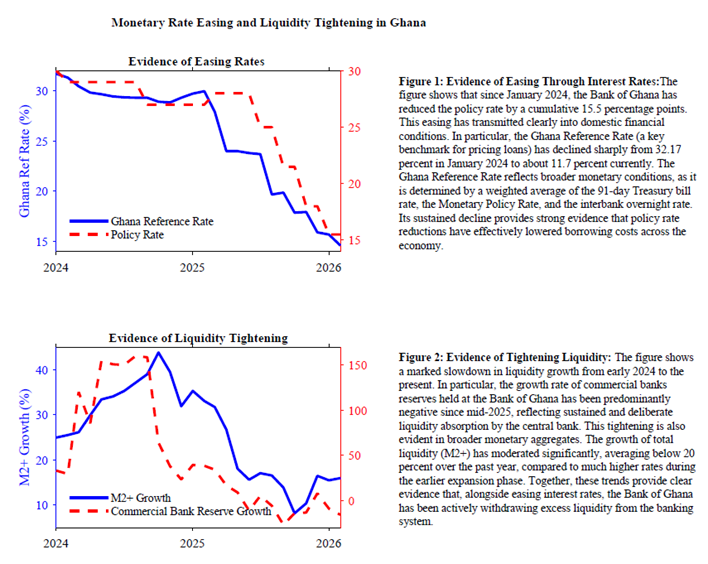
Recent developments in Ghana’s monetary policy point to two trends happening at the same time: interest rates are coming down, making borrowing cheaper, while liquidity is being tightened, reducing the amount of cash circulating in the system.
At first glance, these moves may seem contradictory. In reality, they reflect a deliberate and coordinated policy approach by the central bank, using different tools to achieve separate—but related—objectives.
Two Channels, One Strategy
Monetary policy works through multiple channels, and each serves a specific purpose.
Supporting Recovery Through Lower Rates
The policy rate directly affects the cost of borrowing. With inflation easing to around 3.3 percent, maintaining very high interest rates is no longer necessary. Lowering rates helps ease financing conditions, encourages private sector activity, and supports economic recovery.
Maintaining Stability Through Liquidity Control
At the same time, the central bank is dealing with excess liquidity built up during the 2022–2023 economic crisis. In Ghana’s case, too much liquidity can quickly spill into the foreign exchange market, increasing demand for dollars and putting pressure on the cedi.
To manage this risk, the Bank of Ghana is withdrawing surplus liquidity through sterilisation measures. This helps absorb excess cash, limit speculative demand for foreign currency, and stabilise the exchange rate.
Why Both Actions Matter
Some may ask: if lowering rates adds liquidity and sterilisation removes it, why not do neither?
The answer lies in how these tools function. They are not substitutes—they operate on different parts of the economy.
The policy rate determines the price of short-term funds, while liquidity management controls how money flows through the system, especially in sensitive areas like the foreign exchange market.
If neither action were taken, borrowing costs would remain unnecessarily high, excess liquidity would continue to circulate, and pressure on the exchange rate could return. In such a scenario, the economy would face both tight credit conditions and renewed instability.
Lessons from the United States
A similar approach has been seen in the United States. As inflation declined, the U.S. Federal Reserve began cutting its policy rate—from 5.25 percent in September 2024 to about 3.5 percent by December 2025.
At the same time, it continued its programme of quantitative tightening, reducing its balance sheet from roughly $7.1 trillion to $6.5 trillion.
In effect, the Fed lowered the cost of borrowing while simultaneously reducing excess liquidity created during earlier stimulus efforts. This dual approach was widely seen as a coordinated strategy, not a contradiction.
A Deliberate Balancing Act
The Bank of Ghana is applying a similar logic, adapted to local conditions. Its approach reflects careful calibration rather than inconsistency.
By lowering interest rates, it aims to support growth and recovery. By withdrawing excess liquidity, it seeks to protect the cedi and maintain macroeconomic stability.
Conclusion
What may appear contradictory on the surface is, in fact, a balanced policy mix. The central bank is navigating a complex transition—from stabilisation to recovery—by using multiple tools at once.
Lower rates help ease the cost of credit and stimulate economic activity. Tightening liquidity, on the other hand, safeguards the currency and prevents inflationary pressures from returning.
The challenge for policymakers is not choosing between easing and tightening, but knowing where to apply each. In that sense, the current approach is not a contradiction—it is a carefully managed balancing act.