Sport and fashion have long influenced each other, shaping trends across generations.
In the early 20th century, French tennis figures such as Jane Régny and Suzanne Lenglen helped bring style into sportswear. Decades later, Bruce Lee popularised the tracksuit in the 1970s, while in the 1990s Michael Jordan transformed basketball sneakers into a global fashion statement.
In each of these cases, the influence was intentional, with athletes and icons consciously shaping how sportswear was seen. The story of German coach Otto Martin Pfister, however, unfolded quite differently.
Ask many people on the streets of Ghana who Otto Pfister is, and the answer may not be about the man himself, but rather what his name has come to represent. Over time, his identity became closely tied to a cultural reference that extended far beyond football.
When Pfister arrived in Ghana in 1991, his focus was firmly on football success, with little indication of the wider cultural impact he would eventually have.
By then, he already had experience on the continent, including leading Burkina Faso (then Upper Volta) to their first Africa Cup of Nations qualification in 1978 during one of his earlier coaching roles.
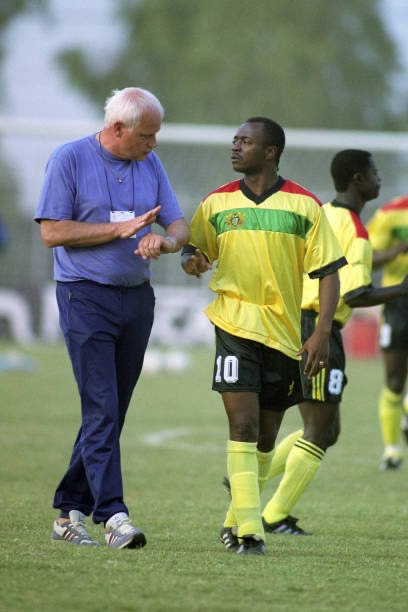
However, his assignment with Ghana’s Black Stars proved to be his most high-profile challenge. Heading into the 1992 Africa Cup of Nations, he worked with a talented squad that included some of Africa’s biggest names, such as Abedi Pelé and Bundesliga forward Anthony Yeboah.
Expectations were high, and there was strong confidence that he could guide Ghana to a fifth Africa Cup of Nations (AFCON) title. The team went on to reach the final in Senegal but ultimately fell short.
Disappointed by the outcome, he stepped down from his role a few months later, leaving behind a legacy that, somewhat unexpectedly, extended beyond football. In an ironic twist, much of the public memory associated with him had little to do with his coaching achievements, but rather his distinctive way of dressing, particularly how he wore his trousers.
During the early 1990s, a particular style of dressing emerged in different parts of the world for varying reasons, yet it sparked similar reactions in society wherever it appeared.
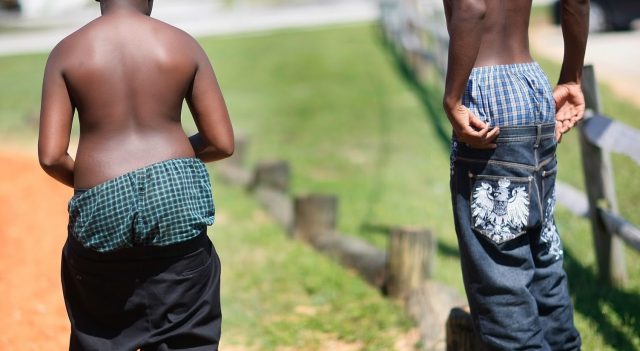
Sagging gradually became a popular fashion trend among some young Black men in both the United States and Ghana.
In the United States, one of the commonly cited origins of the style is linked to the prison system. Inmates were often not allowed to wear belts, which led them to wear their uniforms loosely. After their release, some carried that style into everyday life.
Over time, the trend gained wider visibility, especially with the rise of hip-hop culture, which helped push the look further into mainstream youth fashion during that era.
In Ghana, however, the trend took on a different and unusual reference point—former Black Stars coach Otto Pfister.
Before managing the senior national team, Pfister had already achieved success with Ghana’s U-17 team, the Black Starlets, leading them to their first FIFA U-17 World Cup title in 1991. Ironically, his public profile became even more prominent after Ghana’s unsuccessful 1992 Africa Cup of Nations campaign.
Known for his outspoken and eccentric personality, Pfister often attracted media attention, sometimes for reasons beyond football itself. Over time, his distinctive way of dressing was loosely linked to a fashion style that gained popularity among young people, becoming part of a broader cultural conversation around appearance and identity.
After Ghana’s impressive U-17 World Cup success in 1991, the team’s coach, Otto Pfister, made a bold remark about the quality of his young players, claiming they were “technically more advanced than any mid-level player in the Bundesliga.”
However, for many Ghanaians at the time, Pfister became more widely remembered for something far less technical—his style of dressing, particularly the way he wore his trousers.
Reports suggested that Pfister, who had a relatively slim waist, often struggled to find properly fitting trousers. As a result, he reportedly wore them lower on the hips rather than at the waist, creating the appearance of sagging when viewed from behind.
That unintended look quickly caught on in Ghana and became popularly referred to as the “Otto Pfister style.”
Among young people, the trend evolved into a fashion statement. Many began wearing trousers below the waistline, adopting what was seen as a rebellious or “bad boy” look inspired by the coach’s perceived non-conformist style.
Some even went further, deliberately sewing trousers a few inches larger than their waist size in order to achieve the desired effect, commonly referred to as “doing Otto Pfister.”
Despite its popularity among sections of the youth, the trend was widely criticised by society at the time, with many viewing it as inappropriate and against acceptable dress standards.
Educational institutions and some corporate bodies in Ghana once strongly frowned on a popular fashion trend that came to be famously associated with former Black Stars coach Otto Pfister.
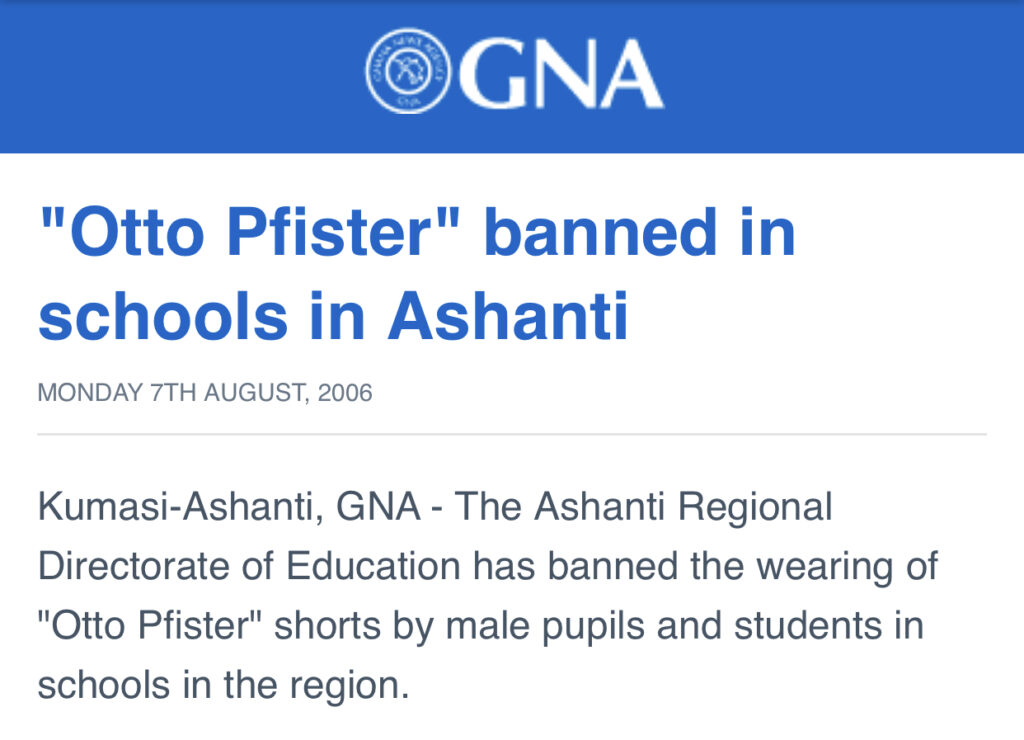
During the late 1990s and 2000s, it was common in many junior and senior high schools to hear the phrase “No Otto Pfister allowed” during assemblies, a warning used to discourage students from wearing sagging trousers that exposed underwear.
The trend became so widely referenced that in 2015, the Presbyterian University College in Ghana formally included it in its dress code regulations, banning what it described as the “Otto Pfister style” of dressing.
At the time, the then Acting President of the university, Prof. Frank S. Arku, reminded students that appearance mattered, stating that the way students dressed reflected their values and future prospects. He also pointed students to the institution’s handbook, which clearly outlined acceptable dress standards.
Although the name “Otto Pfister” was originally linked to the German coach’s unconventional dress style during his time in Ghana, it gradually evolved into a cultural reference for sagging trousers rather than the individual himself.
Ironically, when Pfister returned to Ghana in 2008 as coach of Cameroon during the Africa Cup of Nations, he once again found himself in the spotlight—this time after eliminating Ghana in the semi-finals. However, that sporting achievement did little to change the nickname that had already stuck in local school culture.
Over the years, the phrase has remained part of Ghanaian school folklore, symbolising a strict stance against indecent dressing.
While the trend has faded with changing fashion norms, the “Otto Pfister” reference remains a memorable example of how public figures can unexpectedly become part of everyday cultural language in Ghana.