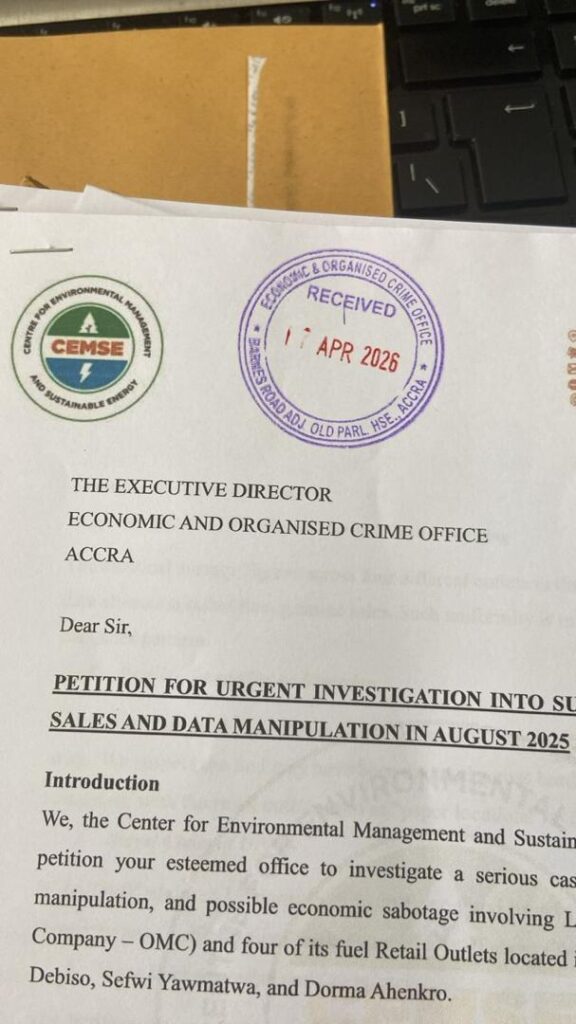
The Centre for Environmental Management and Sustainable Energy (CEMSE) has petitioned the Economic and Organised Crime Office (EOCO) to investigate suspected irregularities in fuel sales and possible subsidy fraud involving an oil marketing company, alleging that the state may have lost about GH¢2.5 million.
In a petition dated April 16, 2026, the policy think tank accused Life Energy, an Oil Marketing Company (OMC), of reporting unusually high fuel sales volumes across four retail outlets located in semi-urban and rural communities.
CEMSE’s Executive Director, Benjamin Nsiah, said the figures raise red flags about possible data manipulation, fuel diversion, and economic sabotage within Ghana’s downstream petroleum sector.
“These locations are not major industrial or high-traffic transit hubs,” he said. “Even if operations run 24 hours a day, selling about 44,650 litres daily at a single rural outlet is commercially difficult to justify without evidence of large-scale bulk off-take or possible fraud.”
According to the petition, Life Energy reportedly lifted more than 5.5 million litres of petroleum products from Rock Africa Limited in August 2025. It further claimed that four outlets—located in Sefwi Osei Kojokrom, Sefwi Debiso, Sefwi Yawmatwa, and Dormaa Ahenkro—each recorded average sales of 1,384,250 litres.
CEMSE argues that the identical sales figures across different locations appear suspicious and may indicate artificial allocation of data rather than actual retail demand.
The group also questioned whether the reported volumes reflect real consumption patterns, noting that the affected communities are not major industrial centres or key transport corridors.
It further suggested that if the figures were used to claim reimbursements under the Uniform Petroleum Price Fund (UPPF), the state could have suffered financial losses estimated at GH¢2.5 million.
CEMSE has therefore urged EOCO to compel Rock Africa Limited to provide loading manifests, delivery waybills, and GPS discharge records to verify fuel movements.
It is also asking investigators to obtain daily sales receipts and electronic tank gauge data from the outlets, conduct physical inspections to confirm storage capacity, and freeze relevant accounts if preliminary findings indicate fraud.
“The integrity of Ghana’s downstream petroleum sector is critical to national revenue and energy security,” Mr. Nsiah stated. “Allowing implausible sales figures to go unchecked would set a dangerous precedent and encourage economic crime.”
Copies of the petition have also been sent to the National Petroleum Authority (NPA) and the Chamber of Oil Marketing Companies (COMAC).
The development comes amid heightened scrutiny of the petroleum downstream sector, as regulators intensify efforts to curb fuel diversion, subsidy abuse, and illegal supply activities.