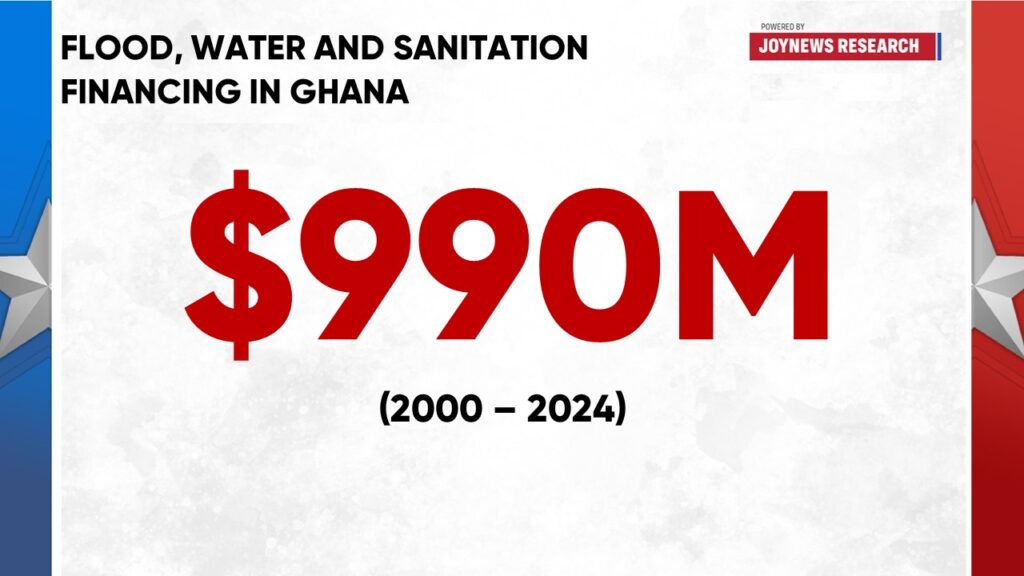
Nearly $1 billion in international financing has been invested in Ghana’s flood-control, sanitation and urban water infrastructure over the past two decades. Yet despite these substantial investments, the country—particularly the capital, Accra—continues to experience destructive floods that claim lives, displace residents and cause significant damage to property during almost every rainy season.
A review by JoyNews Research of official records from the World Bank, the African Development Bank (AfDB) and the African Water Facility reveals that Ghana secured approximately $990 million in major multilateral funding between 2000 and 2024 to support flood resilience, sanitation and water infrastructure projects.
Of that total, an estimated $723 million was directed specifically toward Greater Accra and the Greater Accra Metropolitan Area (GAMA), reflecting the urgency of addressing the capital’s long-standing vulnerability to flooding and inadequate sanitation infrastructure.
Nearly $1 Billion Invested Through 11 Major Projects
JoyNews Research traced the funding history over a 24-year period, identifying 11 major projects backed by the World Bank and the African Development Bank. The initiatives, which focused on improving water supply, sanitation services and flood resilience, collectively accounted for approximately $990 million in board-approved financing.
The findings underscore the scale of international support mobilised to tackle Ghana’s water and sanitation challenges, while also raising important questions about the extent to which these investments have translated into lasting solutions for communities repeatedly affected by flooding.
While a significant amount of international financing has been directed toward Ghana’s water, sanitation and flood-management sectors over the past two decades, not all of those funds were earmarked exclusively for Accra. Several programmes were national in scope, with the capital benefiting as one of many target areas.
However, when the focus is narrowed to projects specifically targeting Greater Accra and the Greater Accra Metropolitan Area (GAMA), the total investment amounts to approximately $723 million. The funding was channelled through four major financing programmes and a smaller project-preparation grant, representing one of the largest sustained efforts to address the capital’s longstanding water, sanitation and flooding challenges.
The earliest identified investment dates back to 2000, when the World Bank approved a $21.9 million credit for the second phase of the Community Water and Sanitation Programme. The initiative focused on rural communities and small towns and ultimately benefited nearly 800,000 people nationwide.
Four years later, the World Bank approved the Urban Water Project, a $120 million programme comprising $103 million from the Bank, $5 million from the Nordic Development Fund and $12 million from the Government of Ghana. The project aimed to expand access to piped water and strengthen the financial position of the Ghana Water Company Limited. In 2012, an additional $50 million was approved to support the programme.
In 2010, a separate $75 million World Bank credit was allocated to the Sustainable Rural Water and Sanitation Project, which operated across six regions of the country.
The African Development Bank joined the effort in 2006 through its concessional financing arm, the African Development Fund, with a $68 million loan for the Accra Sewerage Improvement Project. The initiative sought to increase sanitation coverage in urban and peri-urban areas of Accra from 40 per cent to 65 per cent and improve services for an estimated 1.5 million residents.
Yet, nearly two decades later, significant portions of the city’s sewerage infrastructure remain unfinished. In 2024, the African Water Facility, a project preparation fund hosted by the African Development Bank, approved a €225,000 grant to update feasibility studies and engineering designs for a long-delayed sewerage project in Accra East. The original designs had been completed in 2005, but the project was never implemented due to funding constraints.
World Bank Projects at the Centre of Accra’s Flood Fight
At the heart of Accra’s water and sanitation investment story is a series of World Bank-supported projects launched over the past decade. Independent verification of official project records and financing documents shows that five World Bank-backed initiatives approved since 2013 account for a combined $655 million in funding.
The first was the Greater Accra Metropolitan Area (GAMA) Sanitation and Water Project, approved in June 2013 with financing of $150 million. The project was designed to improve access to sanitation and water services in low-income communities across Accra.
Its impact became visible over time. According to Ghana’s Population and Housing Census, household access to toilet facilities in Greater Accra increased from 21 per cent in 2014 to 51.7 per cent in 2021, indicating significant gains in sanitation coverage.
The second and most prominent intervention is the Greater Accra Resilient and Integrated Development (GARID) Project. Approved in May 2019 with an initial allocation of $200 million, GARID was specifically created to address flooding within the Odaw River Basin, one of the most densely populated and flood-prone areas in the capital.
The project covers critical interventions including drainage rehabilitation, dredging of the Odaw Channel, flood-retention infrastructure and improved solid waste management aimed at preventing drains from becoming blocked.
The GAMA project later received two additional rounds of financing. In September 2020, a further $125 million was approved to expand activities into the Greater Kumasi Metropolitan Area and support hygiene-related responses during the COVID-19 pandemic. Another $30 million followed in August 2024 to address inflation-driven cost increases and complete rehabilitation works on the Asafo Sewerage Network.
GARID also received additional support. In May 2023, the World Bank approved an extra $150 million, increasing the project’s total financing package to $350 million. The additional funding was justified in part by the devastating June 3, 2015 flood disaster, which affected more than 53,000 people and resulted in an estimated $105 million in reconstruction costs.
The Gap Between Funding Approval and Implementation
Despite the scale of the financial commitments, a key distinction remains: money approved is not necessarily money spent.
For many residents affected by annual flooding, this gap between financing commitments and actual implementation lies at the centre of growing public frustration.
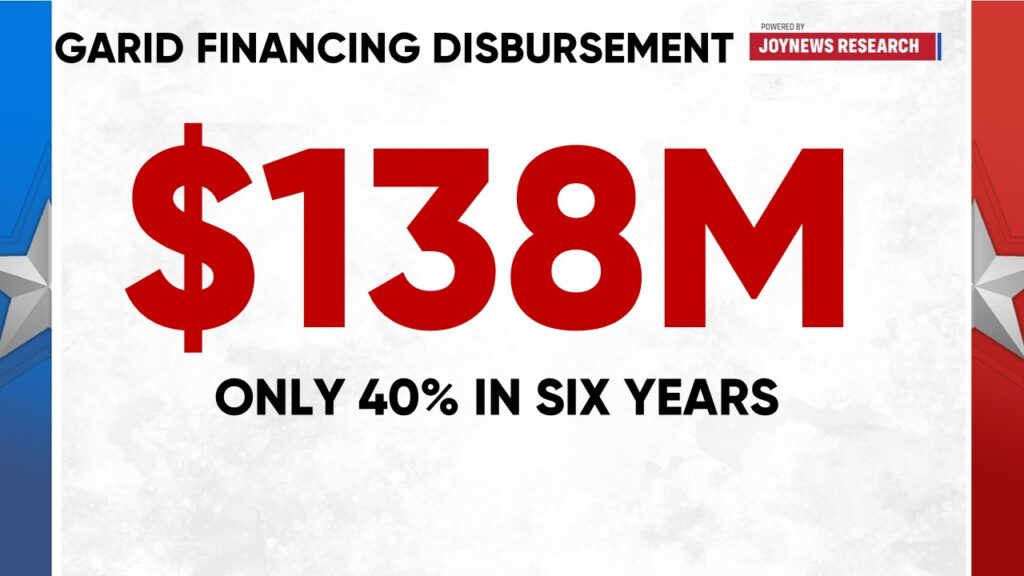
According to World Bank implementation reports, only about $138 million of the combined $350 million allocated to GARID had been disbursed by the latest reporting period—representing roughly 40 per cent of the total approved financing.
The reports identify several factors behind the slow pace of implementation. These include government-imposed funding restrictions that temporarily removed GH¢13.8 million from project accounts before the funds were later restored, prolonged delays in contractor payments and a 16-month period during which no project disbursements were made.
The resulting financial constraints slowed progress on several worksites, with some projects experiencing significant delays or temporary suspension. Rising project costs, delayed compensation payments, permitting challenges and compliance issues related to safety and regulatory requirements also contributed to implementation setbacks.
The experience highlights a recurring challenge in large-scale infrastructure delivery: securing financing is only the first step. The real test lies in translating approved funds into completed projects that deliver tangible improvements for communities vulnerable to flooding and poor sanitation.
It is worth noting that not all of the early funding disbursed under the Greater Accra Resilient and Integrated Development (GARID) Project was used for flood-control works. In 2020, part of the project’s funds was redirected to support Ghana’s response to the COVID-19 pandemic, a decision that later attracted criticism from opposition lawmakers.
In 2024, Members of Parliament raised concerns about the use of GARID funds after visiting several project sites and reportedly finding limited evidence of preliminary works. They subsequently called for a comprehensive account of how the funds had been utilised.
Despite those concerns, visible progress has been recorded in recent years. Nine major civil works contracts are currently being implemented under GARID, including the performance-based dredging of the Odaw Channel, a project described as the first of its kind in Africa. The dredging works commenced in early 2024, while other flood mitigation and drainage projects are ongoing in communities such as Nima, Akweteyman, Alogboshie and Achimota.
However, significant portions of the planned drainage and flood-control infrastructure remain incomplete, even as seasonal rains continue to expose the city’s vulnerability to flooding.
Governance Challenges Beyond Funding
Development experts monitoring Accra’s recurring flood crisis increasingly argue that the challenge extends beyond financing. In their view, stronger enforcement of existing planning and development regulations may be just as important as securing additional funding.
Recent events have reinforced that argument. Following the June 2026 floods, President John Dramani Mahama questioned how some structures currently marked for demolition had originally received permits despite being located within waterways.
“Some of the houses have building permits. How did they get them? So we have to do some soul-searching,” the President remarked as he directed state institutions to undertake a comprehensive assessment of flood-prone areas across the capital.
More than a decade after the devastating June 3, 2015 flood and fire disaster near the Kwame Nkrumah Circle, which claimed over 150 lives and served as a key catalyst for the design of GARID, Accra continues to grapple with recurring floods.
Analysts say the city remains trapped in a cycle of disaster, public outrage and repeated promises of reform, with many of the underlying structural challenges yet to be fully addressed.
A New Approach: Disaster Insurance
Alongside infrastructure investments, Ghana has in recent years begun exploring alternative financial tools to manage disaster risks.
One such innovation is parametric disaster insurance, a trigger-based mechanism that provides automatic payouts when predetermined conditions—such as extreme rainfall or severe drought—are met. Unlike conventional insurance, payouts are made without lengthy claims assessments.
In 2024, Ghana secured its first sovereign drought insurance policy through the African Risk Capacity, with premium support from Germany’s development bank, KfW.
The policy has already generated two payouts: approximately $960,000 in February 2025 and $1.93 million in April 2025. The funds were used to support emergency food and seed distribution programmes in drought-affected communities across northern Ghana.
A separate flood insurance product tailored for Greater Accra was still undergoing procurement as of September 2025, with development support from the Ministry of Finance and international partners.
While such insurance schemes do not directly finance drains, culverts or dredging projects, they are intended to provide rapid financial relief immediately after disasters, helping governments respond more quickly before traditional funding mechanisms become available.
Whether these financial instruments will significantly complement the hundreds of millions of dollars already invested in Accra’s flood-control infrastructure remains an open question.
Growing Calls for Independent Assessment
Given the scale of international financing committed to addressing Ghana’s flooding, water and sanitation challenges, experts argue that an independent evaluation of project outcomes is increasingly necessary.
Supporters of such a review point to the significant gap between funds approved and those actually disbursed, as well as the persistent human and economic costs of annual flooding.
Some evidence is already available. The Greater Accra Metropolitan Area (GAMA) Sanitation and Water Project, launched in 2013, concluded in December 2020 and produced a published Implementation Completion and Results Report. The project also recorded measurable improvements in access to household sanitation facilities, findings that were later reflected in national census data.
GARID, however, remains in the implementation phase and continues to face substantial disbursement challenges. As a result, any independent review would likely focus on implementation progress, delays, bottlenecks and value for money rather than final outcomes.
At the centre of the debate lies a broader public-interest question: of the nearly $1 billion in international financing directed toward Ghana’s water, sanitation and flood-management challenges over the past two decades, how much has translated into fewer flooded homes, fewer lives lost and a more resilient capital city?
Equally important is determining how much remains tied up in delayed disbursements, diverted resources and incomplete projects.
Until that question is answered through transparent evidence rather than competing political narratives, many residents of Accra are likely to continue approaching every rainy season with the same uncertainty and anxiety that have defined life in the city for generations.