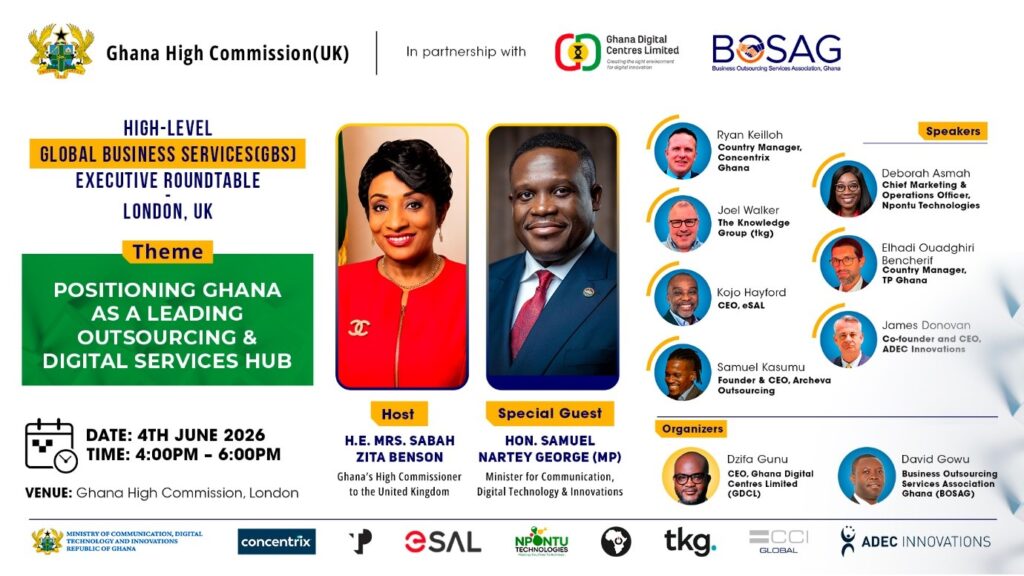
The Business Outsourcing Services Association of Ghana (BOSAG), in partnership with Ghana Digital Centres Limited (GDCL) and the Ghana High Commission in the United Kingdom, has successfully convened a High-Level Global Business Services Executive Roundtable in London.
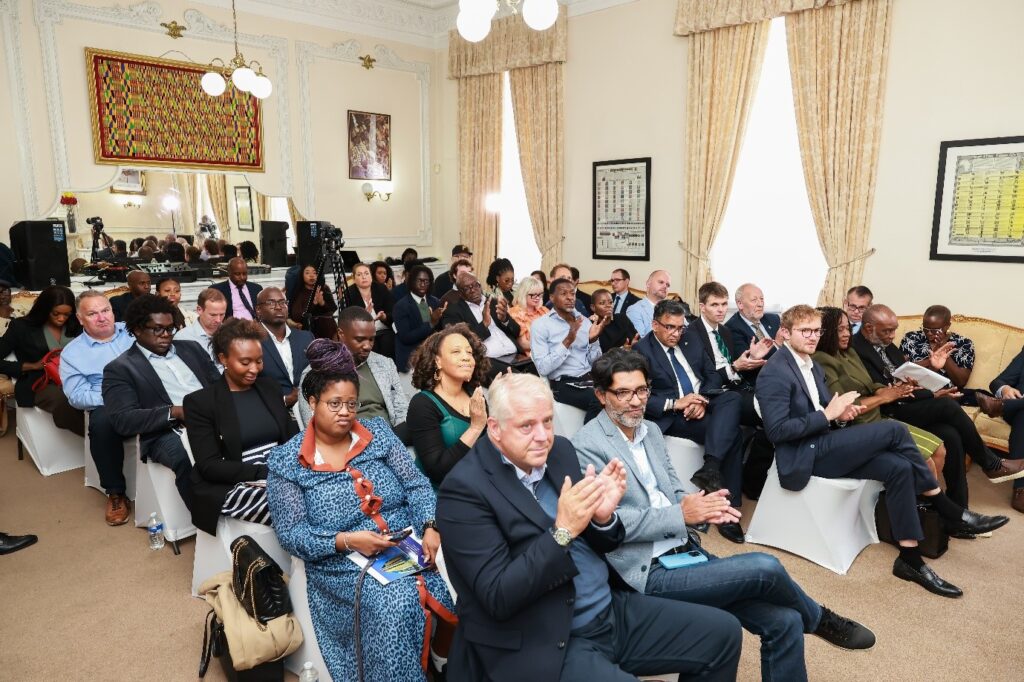
Held at the Ghana High Commission in Belgrave Square, the event brought together senior government officials, global industry leaders, investors and key ecosystem stakeholders for discussions on Ghana’s growing position as a competitive destination for outsourcing and digital services targeting the UK and European markets.
The session was moderated by Samuel Kasumu, Founder and Chief Executive Officer of Archeva Outsourcing and former Senior Advisor to the UK Prime Minister. In his opening remarks, he drew on his “Powered by Africa” initiative, calling for a shift in global perceptions of the continent and highlighting Africa’s increasing contribution to global industries through talent, innovation and enterprise.
The Roundtable followed the Ghana–UK Investment Summit held earlier in the week, building on momentum to deepen bilateral trade and investment ties, particularly within the fast-growing global services sector. The summit reinforced cooperation between Ghana and the United Kingdom and advanced discussions on trade expansion, investment flows and economic transformation.
In his opening address, the Deputy High Commissioner of the Republic of Ghana to the United Kingdom, H.E. Aquinas Tawiah Quansah, said Ghana is steadily transitioning toward a production-, innovation- and export-led economic model.
He noted that the country is at a key turning point as it moves away from dependence on primary commodities toward a more diversified, value-driven economy anchored in industrialisation and services exports.
He highlighted the Government’s 24-Hour Economy Agenda as central to this transformation, describing it as a framework designed to boost productivity, expand economic activity and create sustainable jobs. Within this strategy, Global Business Services and Business Process Outsourcing are expected to play a major role in driving exports, improving competitiveness and generating quality employment.
He also pointed to Ghana’s strong alignment with the United Kingdom, citing shared time zone advantages, high English proficiency and cultural compatibility as factors that support seamless nearshore service delivery.

Delivering the keynote address, the Minister for Communication, Digital Technology and Innovations, Samuel Nartey George (MP), outlined Ghana’s ambition to become Africa’s leading hub for outsourcing and digital services. He said the country is steadily moving from potential to execution, with digital services increasingly positioned as key export drivers alongside traditional sectors.
He explained that Ghana’s strategy is built on three main pillars: the digitalisation of public services, the development of export-ready digital products and services, and deeper integration into global markets through the African Continental Free Trade Area (AfCFTA), which provides access to a market of about 1.5 billion people.
The Minister noted Ghana’s strong fundamentals as a global delivery hub, pointing out that more than 100,000 graduates enter the labour market each year, supported by a growing pool of over 500,000 English-proficient professionals. He added that Ghana’s position within the Greenwich Mean Time zone gives it a strategic advantage for real-time service delivery to major global markets.
He further explained that, under the 24-Hour Economy framework, Ghana is developing a round-the-clock operational model designed to meet rising global demand for outsourcing and digital services.
Providing an implementation-focused perspective, the Chief Executive Officer of Ghana Digital Centres Limited, Dzifa Gunu, said Ghana has now moved beyond promotion into active execution. He highlighted GDCL’s role as the government’s operational arm responsible for infrastructure delivery, ecosystem development and investor support, ensuring a smooth transition from investment interest to full-scale operations.
Infrastructure expansion and digital backbone growth
The Board Chair of the National Communications Authority, Mavis Ampah Sintim-Misa, highlighted Ghana’s transformation into a more robust digital economy over the past two decades.
She recalled that in the early 2000s, Ghana had limited connectivity, with mobile penetration below 10% and internet access at around 2%, while international submarine cable connectivity was non-existent.
Today, she noted, the country has more than 44 million mobile subscriptions and around 30 million active data subscriptions, reflecting widespread digital access.
This growth has been supported by multiple submarine fibre optic cables, which have improved redundancy and significantly increased international bandwidth capacity.
Ghana now operates within a competitive multi-operator telecommunications environment, supported by an extensive national fibre backbone and ongoing broadband investments. These developments, she said, have greatly improved connectivity, service reliability and access to digital services across both urban and emerging communities.
This transformation has helped create a resilient and reliable digital backbone capable of supporting large-scale outsourcing operations. It has also positioned Ghana to compete more effectively in global service delivery, while opening up new opportunities for innovation, digital entrepreneurship and technology-driven growth.
24-Hour Economy as a Driver of Structural Transformation
The Chief Programme Officer of the 24-Hour Economy and Accelerated Export Development Secretariat, Abdul Nasser Alidu Suglo, has outlined the broader economic vision behind the initiative, noting that growth in the economy has not always translated into sufficient job creation.
He stressed the need for a more inclusive, productivity-driven model capable of expanding opportunities for a growing workforce.
According to him, the 24-Hour Economy Programme seeks to address this gap by boosting exports, expanding productive capacity and creating large-scale employment opportunities. Within this framework, the Business Process Outsourcing (BPO) sector is expected to play a central role, supported by major investments in infrastructure, including dedicated BPO parks and integrated facilities designed to enable sector expansion.
Industry Leaders Panel: Operating and Scaling from Ghana
A key feature of the Roundtable was an Industry Leaders Panel moderated by Joel Walker, Co-Founder of The Knowledge Group. The panel included Ryan Keilloh, Country Manager and Senior Director of Concentrix Ghana; Elhadi Ouadghiri Bencherif, Country Manager and Chief Operating Officer of Teleperformance Ghana; Kojo Hayford, Founder and Chief Executive Officer of eServices Africa; and Deborah Asmah, Chief Marketing and Operations Officer of Npontu Technologies.
Panelists shared practical insights into Ghana’s growing role as a global delivery hub, noting that the country has evolved into a proven and scalable outsourcing destination already serving major international clients.
They highlighted the strength of Ghana’s talent pool, improving technical capabilities and its gradual shift toward higher-value, technology-driven services. Artificial intelligence was identified as a key enabler, supporting hybrid operating models that combine human expertise with advanced digital tools.
The panel also pointed to Ghana’s competitiveness in terms of flexibility, scalability and cost efficiency, reinforcing its position as an emerging and future-ready global services hub.
Investor Confidence: ADEC Innovations
Chief Executive Officer of ADEC Innovations, James Donovan, has outlined the company’s reasons for choosing Ghana as a base for its operations, describing the country as a strong contender following a rigorous global selection process.
He explained that the outsourcing industry is rapidly evolving towards more advanced, technology-driven and outcome-focused models, adding that Ghana’s talent pool, infrastructure and overall ecosystem readiness make it well-positioned for this shift.
According to him, Ghana represents not only a promising investment destination but also a platform for long-term growth and meaningful impact.
Conclusion
The High-Level Global Business Services Executive Roundtable has been described as a key milestone in Ghana’s ambition to position itself as a competitive and scalable destination for global outsourcing and business services.
Stakeholders say the growing alignment between government policy, operational leadership from the Ghana Digital Centres Limited (GDCL), industry coordination through the Business Outsourcing Services Association of Ghana (BOSAG), and increasing private sector participation is helping to build a stronger ecosystem for global service delivery.
BOSAG has reiterated its commitment to expanding the sector, attracting investment, and strengthening Ghana’s position as a preferred hub for global business services.