On January 5, 2026, Africa’s fintech landscape shifted. News broke that Flutterwave, widely regarded as the continent’s largest fintech, had acquired Nigerian open banking startup Mono in an all-stock deal reportedly valued between $25 million and $40 million.
The deal brings together two major infrastructure players. Flutterwave operates one of Africa’s most extensive payments networks, powering transactions for businesses across multiple countries. Mono, often described as the “Plaid for Africa,” built APIs that allow companies to securely access bank data, verify customers and initiate payments. Together, the acquisition tightens Flutterwave’s grip on the rails that underpin Africa’s digital payments ecosystem.
For some analysts, the transaction signals something bigger.
Lumi Mustapha, General Counsel at Pareto Mosca Elite Advisory, believes the Mono deal could mark the beginning of a broader consolidation wave in African fintech. He predicts that over the next 18 months, between eight and 12 acquisitions could take place, with the top three to five fintech players absorbing Series A and B startups valued between $50 million and $200 million that are struggling to raise fresh growth capital.
In his view, Flutterwave’s decision to pay in stock says as much about the market as it does about the company’s balance sheet. The era of sky-high valuations seen in 2021 and 2022 has given way to tougher conversations about margins, profitability and sustainable growth. The next year, he argues, will be critical in determining whether Flutterwave can navigate its reported down round at a $1.5–2 billion valuation, achieve profitability and cement its position as Africa’s long-term payments backbone.
Paystack’s Banking Pivot
The consolidation story is also unfolding elsewhere in Nigeria.
Paystack has formally entered the banking space after acquiring Ladder Microfinance Bank, now rebranded as Paystack Microfinance Bank (MFB). The move gives the company greater control over customer funds and allows it to offer lending and deposit services directly to businesses.
Paystack MFB will operate independently but leverage transaction data from Paystack’s payments network to underwrite loans more efficiently, enabling faster approvals and sharper risk assessment.
As it marked its 10th anniversary, the company announced a sweeping restructuring. It is transitioning from a payments processor into The Stack Group (TSG), a multi-brand holding company structure pending regulatory approval. The new group will house Paystack as its core merchant payments engine, Paystack MFB as a standalone microfinance bank, Zap as a consumer-facing payments brand, and TSG Labs, a venture studio focused on building new products.
Cross-Border Expansion Gains Pace
Beyond fintech, deal activity is accelerating across sectors and geographies.
India’s Varun Beverages Ltd (VBL), the largest bottler of PepsiCo products outside the United States, is expanding deeper into Africa with the acquisition of Twizza Proprietary Limited in South Africa for approximately $125 million. The deal, executed through VBL’s South African subsidiary Bevco, gives it control of three Twizza manufacturing plants in Cape Town, Queenstown and Middelburg.
In the technology space, Motorola acquired RapidDeploy in February 2025 for an undisclosed amount. Founded in South Africa, RapidDeploy expanded into the United States, where its software now supports critical 911 emergency infrastructure. The exit delivered returns to investors and underscored the ability of African private equity firms to scale sophisticated software businesses beyond the continent. Among them is Sango Capital, which manages more than $670 million in assets and backed RapidDeploy’s international push.
Meanwhile, Nedbank Group has offered to acquire a controlling stake in Kenya’s NCBA Group in a cash-and-stock deal valued at $855.5 million, accelerating its expansion into East Africa.
Regulatory Shifts and Market Momentum
Governments are also moving to facilitate deal-making. South Africa’s Department of Trade, Industry and Competition has proposed raising the minimum thresholds that trigger mandatory antitrust reporting. If adopted, fewer transactions would require regulatory approval, cutting legal costs and shortening timelines. Backed by President Cyril Ramaphosa’s Operation Vulindlela reform drive, the changes are part of a broader effort to stimulate economic activity and restore investor confidence.
Taken together, these developments point to a surge in mergers and acquisitions both into and out of Africa. Private market transactions increasingly reflect a maturing ecosystem, one that is consolidating and integrating more deeply with global capital markets. Stronger players are absorbing weaker or capital-constrained firms, creating larger and more resilient businesses in the process.
Public markets are also showing renewed activity, with IPOs and trading volumes picking up in countries such as Kenya, South Africa, Ghana, Tanzania and Zambia.
Africa’s market performance in 2025 is challenging long-held assumptions. OECD analysis suggests that scaling up energy and infrastructure investment could significantly boost growth and potentially double the continent’s GDP over time. Surveys by the European Bank for Reconstruction and Development indicate that households in Sub-Saharan Africa rank among the most optimistic globally about future prospects.
For long-term investors willing to look beyond traditional cycles, the message is becoming clearer: Africa’s deal-making momentum is not just a flurry of transactions — it may be the start of a new phase of economic consolidation and global integration.
Last week, Kenya kickstarted the year with its biggest IPO, with the government offloading 65% stake in Kenya Pipeline Company (KPC) at a valuation of $835M, ending an 11-year public offering drought. If successful, it could thaw Nairobi’s long-frozen public markets and boost infrastructure funding.
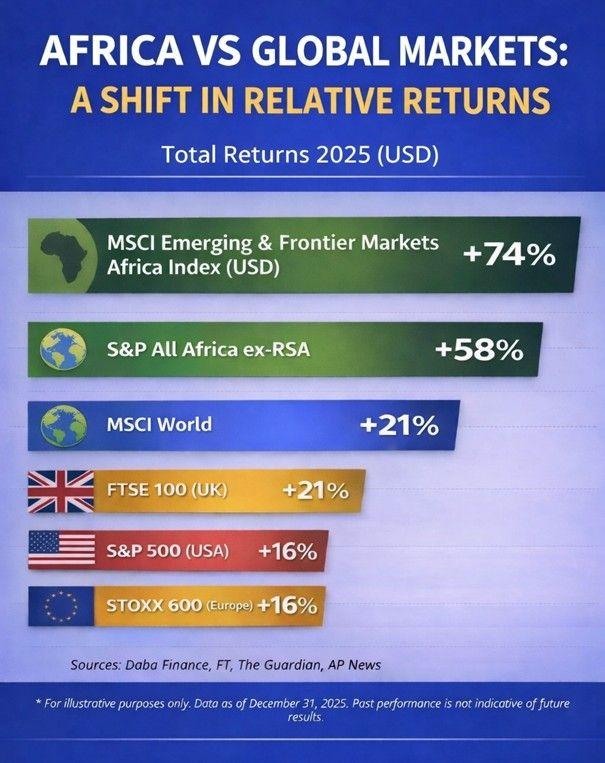
Meanwhile, South Africa’s stock market has reached its highest valuation since 2019. The FTSE/JSE Africa All Share Index recently surpassed $500 billion in total market value, outperforming the equity markets of several peer nations. This milestone caps an extraordinary run, with the Johannesburg Stock Exchange posting a 38% gain in 2025—its best annual performance in two decades. The rally, led by precious metals and mining stocks, has been supercharged by a 14% appreciation of the rand against the US dollar, pushing the index up 57% in dollar terms. The momentum continued into 2026, driven by rising gold prices and a strong rand, which is trading at its strongest level in three years.
The Johannesburg Stock Exchange has listed the Cartesian EasyETFs Balanced Actively Managed Exchange Traded Fund, marking the latest expansion of actively managed investment products on the exchange’s Main Board.
The Ghana Stock Exchange (GSE) commenced trading for 2026 on a positive note on January 5th, with the benchmark GSE Composite Index (GSE-CI) advancing 11.3 points to close at 8,781.55, representing a 0.13 per cent gain as investors returned from the New Year holiday break. The Financial Stocks Index (GSE-FSI) also edged higher by 0.96 points to settle at 4,648.13, though the year-to-date increase stood at just 0.02 per cent in the first trading session.
By the following Monday, the benchmark GSE Composite Index (GSE-CI) climbed to 7,005.69 points, representing a Year-To-Date (YTD) return of 43.31%. The Financial Stocks Index (GSE-FSI) also inched up by 0.38 points to 3,428.53, translating into a YTD return of 44.01%. Market capitalisation ended the trading session GHS139.62 million higher, closing at GHS146.27 billion, as investor sentiment appeared buoyant.
The modest opening reflects cautious optimism among investors as they assess Ghana’s economic trajectory following the exchange’s spectacular 2025 performance, when it emerged as Africa’s best-performing equity market with a remarkable 79.4 per cent annual return.
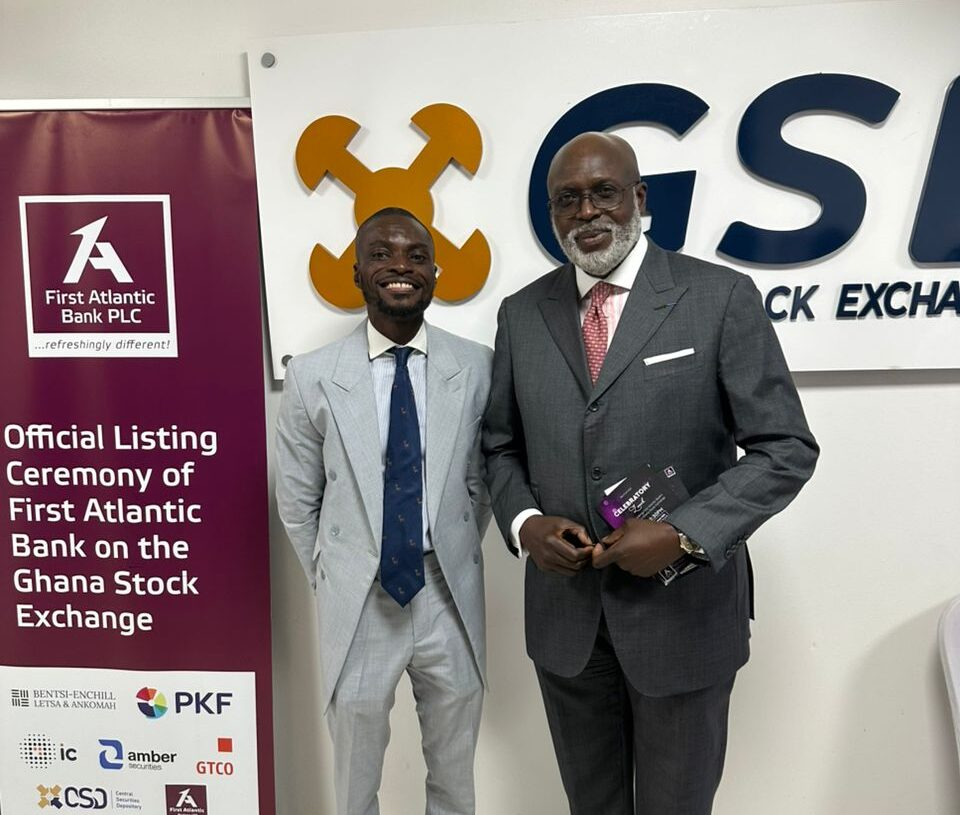
The December 2025 listing of the 30-year-old First Atlantic Bank (FAB) takes some credit for this renewed market exuberance on the back of the incredible work of the leadership of the bourse over the last three to five years under the stewardship of Ms Abena Amoah. The FAB listing presented a rare and resounding signal of liquidity for West African private equity as PCM Capital Partners (“PCP”) completed its full exit from FAB. This was executed via the FAB IPO on the Ghana Stock Exchange at a time when frontier market investors are hungry for proof that the “private-to-public” pipeline remains viable in the region.
The offering was met with robust demand, finishing oversubscribed despite a global environment where emerging market listings have faced significant scrutiny. The exit marked the fourth successful liquidation for PCP’s maiden fund, the West Africa Emerging Markets Growth Fund (WAEMGF).
Equities on the Dar es Salaam Stock Exchange rose modestly on Wednesday, January 7th, with banks extending recent gains as investors focused on a small number of liquid counters while bond trading continued to absorb the bulk of market value. Total equity turnover reached 4.47bn/-, with 2.24 million shares changing hands across 2,836 deals, reflecting steady participation early in the year. Trading activity was reinforced by strong demand in the bond market, where government and corporate securities worth 18.81bn/- were exchanged, underscoring investors’ continued appetite for fixed-income instruments.
Zambia’s stock market emerged as one of the best-performing globally so far this year, as a copper-price boom and stronger growth expectations lifted the Lusaka Securities Exchange (LuSE) to the top of African equity returns.
The benchmark index climbed 17% in dollar terms since the turn of the year, propelled by record copper prices that have boosted mining sector earnings—and investor appetite for Zambian assets. Higher metal revenues have underpinned broader confidence in the country’s economic trajectory, supporting expectations of faster GDP growth.