In November 2023, Asantehene Otumfuo Osei Tutu II launched the Heal Komfo Anokye Project (HeKAP), an ambitious initiative aimed at raising US$10 million to rehabilitate deteriorating infrastructure at the Komfo Anokye Teaching Hospital (KATH) in Kumasi. Several of the hospital’s buildings had gone decades without major renovation, despite serving as one of Ghana’s leading referral health facilities.
More than two years after its launch, the project has attracted substantial financial support from state institutions, private companies, Members of Parliament, Ministers of State, former Vice President Dr Mahamudu Bawumia, religious organisations and individual donors.
Available records indicate that about GH¢50 million has already been spent on various aspects of the project, while approximately GH¢13 million remains outstanding in payments to contractors. The project committee has indicated that the amount is yet to be fully validated.
However, questions over accountability and governance have emerged following efforts by KATH’s board and management to obtain detailed accounts of the project’s finances and operations. The hospital’s leadership also requested that the project be handed over to KATH, but those demands were rejected by the HeKAP Committee.
A months-long investigation, supported by findings contained in an independent audit report, has uncovered a number of irregularities that auditors warn could undermine donor confidence in the initiative.
The concerns range from procurement and documentation weaknesses to missing receipt records and an ongoing dispute over ownership of the project itself. At the centre of the controversy is the question of whether HeKAP is a hospital-led initiative or a privately managed project.
Foundation Managing Donations Not Linked to KATH
Donations raised for HeKAP and the implementation of the project are overseen by the Heal Komfo Anokye Hospital Foundation.
Records at the Registrar of Companies identify journalist Samuel Adu Boakye of Kumasi-based Kessben FM and Kojo Darko Asante, a Chief Architect with the Public Works Department in the Ashanti Region, as the directors of the foundation.
Neither director is officially affiliated with KATH, and available information suggests they were not formally appointed by the hospital’s board or management to administer the project or receive donations on behalf of the institution.
Auditors noted that during their review, they found no Memorandum of Understanding (MoU) defining the relationship between KATH and HeKAP.
According to the audit report, the absence of such an agreement created uncertainty over the project’s governance structure and operational arrangements.
“The legal and operational activities and structure of HeKAP remained unclear,” the auditors observed, adding that issues relating to ownership of assets and the handling of sensitive information could not be adequately controlled without a formal framework.
Dispute Over Registration of Foundation
Speaking during an interview, Samuel Adu Boakye claimed that former KATH Chief Executive Officer, Professor Otchere Addai-Mensah, was not informed when the Heal Komfo Anokye Hospital Foundation was registered as a private company.
According to him, Professor Addai-Mensah initially expressed displeasure after learning about the registration.
“At some point, he was even angry and asked how I had registered it without informing him,” Mr Adu Boakye said.
He explained that he considered it inappropriate to involve the KATH CEO directly in the registration process because of his official role at the hospital.
“I told him, ‘You are the CEO of Komfo Anokye and I am the chairman of Heal Komfo Anokye. How do I come and ask you to be part of it?’” he recounted.
However, the audit report appears to raise questions about that assertion.
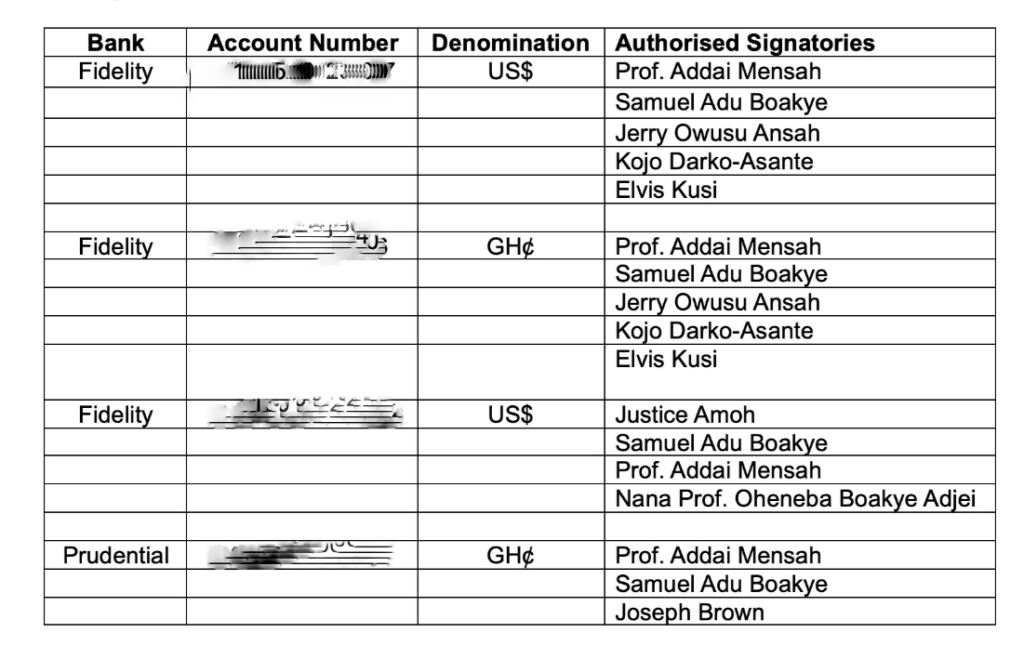
Auditors identified Professor Addai-Mensah as one of the signatories to HeKAP’s bank accounts, suggesting he had some level of involvement in the project’s financial arrangements.
The report further disclosed that a resolution was passed on February 6, 2024, to open an account with Prudential Bank’s Santasi Roundabout Branch in Kumasi. Auditors noted, however, that documentation authorising the opening of some other project accounts was not made available for review.
The audit findings have intensified calls for greater transparency regarding the management of donor funds and the governance structure of the Heal Komfo Anokye Project, which remains one of the most significant healthcare fundraising initiatives undertaken in the Ashanti Region in recent years.
The Heal Komfo Anokye Hospital Foundation, the entity established to manage the Heal Komfo Anokye Project (HeKAP), is registered as a private company limited by guarantee. According to its registration documents, the company’s principal objective is to raise funds in support of Komfo Anokye Teaching Hospital (KATH).
However, a review of the project’s timeline has raised questions about its fundraising activities prior to the foundation’s incorporation.
HeKAP was officially launched on November 10, 2023, yet the Heal Komfo Anokye Hospital Foundation was not incorporated until March 25, 2024 — approximately four months later.
Former KATH Chief Executive Officer, Professor Otchere Addai-Mensah, explained that the decision to register the foundation was primarily to facilitate the opening of bank accounts for the project.
Despite this explanation, available records indicate that donations were already being solicited and bank accounts were being promoted months before the foundation was formally registered.
For example, on November 13, 2023, just three days after the project’s launch, the official Heal Komfo Anokye Facebook page published a flyer providing bank account details for public donations.
The existence of those accounts before the foundation’s incorporation has prompted questions about how banking arrangements were established for a project that had not yet been formally registered as a legal entity.
Addressing the issue in an interview, Professor Addai-Mensah stated that Fidelity Bank held the donations on behalf of the project before the foundation was incorporated.
When asked how funds could be received and managed in the absence of a formally registered entity and dedicated account, he said the question should be directed to the bank.
Professor Addai-Mensah acknowledged that KATH already maintained accounts with Fidelity Bank but explained that project managers deliberately chose not to operate HeKAP through the hospital’s existing financial structures.
According to him, concerns over the administrative requirements associated with the Public Procurement Act and the Public Financial Management Act influenced that decision.
He argued that subjecting the project to those regulatory processes could have slowed implementation and delayed the mobilisation and utilisation of funds needed to support the hospital’s redevelopment agenda.
The circumstances surrounding the project’s early fundraising activities and banking arrangements continue to attract public interest as questions persist over governance, accountability and the legal framework under which HeKAP operated during its formative months.

HeKAP Committee Rejects KATH’s Call for Accountability and Handover
A dispute over the ownership and management of the Heal Komfo Anokye Project (HeKAP) intensified in July 2025 when the Board of Komfo Anokye Teaching Hospital (KATH) formally requested accountability from the project’s managers and called for the initiative to be handed over to the hospital’s Chief Executive Officer.
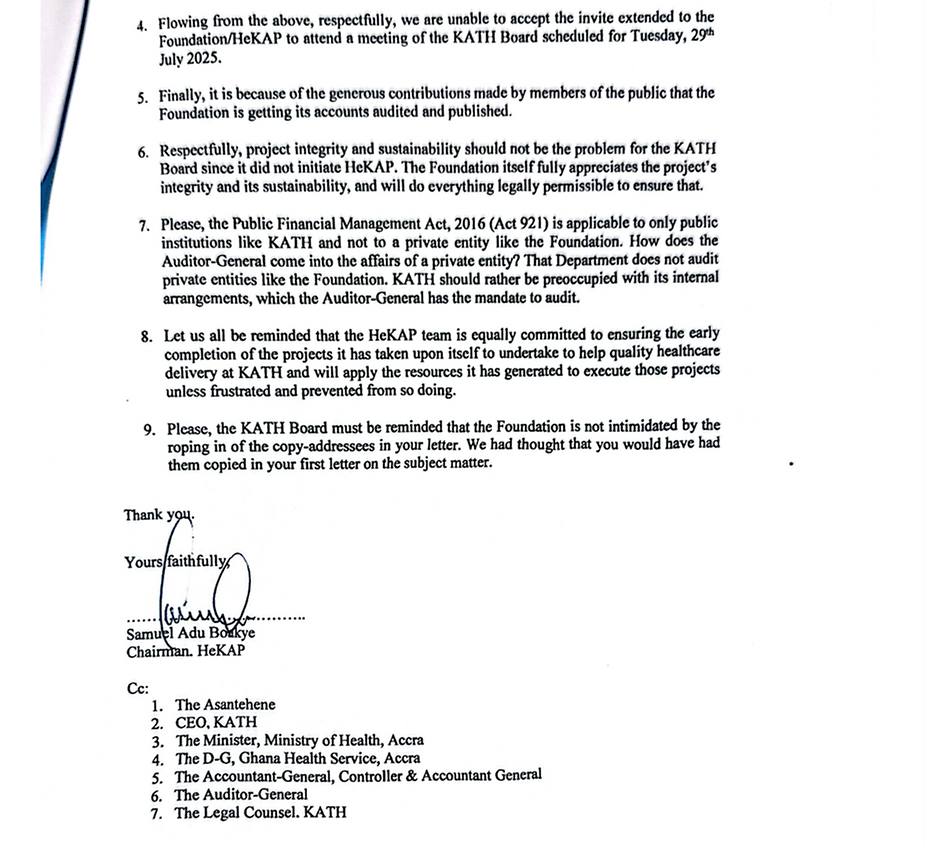
In a response dated July 8, 2025, Chairman of the HeKAP Committee, Samuel Adu Boakye, rejected the request, maintaining that the project is not owned or managed by KATH.
According to Mr Adu Boakye, the Heal Komfo Anokye Project was launched and is being implemented by the Heal Komfo Anokye Hospital Foundation, a private corporate entity operating with the active support of Asantehene Otumfuo Osei Tutu II.
He argued that although KATH is the primary beneficiary of the project’s activities, the initiative was never conceived or established by the hospital.
“HeKAP has never been a KATH-initiated project, even though KATH is the beneficiary of its activities, and KATH, as an institution or through any of its officers, has never been part of the corporate entity,” Mr Adu Boakye stated in the letter.
He further maintained that the HeKAP Committee was not created by the hospital’s management or board and therefore could not be regarded as a committee of KATH.
“The HeKAP Committee has never been a committee of KATH set up by the management and/or the Board of Directors,” he added.
Otumfuo Awaits Audit Briefing
Efforts to obtain official comments from Manhyia Palace on the matter, including whether Otumfuo Osei Tutu II was aware that the project had been registered as a private entity, have so far been unsuccessful.
The Asantehene, who has publicly championed and mobilised support for the project, is currently outside the country and has not yet responded to requests for clarification.
However, sources close to Manhyia Palace indicate that Otumfuo recently directed that an independent audit of the project’s operations be conducted.
The audit report was reportedly submitted to the Palace about three weeks ago and is expected to form the basis of further discussions on the future of the initiative.
According to the sources, the Asantehene plans to meet with members of the HeKAP Committee and other key stakeholders upon his return to Ghana to review the audit findings, address outstanding concerns and determine the next steps for the project.
The anticipated meeting is expected to provide greater clarity on issues surrounding accountability, governance and the long-term management of the Heal Komfo Anokye Project.

Debate Continues Over Ownership of Heal Komfo Anokye Project
Questions continue to surround the ownership and origins of the Heal Komfo Anokye Project (HeKAP), with conflicting accounts emerging over whether the initiative was conceived as a private undertaking or a project spearheaded by the management of Komfo Anokye Teaching Hospital (KATH).
The issue has become central to ongoing discussions about the project’s governance, particularly amid arguments that HeKAP should remain under private management rather than be handed over to KATH.
Speaking during an interview, Samuel Adu Boakye maintained that HeKAP was not a hospital project but a private initiative he started.
“This is not a project of the hospital,” he said. “I initiated the project. However, in corporate governance, the CEO [of KATH] had to own it. He also takes it as his baby.”
His claim, however, has been challenged by several individuals familiar with the project’s development.
Former KATH Chief Executive Officer, Professor Otchere Addai-Mensah, who supports the decision to register HeKAP as a private entity, also told investigators that the concept had been one he developed before assuming office as CEO and began pursuing shortly after taking up the role.
That account appears to contradict Mr Adu Boakye’s assertion that the initiative did not originate from within the hospital.
Investigations into the project’s history uncovered at least three different versions of how HeKAP began, with many sources pointing to KATH officials as the original drivers of the initiative.
Sources Point to KATH Officials as Early Promoters
One account, supported by former Ghana National Petroleum Corporation (GNPC) Chief Executive and Chancellor of the University of Professional Studies, Accra (UPSA), Dr K.K. Sarpong, suggests that the idea originated within KATH’s leadership.
According to multiple sources familiar with the project, the current KATH CEO, Dr Paa Kwesi Baidoo, first proposed a broader fundraising initiative after successfully mobilising resources to renovate the hospital’s trauma centre while serving as its head.
The sources said Dr Baidoo later presented the idea to then-CEO Professor Addai-Mensah, who embraced the proposal and supported efforts to expand it into a larger hospital-wide intervention.
Two individuals with knowledge of the project’s early stages said KATH management subsequently approached Dr K.K. Sarpong for advice and support.
Professor Addai-Mensah confirmed that he met Dr Sarpong together with Dr Baidoo, KATH Public Relations Officer Kwame Frimpong and another medical officer, Dr Frankie.
Although he could not recall the exact date of the meeting, he confirmed that all those present were officials of KATH.
Dr K.K. Sarpong Recounts Initial Discussions
Dr Sarpong also confirmed meeting members of the hospital’s management team regarding the proposed project.
“They were about four of them,” he recalled. “They came with a concept and requested that I help them raise funds.”
According to him, after reviewing the proposal, he advised that the initiative should be linked to Asantehene Otumfuo Osei Tutu II in order to maximise its impact and public appeal.
Dr Sarpong said he further suggested that the project be positioned as a legacy initiative to commemorate Otumfuo’s 25th anniversary on the Golden Stool.
Following those discussions, he said he played no further role in the project and was not involved in fundraising or expenditure decisions.
However, he expressed surprise at suggestions that HeKAP could be claimed as the property of private individuals.
“I don’t think that any private individual can claim it. I’ll be surprised, unless they told different people different stories,” Dr Sarpong said.
“At the meeting, they said it was for them.”
The differing accounts continue to fuel debate over the true origins of HeKAP and whether the project should be regarded as a private initiative or one conceived and promoted by officials of Ghana’s second-largest referral hospital.

Conflicting Claims Over HeKAP’s Origins
Former Chief Executive Officer of Komfo Anokye Teaching Hospital (KATH), Professor Oheneba Boachie-Adjei Woahene Addai-Mensah, has described himself as the visionary behind the Heal Komfo Anokye Project (HeKAP), recounting how the initiative was conceived following discussions with the Asantehene, Otumfuo Osei Tutu II.
According to Professor Addai-Mensah, shortly after assuming office as CEO of KATH, the Asantehene visited a prominent patient receiving treatment at the hospital. During the visit, he said, he drew Otumfuo’s attention to the deteriorating state of the hospital’s infrastructure.
He recalled that the Asantehene shared similar concerns and subsequently invited him to a meeting to discuss possible solutions. During that engagement, Otumfuo encouraged him to develop a concept note outlining a potential intervention.
Professor Addai-Mensah said that during a subsequent meeting with the Asantehene, he was accompanied by journalist Samuel Adu Boakye. However, he noted that before they could present their ideas, Otumfuo had already outlined in detail his vision for transforming the hospital.
“The only thing we added was that we wanted to tie the project to his 25th anniversary celebration,” Samuel Adu Boakye said.
According to Professor Addai-Mensah, two additional individuals were later brought on board to help refine the proposal before a formal committee was established and inaugurated by the Asantehene to spearhead the project.
Samuel Adu Boakye’s Account
Samuel Adu Boakye, who also lays claim to the origins of HeKAP, offered a different perspective on the project’s development.
He said his involvement began after the initial discussions between Professor Addai-Mensah and the Asantehene. Following the meeting he attended with the former KATH CEO, Mr Adu Boakye said he took a leading role in driving the initiative forward.
According to him, he spearheaded the project while Professor Addai-Mensah served as its public face. He further claimed responsibility for identifying and recruiting members who later served on the HeKAP Committee.
Questions Over Donations and Accountability
Questions have also emerged regarding the amount of money raised for the project and the nature of the funds received.
Neither Samuel Adu Boakye nor Professor Addai-Mensah was able to state the exact amount of donations received or expenditure incurred under the project as of June 2026.
However, an audit management letter containing responses from the HeKAP Committee indicates that more than GH¢50 million had been raised by the time of the audit.
The audit examined activities undertaken between March 25, 2024, when the company established to run the project was incorporated, and April 30, 2025.
During an interview, Professor Addai-Mensah repeatedly declined to state whether donations received for the project should be regarded as public or private funds, despite being asked the question multiple times.
Instead, he maintained that HeKAP operated under the auspices of Manhyia and was registered as a charity foundation limited by guarantee.
While he did not directly classify the donations, he acknowledged that public funds are ordinarily governed by the Public Financial Management Act and that procurement involving such funds should comply with the Public Procurement Act.
The management of HeKAP funds, however, was not conducted under those legal frameworks because the entity established to implement the project is registered as a private company.
Despite its private status, auditors identified a number of administrative and financial control weaknesses in the management of project funds. These concerns were detailed in an audit management letter reviewed as part of the investigation.
Audit Findings Raise Concerns
The audit report highlighted several irregularities relating to procurement procedures, documentation, record-keeping and accountability mechanisms.
Although the auditors did not conclude that there had been any financial misconduct, they noted that some of the weaknesses identified could create opportunities for abuse and recommended that they be addressed to strengthen transparency and oversight within the project.

An audit management letter submitted to the management of the Heal Komfo Anokye Project (HeKAP) identified several procedural lapses and administrative weaknesses that, while not necessarily indicative of wrongdoing, could create opportunities for misconduct or weaken accountability mechanisms.
Among the key concerns raised by the auditors was the absence of a documented procurement policy during the audit period.
According to the report, the lack of such a policy made it difficult to determine the basis for selecting and approving suppliers, contractors and service providers, as well as assessing whether value for money had been achieved in procurement decisions.
The auditors noted that HeKAP management did not provide a response to this particular observation.
“The lack of a management response suggests a lack of urgency in addressing this high-risk area,” the auditors stated.
Concerns Over Procurement and Contract Documentation
The audit further revealed that no evidence of written contracts was made available for review. Auditors also indicated that procurement procedures used in the selection and award of contracts were not presented, while inspection reports or certificates confirming completed works and supporting payments could not be verified.
In response, HeKAP management acknowledged the findings and attributed the gaps to the project’s early operational approach.
“Management acknowledges the observations. During the initial phase of the project, activities were executed on an informal basis, and as such, formal written contracts and documented procurement procedures were not consistently maintained,” management stated.
The response explained that some contractors and service providers were engaged based largely on trust or through arrangements linked to donors who provided specific items or services.
“While this ensured timely execution of activities, formal procurement documentation, including contracts and evidence of selection procedures, was not adequately retained,” the statement added.
Management also maintained that project works were internally supervised and verified before payments were made but admitted that supporting documentation for those verification processes was not always prepared or properly filed.
Record-Keeping Weaknesses Identified
Although HeKAP is operated by a private entity and Komfo Anokye Teaching Hospital (KATH) was not directly involved in its management, the audit found that receipt books were kept at KATH, where an administrative assistant was responsible for issuing receipts for cash and cheque donations.
The auditors also identified weaknesses in record-keeping practices, noting that no receipt register or register of value documents had been maintained.
In addition, some receipt leaflets were found to be missing from receipt books and had not been attached, marked as void or officially cancelled.
Responding to these concerns, management attributed the lapses largely to the inexperience of a cashier who worked on the project during its early stages.
“Management acknowledges the observations. The noted issues arose primarily due to the inexperience of the cashier engaged during the early phase of the project, which resulted in lapses in receipt issuance, documentation and record-keeping,” the response said.
Management explained that unused and cancelled receipts had been removed by the officer responsible and indicated that new procedures had since been introduced to improve documentation practices.
As an additional accountability measure, management said all donations received under the project were publicly disclosed, allowing donors to verify their contributions.
“All donations were published to enable donors to ensure their donations had been accounted for. The only comments we received related to misspelt names. Thus, all donations have been verified,” management stated.
Despite the explanations provided, the auditors recommended further scrutiny of the receipt records, particularly those that were incomplete or improperly documented.
They concluded by suggesting that the irregularities be investigated, especially instances involving receipt leaflets that were not fully completed.

While the audit report identified a number of irregularities, Samuel Adu Boakye maintained that the findings should not be interpreted as evidence of corruption or financial impropriety.
He argued that the concerns raised were administrative in nature and reflected the type of issues routinely highlighted during audits.
“There’s no iota of malfeasance in the project, except administrative errors, which any audit points out. I don’t see anything wrong in this audit,” he stated.
Sources at Manhyia also revealed that Otumfuo is fully committed to ensuring accountability and is expected to take the necessary steps in response to the audit report when he returns to Ghana.

This report was produced under the Pledge Against Corruption Ghana project, a civil society initiative aimed at promoting transparency, accountability and integrity in public governance.
The project is implemented in partnership with the Africa Centre for Energy Policy (ACEP), Transparency International Ghana and the Ghana Anti-Corruption Coalition (GACC), with support from UK International Development.