A Nigerian scientist has been awarded the global Goldman Environmental Prize for a community-driven conservation campaign sparked by her encounter with a devastating wildfire and its threat to endangered bats she had only recently discovered.
Iroro Tanshi, who works within the Afi Mountain Wildlife Sanctuary in south-eastern Nigeria, said her discovery of the short-tailed roundleaf bat after nearly 50 years was a moment that should have made headlines.
But instead, she recalled a more urgent crisis unfolding around her.
“There was a serious situation… wildfires,” she told the BBC Focus on Africa podcast.
In a country where bats are often linked to witchcraft and superstition, Tanshi led a community-based campaign aimed at protecting the species by tackling the root cause of the threat—wildfires in their habitat.
Explaining how she shifted local attitudes, the ecologist said the key was connecting conservation to everyday realities.
“It’s really the question of: ‘How do we convince people to protect the habitat?’” she said. “In our case, it was because the wildfire problem was also a community problem—that was the hook.”
Tanshi, currently a postdoctoral researcher at the University of Washington, focuses on bat conservation and has identified human-induced wildfires as one of the major threats to the endangered short-tailed roundleaf bat population.
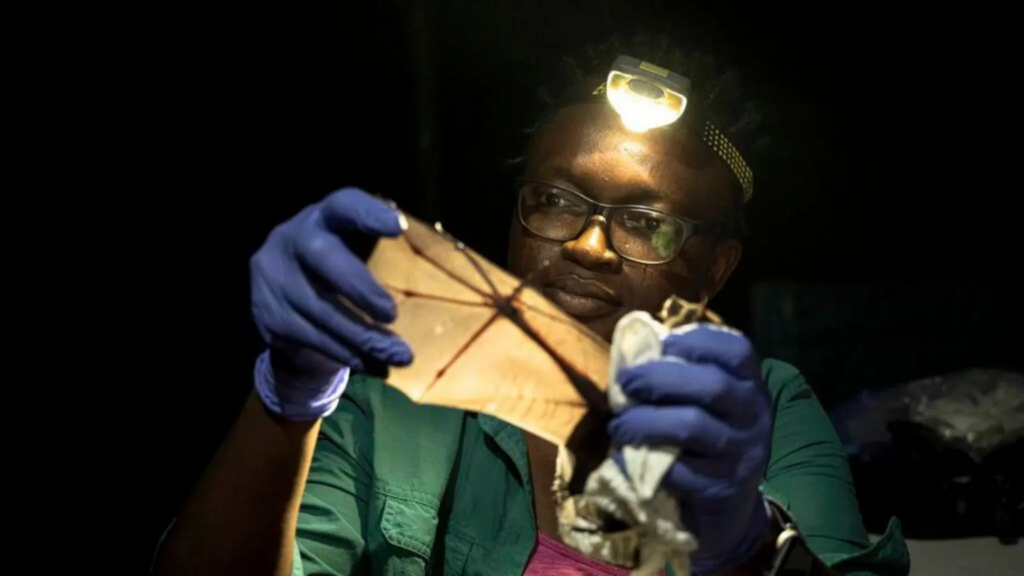
She said, her team believes the fire that sparked her campaign may have been started by a farmer clearing land close to the forest.
“That fire burned for about three weeks until the rain came. There was nothing people could do—we just watched it every day,” she said, adding that local residents later began working with them because they also want solutions to recurring wildfire threats on their farms.
According to the global Goldman Environmental Prize, Afi Mountain Wildlife Sanctuary—a 24,700-acre conservation area—has seen major wildfire prevention efforts led by Tanshi and her community fire brigades between 2022 and May 2025.
Beyond firefighting, her campaign also focuses on environmental education, particularly the role of bats in ecosystems.
In many parts of Nigeria, bats are often linked to superstition and witchcraft, making them widely feared. Tanshi said her team works to change these perceptions through community outreach and “multiple forms of media,” with a strong focus on educating children.
“We don’t shy away from those conversations,” she said, explaining that bats play a vital ecological role, including seed dispersal and pollination.
She pointed to everyday products such as shea butter, noting that bats contribute indirectly to its production by helping spread the seeds of the shea tree.
“So essentially, you come to see that they play so many critical roles, it’s almost impossible to ignore them,” she said.
Tanshi described receiving the award as an “incredible honour,” adding that it affirms the global importance of her work.
“There are very few things in this world that signal to you that the work you’re doing has global relevance like this,” she said.
She is one of six winners of the 2026 Goldman Environmental Prize. For the first time in the prize’s 37-year history, all recipients are women.