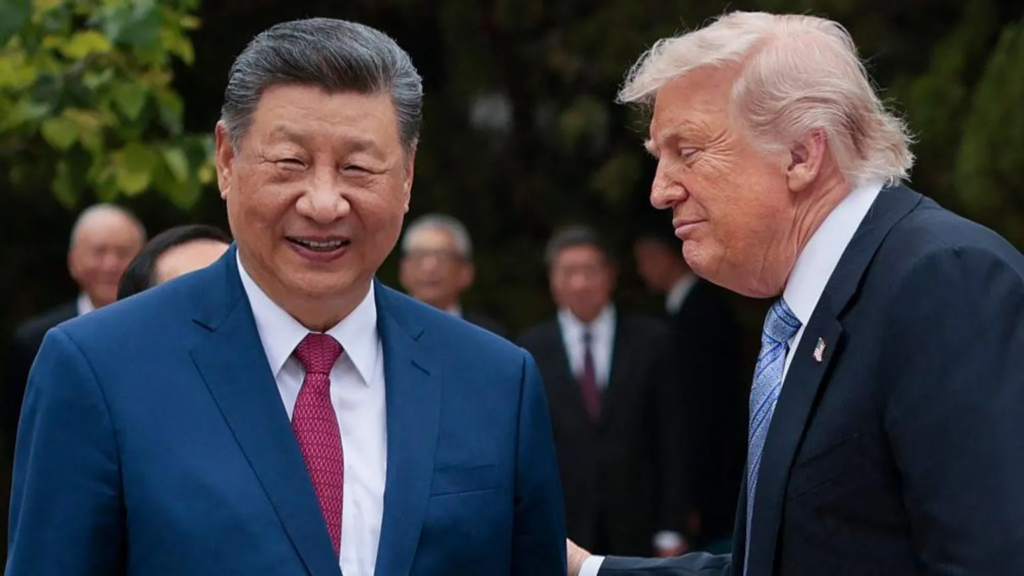
US President Donald Trump has left Beijing saying he secured “fantastic trade deals, great for both countries” following talks with Chinese leader Xi Jinping.
Trump, who was accompanied by a high-profile US business delegation spanning agriculture, aviation, electric vehicles and AI chip industries, described relations between Washington and Beijing as “the world’s most consequential economic relationship.”
The two-day summit was marked more by warm messaging and symbolism than by major policy breakthroughs. The first day featured elaborate ceremonies and upbeat rhetoric, but no sweeping trade deal or significant commercial agreements were announced.
After concluding discussions on Friday, Trump described the talks as “very successful,” while Xi called the visit “historic and landmark.”
Despite the positive tone, no major structural trade agreement was reached.
In an interview with Fox News, Trump said China had agreed to purchase 200 Boeing aircraft, which would mark Beijing’s first major order of US-made commercial jets in nearly a decade, though the figure was lower than some analysts had expected.
However, Chinese officials did not confirm any large-scale aircraft purchases or new trade commitments following the talks.
Chinese foreign ministry spokesperson Guo Jiakun did not directly respond to US President Donald Trump’s remarks on the figures cited, instead reiterating that the “essence of China–US economic and trade relations is mutual benefit and win-win cooperation.”
He added that both sides should work to implement the “important consensus” reached by their leaders, with the aim of strengthening stability in bilateral trade and supporting the wider global economy.
The BBC has reached out to Boeing for comment.
Trade truce still uncertain
Questions remain over the trade truce agreed in October, under which Washington suspended planned tariff increases on Chinese goods while Beijing eased restrictions on rare earth exports.
US Trade Representative Jamieson Greer, who accompanied Trump on the visit, told Bloomberg TV that it has not yet been decided whether the truce will be extended beyond November.
The White House said both sides agreed to create a “Board of Trade” to manage the relationship more efficiently, without repeatedly reopening tariff negotiations.
US Treasury Secretary Scott Bessent, who has been leading trade discussions for Washington, said in a pre-recorded interview with CNBC that he expects progress on a framework to support future investment flows.
However, US officials have warned that significant work remains before any of these mechanisms can be fully implemented.
Tech giants at the centre of diplomacy
Beyond policy, the optics of the visit drew significant attention, particularly as Air Force One landed in Beijing.
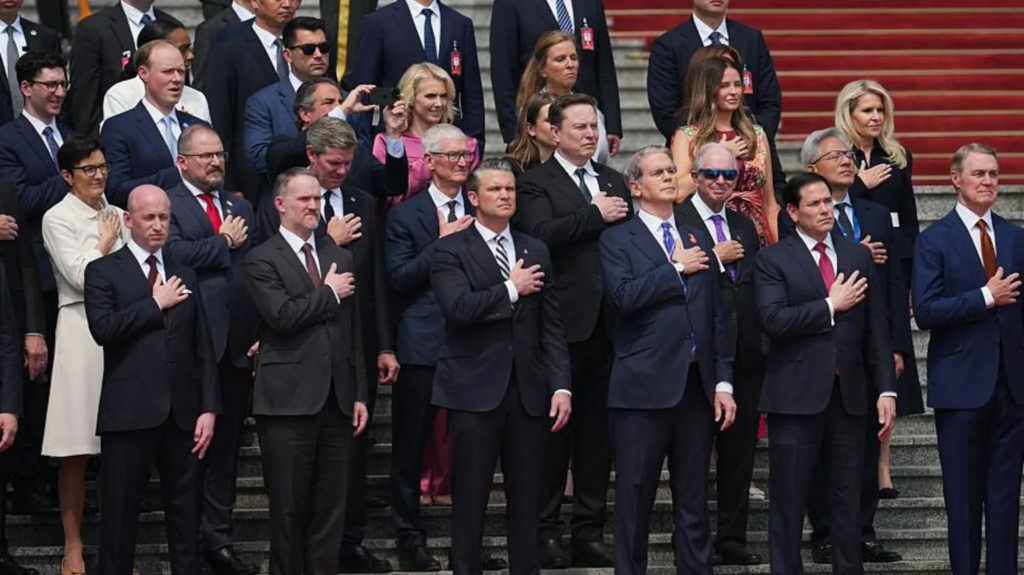
Elon Musk was seen stepping off the aircraft ahead of senior officials including Pete Hegseth, Marco Rubio and Jamieson Greer, in a visit heavily focused on trade and technology ties.
Musk and Nvidia chief Jensen Huang also remained close to Trump during the welcome ceremony, underscoring how central electric vehicles, artificial intelligence and semiconductors have become in US–China relations.
Both companies have significant exposure to China. Tesla depends heavily on its Shanghai gigafactory and Chinese consumers, while Nvidia sits at the heart of the global AI race and remains tightly affected by US export controls on advanced chips.
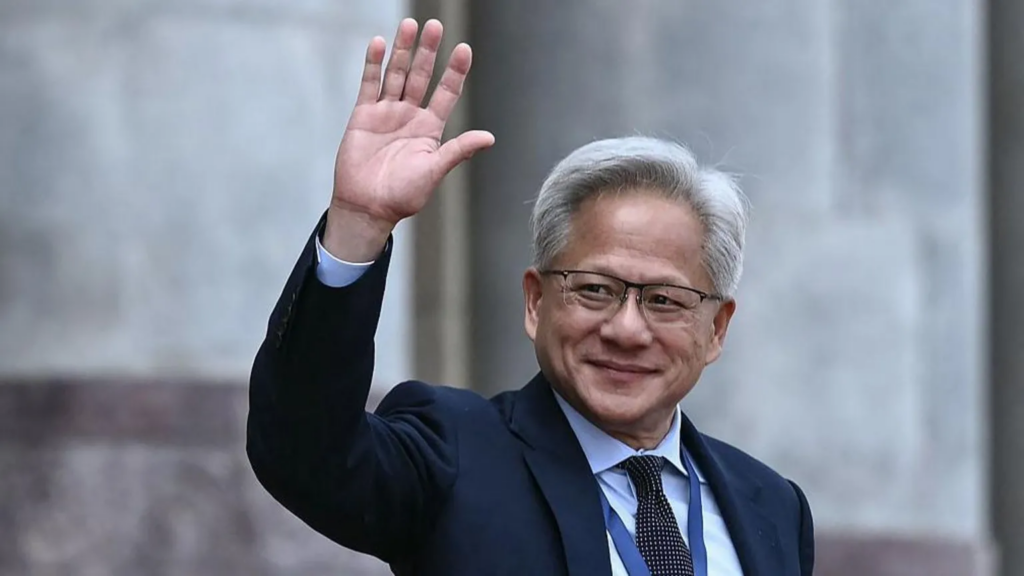
The appearance of Chinese tech executive Jensen Huang drew attention during the summit, as he was not included on the original delegation list. His presence fuelled speculation that discussions on artificial intelligence and semiconductor access played a bigger role than initially expected.
Former US President Donald Trump later told Fox News that “China is going to invest hundreds of billions of dollars with those people,” though he did not provide further details.
Market access and agricultural trade
American farmers have long pushed for greater access to Chinese markets for products such as soybeans, beef and poultry. According to US Trade Representative Jamieson Greer, agreements were reached on Chinese purchases of US farm goods, including beef.
However, China’s foreign ministry did not confirm any new agricultural deals. Instead, it said both sides had agreed to maintain stable trade relations and deepen cooperation based on “equality, mutual respect and mutual benefit.”
The White House said talks also covered expanding access for US companies in the Chinese market and encouraging greater Chinese investment in US industries.
Chinese President Xi Jinping told US business leaders that China’s “doors will open wider,” according to state news agency Xinhua, adding that American firms would have “broader prospects” in the Chinese market.
He also called for deeper cooperation in areas such as trade, agriculture, healthcare, tourism and law enforcement, describing the relationship as “mutually beneficial” and capable of delivering “win-win results.”
Despite these assurances, US companies continue to face challenges in China, including tight regulations, bureaucratic hurdles and ongoing geopolitical uncertainty.
Taiwan emerges as the key pressure point
One of the most notable shifts from the summit was Beijing’s sharper focus on Taiwan as part of the broader US-China relationship.
In previous rounds of trade talks, Taiwan was treated as one of several points of disagreement, alongside issues such as semiconductor cooperation, US-Taiwan trade ties and arms sales to Taipei. This time, however, Chinese messaging appeared to elevate it as a central condition in relations.
According to Beijing’s official readout, Xi said the two sides had agreed on a “new positioning” for relations based on “constructive strategic stability,” but warned that Taiwan remains the most sensitive issue.
“The Taiwan question is the most important issue in China-US relations,” Xi said, according to state media, adding that if mishandled, it could lead to confrontation or even conflict.
Ongoing tech tensions
Technology continues to define the deepest divide between Washington and Beijing.
US export controls on advanced semiconductors and chipmaking equipment—designed to limit China’s access to cutting-edge AI capabilities—remain firmly in place. Greer said these restrictions were not a major focus of the talks.
Beijing, meanwhile, continues to call for greater access to advanced technologies while criticising what it sees as deliberate efforts to slow its industrial progress.
Although artificial intelligence was widely expected to feature prominently in the discussions, it was notably absent from official readouts of the summit.
US Treasury Secretary Scott Bessent said delegations in recent talks discussed safeguards for artificial intelligence, stressing that it was “of utmost importance” for the United States to maintain its lead over China in AI development.
He noted that the priority was to avoid restricting innovation while still ensuring safety. “What we don’t want to do is stifle innovation,” Bessent said. “So our responsibility is to come up with the highest performance calculus where we can get the most innovation and the highest level of safety.”
Former US President Donald Trump also entered the discussions with hopes of securing Chinese cooperation on the Iran conflict and stabilising global oil markets.
“[Xi would] like to see the Hormuz Strait open, and said ‘if I can be of any help whatsoever, I would like to help,’” Trump told Fox News.
In response, China’s foreign ministry issued a statement on Friday calling for “a comprehensive and lasting ceasefire,” adding that “shipping lanes should be reopened as soon as possible in response to the calls of the international community.”
Oil price fluctuations and repeated disruptions to shipping routes have already increased China’s import costs and contributed to rising global energy prices.
Trump has suggested that China could use its influence to encourage Iran to help stabilise traffic through the Strait of Hormuz, a vital global energy corridor.
While official Chinese readouts confirmed that Middle East issues were part of the discussions, they provided limited detail on the substance of those talks.
At a state banquet in Beijing on Thursday evening, Trump invited Chinese leader Xi Jinping to the White House for a meeting scheduled for 24 September.
Further negotiations are expected ahead of that visit, with both sides hoping to achieve a breakthrough on trade relations that has so far remained out of reach.