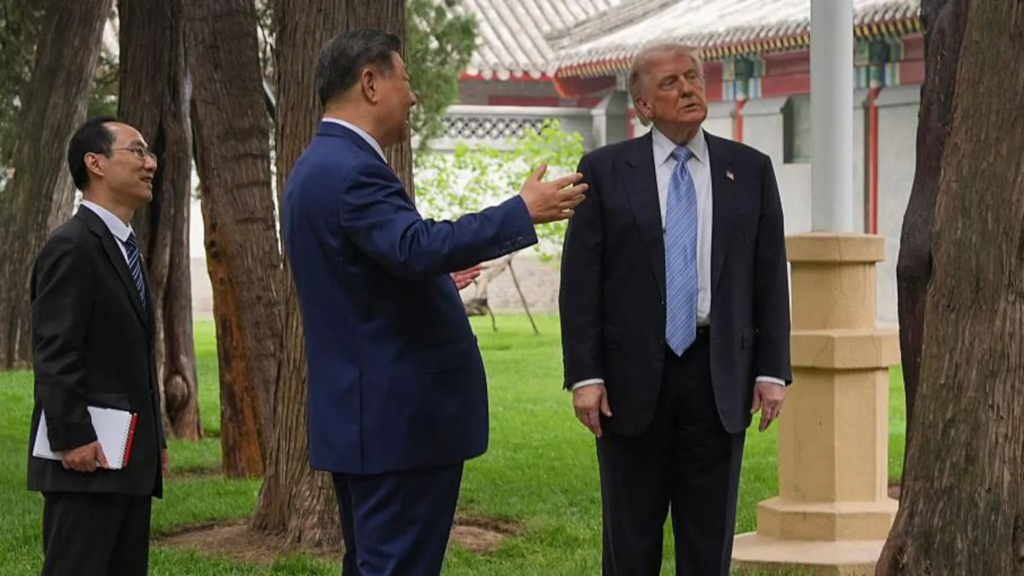
Donald Trump concluded his visit to Beijing with a rare tour of Zhongnanhai, the heavily guarded 14th-century leadership compound where China’s top officials live and work.
The visit, led by Chinese President Xi Jinping, provided another symbolic moment during a two-day trip marked by elaborate diplomatic displays but limited details on concrete policy agreements between the two global powers.
The summit came amid ongoing tensions surrounding trade relations and the conflict involving Iran, though both leaders adopted a notably cordial tone throughout the visit.
Trump described the trip as “incredible,” while Xi referred to the engagements as the beginning of a “new bilateral relationship.”
During their walk through the historic compound, Xi reportedly promised to send Trump seeds from the Chinese roses they admired together.
“I love that, it’s great,” Trump responded.
Zhongnanhai, situated near Tiananmen Square, is often regarded as China’s equivalent of the White House.
Originally used as a secondary residence for Chinese emperors, the complex is known for its lakes, traditional architecture, and carefully maintained gardens. It later became the political headquarters of China’s Communist government following the establishment of the People’s Republic in 1949.
Today, Zhongnanhai remains one of Beijing’s most politically sensitive and prestigious locations, and invitations extended to foreign leaders are widely viewed as signs of diplomatic goodwill and close relations.
During the visit, Trump reportedly asked Xi which other world leaders had previously been invited into the compound.
Xi responded that such visits were “extremely rare” before mentioning Russian President Vladimir Putin as one of the few leaders to have toured the site. Belarusian President Alexander Lukashenko also visited Zhongnanhai last year.
Several former US presidents, including Barack Obama, George W. Bush, and Richard Nixon, have previously toured the compound, including Nixon during his historic 1972 visit to China.
As the tour continued on Friday, Trump paused to admire what he described as “the most beautiful roses anyone has ever seen,” as well as ancient trees within the compound.
Xi explained that some of the trees were between 200 and 400 years old.
“They live that long?” Trump asked.
“Yes,” Xi replied. “There are also 1,000-year-old trees in other places.”
Hours before their meeting at Zhongnanhai, Donald Trump appeared in a pre-recorded interview on Fox News, where he described Chinese President Xi Jinping as “warm” and “very smart.”
Speaking to Fox News host Sean Hannity, Trump claimed Xi had assured him that China would not supply military weapons to Iran.
According to Trump, Xi also indicated that China intended to continue purchasing Iranian oil and wanted the Strait of Hormuz to remain open to global trade.
“But at the same time, he said they buy a lot of their oil there, and they’d like to keep doing that,” Trump said. “He’d like to see Hormuz Strait open.”
Chinese authorities have not publicly commented on Trump’s remarks. However, China’s foreign ministry later issued a statement saying Beijing had been working actively to help ease tensions and support efforts aimed at ending the conflict, signalling ongoing diplomatic engagement behind the scenes.
China remains Iran’s largest buyer of oil and its biggest trading partner, giving Beijing considerable economic and political influence in Tehran. The Trump administration has reportedly hoped that Xi would use that leverage to encourage Iran toward renewed negotiations.
Although trade remained an important topic during the discussions, developments involving Iran have increasingly dominated diplomatic conversations in recent months.
Trump, however, described the latest trade talks as more productive than previous negotiations.
“It went better than last time,” he said during the interview.
He also noted that several American business leaders who accompanied him to Beijing were focused on securing commercial agreements and expanding economic opportunities for the United States.
Trump claimed China had agreed to purchase US oil, 200 Boeing aircraft, and large quantities of American agricultural products. However, China’s foreign ministry later avoided directly answering questions regarding the reported Boeing deal and agricultural purchases.
Chinese officials instead highlighted what they described as “a series of new consensuses” reached during the discussions, though no detailed explanation was provided.
Analysts say China’s global influence has strengthened in recent years as Beijing expanded trade partnerships beyond the United States to cushion the impact of tariffs introduced during Trump’s presidency.
Trump’s visit to China follows recent visits by leaders from Britain, Canada, and Germany, all seeking stronger economic and diplomatic ties with Beijing.
A second high-level meeting may also be on the horizon after Trump reportedly invited Xi Jinping to the White House in September.
“You’re gonna walk away hopefully very impressed, like I’m very impressed with China,” Trump said at the end of his visit.